

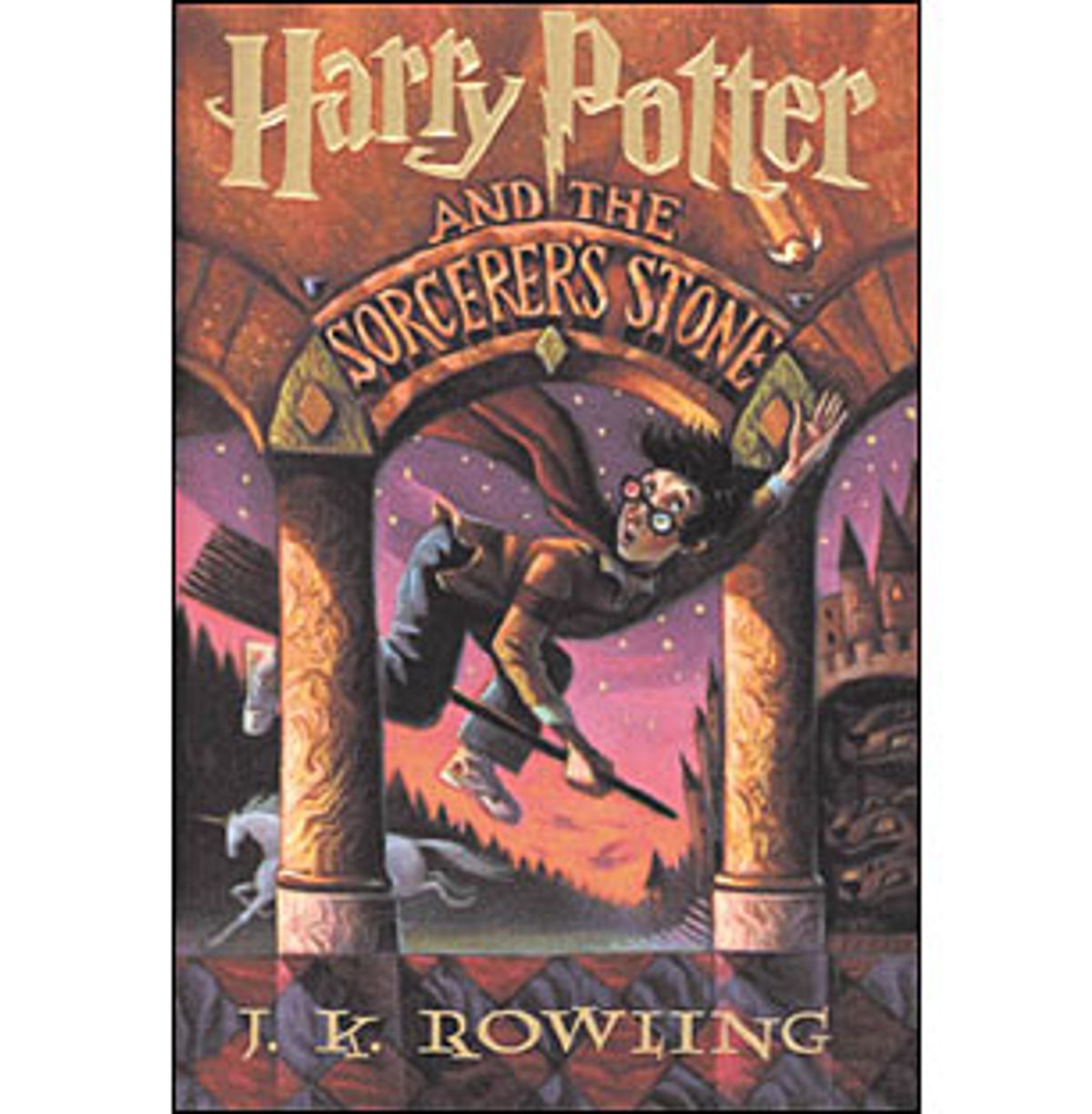
Four factors made me go out and buy the Harry Potter books: Their impressive lead on the bestseller lists, parents' raves about Harry Potter's magical ability to turn kids into passionate readers, my daughters' clamoring and the mile-long waiting lists at the public library. Once I opened "The Sorcerer's Stone," I was hooked and read to the last page of Volume 3. Glittering mystery and nail-biting suspense, compelling language and colorful imagery, magical feats juxtaposed with real-life concerns all contributed to making these books page turners. Of course, Diagon Alley haunted me, the Sorting Hat dazzled me, Quidditch intrigued me. Believe me, I tried as hard as I could to ignore the sexism. I really wanted to love Harry Potter. But how could I?
Harry's fictional realm of magic and wizardry perfectly mirrors the conventional assumption that men do and should run the world. From the beginning of the first Potter book, it is boys and men, wizards and sorcerers, who catch our attention by dominating the scenes and determining the action. Harry, of course, plays the lead. In his epic struggle with the forces of darkness -- the evil wizard Voldemort and his male supporters -- Harry is supported by the dignified wizard Dumbledore and a colorful cast of male characters. Girls, when they are not downright silly or unlikable, are helpers, enablers and instruments. No girl is brilliantly heroic the way Harry is, no woman is experienced and wise like Professor Dumbledore. In fact, the range of female personalities is so limited that neither women nor girls play on the side of evil.
But, you interject, what about Harry's good friend Hermione? Indeed, she is the female lead and the smartest student at Hogwart's School of Witchcraft and Wizardry. She works hard to be accepted by Harry and his sidekick Ron, who treat her like a tag-along until Volume 3. The trio reminds me of Dennis the Menace, Joey and Margaret or Calvin, Hobbes and Suzy. Like her cartoon counterparts, Hermione is a smart goody-goody who annoys the boys by constantly reminding them of school rules. Early on, she is described as "a bossy know-it-all," hissing at the boys "like an angry goose." Halfway through the first book, when Harry rescues her with Ron's assistance, the hierarchy of power is established. We learn that Hermione's bookish knowledge only goes so far. At the sight of a horrible troll, she "sinks to the floor in fright ... her mouth open with terror." Like every Hollywood damsel in distress, Hermione depends on the resourcefulness of boys and repays them with her complicity. By lying to cover up for them, she earns the boys' reluctant appreciation.
Though I was impressed by Hermione's brain power, I felt sorry for her. She struggles so hard to get Harry and Ron's approval and respect, in spite of the boys' constant teasing and rejection. And she has no girlfriends. Indeed, there don't seem to be any other girls at the school worth her -- or our -- attention. Again and again, her emotions interfere with her intelligence, so that she loses her head when it comes to applying her knowledge. Although she casts successful spells for the boys, Hermione messes up her own and as a result, while they go adventuring, she hides in the bathroom with cat fur on her face. I find myself wanting Hermione to shine, but her bookish knowledge and her sincere efforts can't hold a candle to Harry's flamboyant, rule-defying bravery.
Even though Hermione eventually wins the boys' begrudging respect and friendship, her thirst for knowledge remains a constant source of irritation for them. And who can blame them? With her nose stuck in books, she's no fun. Thankfully, she is not hung up on her looks or the shape of her body. But her relentless studying has all the characteristics of a disorder: It makes her ill-humored, renders her oblivious to her surroundings and threatens her health, especially in the third volume.
Ron's younger sister Ginny, another girl student at Hogwart's, can't help blushing and stammering around Harry, and she fares even worse than Hermione. "Stupid little Ginny" unwittingly becomes the tool of evil when she takes to writing in a magical diary. For months and months, "the foolish little brat" confides "all her pitiful worries and woes" ("how she didn't think famous good great Harry Potter would 'ever' like her") to these pages. We are told how boring it is to listen to "the silly little troubles of an eleven-year-old girl."
Again and again, we see girls so caught up in their emotions
that they lose sight of the bigger picture. We watch them "shriek," "scream," "gasp" and "giggle" in situations where boys retain their composure. Again and
again, girls stay at the sidelines of adventure while the boys jump in. While Harry's friends clamor to ride his brand-new Firebolt broomstick, for example, classmate Penelope is content just to hold it.
The only female authority figure is beady-eyed, thin-lipped Minerva McGonagall, professor of transfiguration and deputy headmistress of Hogwart's. Stern instead of charismatic, she is described as eyeing her students like "a wrathful eagle." McGonagall is Dumbledore's right hand and she defers to him in every respect. Whereas he has the wisdom to see beyond rules and the power to disregard them, McGonagall is bound by them and enforces them strictly. Although she makes a great effort to keep her feelings under control, in a situation of crisis she loses herself in emotions because she lacks Dumbledore's vision of the bigger picture. When Harry returns from the chamber of secrets, she clutches her chest, gasps and speaks weakly while the all-knowing Dumbledore beams.
Sybill Trelawney is the other female professor we encounter. She teaches divination, a subject that includes tea-leaf reading, palmistry, crystal gazing -- all the intuitive arts commonly associated with female practitioners. Trelawney is a misty, dreamy, dewy charlatan, whose "clairvoyant vibrations" are the subject of constant scorn and ridicule. The only time she makes an accurate prediction, she doesn't even know it because she goes into a stupor. Because most of her students and all of her colleagues dismiss her, the entire intuitive tradition of fortune-telling, a female domain, is discredited.
A brief description of the guests in the Leaky Cauldron pub succinctly summarizes author J.K. Rowling's estimation of male and female: There are "funny little witches," "venerable looking wizards" who argue philosophy, "wild looking warlocks," "raucous dwarfs" and a "hag" ordering a plate of raw liver. Which would you prefer to be? I rest my case.
But I remain perplexed that a woman (the mother of a daughter, no less) would, at the turn of the 20th century, write a book so full of stereotypes. Is it more difficult to imagine a headmistress sparkling with wit, intelligence and passion than to conjure up a unicorn shedding silver blood? More farfetched to create a brilliant, bold and lovable heroine than a marauder's map?
It is easy to see why boys love Harry's adventures. And I know that girls' uncanny ability to imagine themselves in male roles (an empathic skill that boys seem to lack, honed on virtually all children's literature as well as Hollywood's younger audience films) enables them to dissociate from the limitations of female characters. But I wonder about the parents, many of whom join their kids in reading the Harry Potter stories. Is our longing for a magical world so deep, our hunger to be surprised and amazed so intense, our gratitude for a well-told story so great that we are willing to abdicate our critical judgment? Or are the stereotypes in the story integral to our fascination -- do we feel comforted by a world in which conventional roles are firmly in place?
I have learned that Harry Potter is a sacred cow. Bringing up my objections has earned me other parents' resentment -- they regard me as a heavy-handed feminist with no sense of fun who is trying to spoil a bit of magic they have discovered. But I enjoyed the fantastical world of wizards, witches, beasts and muggles as much as anyone. Is that a good reason to ignore what's been left out?
Shares