
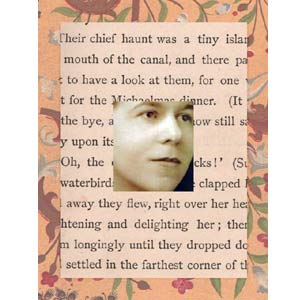

“The human comedy is always tragic, but since its ingredients are always the same — dupe, fox, straight, like burlesque skits — the repetition through the ages is comedy. The basis of tragedy is man’s helplessness against disease, war and death; the basis of comedy is man’s helplessness against vanity (the vanity of love, greed, lust, power).”
— from “The Diaries of Dawn Powell”
The NASDAQ may be slipping, but not the boom market in vanity. As I am sure you have noticed, there is a carnival of unbridled self-regard, self-interest and self-promotion out there. Financial gurus, with a straight face, prescribe techniques to couple monetary increase with spiritual perfection. Love and lust align themselves with social and pecuniary advantage in uncanny fashion. No work of art or entertainment or its maker is allowed to face the public without exquisitely devised campaigns of hype, buzz and spin. If you are neither rich nor famous, our whole culture implies, chances are you are a chump. (Not invited to the Talk party, were you?) How, amid this dispiriting spectacle, is a thinking, feeling human being supposed to avoid the counsels of despair and the lure of cheap cynicism?
May I suggest a massive inoculation of the works of the late, great American novelist Dawn Powell? Although she published her last novel, “The Golden Spur,” in 1962, at the tail end of the Beat era, and died in l965 as little known as she was through her entire career, I believe no other writer, living or dead, speaks more directly to our cheesy, gaudy, unsettling moment. As natural and skillful a satirist as American literature has ever produced, she is the equal, as Edmund Wilson averred (rather too late in the game to do her much good) of Evelyn Waugh and Anthony Powell as a fashioner of devastatingly funny social comedies.
The novels of Manhattan’s beau and demi-mondes, on which Powell’s current reputation rests — “The Locusts Have No King,” “A Time to Be Born,” “The Wicked Pavilion,” “Angels on Toast” and “Turn, Magic Wheel” among them — rival Ring Lardner’s fiction in their drollery and ear for American lingo, and they match the screwball comedies of Preston Sturges in speed and sophistication. To all of this they add a bracing sexual realism that would have made the Hays Office apoplectic. Informing her work, above and beyond its surface delights, was an exquisitely evolved view of human nature that allowed Powell to crack wise and be wise at the same time.
Just the simple fact of a Dawn Powell revival is immensely cheering. You can’t say that she’d been eclipsed because — a small circle of admirers aside — she labored for decades in a long commercial twilight. Then it was Team Powell to the rescue: her close friend Gore Vidal, whose landmark 1987 essay “Dawn Powell: The American Writer” sparked the first flames of interest; music critic Tim Page, her biographer, the editor of her diaries and a tireless proselytizer, whose selflessness in this potentially quixotic cause is truly astonishing; and the noble Steerforth Press of Vermont, which has made the bulk of her work available in handsome editions. A literary revival undertaken purely on the basis of taste and devotion, with no obvious ideological constituency for it nor profit in it? It’s not a scenario that could be found in any Dawn Powell novel — yet her work has gradually found a passionate coterie, even among writers and editors in their 20s and 30s who might have been expected to find her books rather antique.
Improbable as it may seem, Dawn Powell is nothing less than a girl of the Zeitgeist. Even more improbably, her work, if correctly read, provides a necessary aid toward developing a proper attitude about life. In his delightful 1997 book, Alain de Botton demonstrated “How Proust Can Change Your Life.” In the same spirit, I maintain that Dawn Powell can save it. Dawn Powell can get you through. By peering into (and looking behind) the not at all distant mirror of her work, we anxious postmoderns can learn much. To wit:
How to be a romantic realist.
Powell’s signature novels were dizzying comedies of Manhattanites on the make. As culturally and geographically specific as they were, however, they manage to be timeless and universal. These same social, sexual and career shenanigans can be observed in dozens of other hyper-prosperous urban settings where life has been transformed into a theater of the self. Now we are all out there on a shoeshine and a smile. Arthur Miller thought this was tragic. Dawn Powell thought it was funny — and wonderful to observe.
A permanently transplanted Midwesterner, Powell had a feeling for the city — and the possibilities it offered escapees from elsewhere — that was genuinely romantic, even if her characterizations were anything but. She plants her cast of urban types — the writers and artists on the skids or on the rise, the publishers and gallery owners who feed on their talent, the gold-digging sexual opportunists and the mistress-juggling businessmen, the social-climbing salonistes and the slumming tycoons — on her stage with perfect economy and for a couple of hundred pages watches them mingle and angle, collide and connect and carom off each other with an amused and nonjudgmental eye. Love blooms and dies, luck smiles and frowns, virtue goes unrewarded and venality unpunished exactly after the fashion of life itself. Dawn Powell is utterly onto her characters, but they rarely get wise to themselves. She has a peerless understanding of the endless varieties of self-deception, locating her comedy in the spaces between what her characters think of themselves and how others see (or see through) them. Yet one never feels that she finds their dreams, desires and ambitions small or corrupt or unworthy.
How to avoid hypocrisy.
There is a censoriousness abroad in the land that coexists oddly with our prosperity and its related license. The gaming industry funds anti-gambling campaigns, tobacco companies anti-smoking campaigns, distillers sobriety campaigns. The message: Indulge your vices, but have the decency to feel guilty about them.
The novels of Dawn Powell have no truck with such hypocrisies. She does not judge, excuse or sentimentalize, viewing her characters with a fine
indifference to their manifold failings. Her almost Flaubertian aesthetic morality was often misread as sour detachment, but it was anything but. As she noted in her diary, “The satirist who really loves people loves them so well the way they are that he sees no need to disguise their characteristics — he loves the whole, without retouching. Yet the word used for this unqualifying affection is ‘cynicism.'” The Powell Effect is strikingly evident in her handling of the Clare Booth Luce character in her roman ` clef “A Time to Be Born.” The character is, in every conventional sense, a monster of sexual and literary deception, and a consummate liar and user, yet seen through Powell’s clarifying lens her actions become understandable — one even comes to accord her energies a respect akin to that we have for Becky Sharp. To feel, really feel, the heartbreak of an objectively contemptible character is an exquisitely mixed literary experience, and Powell was peerless in keeping her readers off stride.
How to handle sex and love.
Astonishingly and annoyingly, “Sex and the City”
is being taken for the last word in metropolitan sophistication, when it is at best a slickly packaged exercise in screwing cute. Other avatars of the comedy of unmarriage are so ubiquitous that, as Stacy D’Erasmo writes in the New York Times Magazine, “the marital quest of the fashionable, sexually well-traveled, 30-something woman has become so popular as to seem like the dominant narrative of life on earth right now.” As diverting as some of these books and shows are, it’s not hard to detect the bitterness beneath the brittleness and faux ennui of the heroines, the deep sense of betrayal — by men, by feminism, by the whole vexed enterprise of sex and love.
It is time for the culture to evolve to the next level — to the Dawn Powell level — on this matter. Even today her novels can startle with their frank, matter-of-fact acceptance of the carnal imperative and the ease with which sex and lying shack up. The randy executives of “Angels on Toast” expend more time and energy cavorting with their various mistresses and cooling off their miserable and suspicious wives than on their business affairs — rich fodder for the all-
How to stop whining.
Dawn Powell’s literary career was one long quest for some modest measure of commercial success and critical understanding — neither of which arrived in her lifetime. She was taken on by the best publishers (including the legendary Maxwell Perkins), but they never quite caught the trick of presenting her cheerfully amoral novels to a public in constant search of uplift. She paid tribute to none of the reigning pieties, and for this, Gore Vidal believes, she had to be punished: “Powell was that unthinkable monster, a witty woman who felt no obligation to make a single, much less a final down payment on Love and the Family.” (As my “Dictionary of Literary Terms” informs me, “Women satirists are very rare …”) The high-toned critics of the Lionel Trilling persuasion were put off by the evident absence of any “moral center” in her novels, and no one else materialized to teach an audience how to read her. Her private life was marked by ill health, financial difficulties, an alcoholic husband with a failing advertising career and an autistic son who eventually required expensive institutionalization. In spite of all that she is remembered by everyone who knew her as a fast friend and the best and funniest of company — and she produced superior novel after superior novel across the decades, without flagging or public complaint.
The inner Dawn Powell was even more impressive. Her novels imply no correspondence whatsoever between artistic and literary abilities and any other admirable qualities (if anything, they suggest the opposite). Yet the absolutely remarkable book “The Diaries of Dawn Powell: 1931-1965” reveal her to be a tenacious and tough-minded artist and quite simply a courageous human being. In American literature only Flannery O’Connor’s indelible collection of letters, “The Habit of Being,” is its equal for bracing intelligence and resilience. Like O’Connor, Powell knew her worth without a scintilla of either arrogance or false modesty; she suffered fools not at all and dealt with ill health and adversity with no self-pity whatsoever. In the diaries, she notes one day, at low ebb, “Again facing hopeless years of good work never properly presented so that the best years seem a riotous waste.” A week later she rebounds with “Did a great deal of work on a novel with a feeling of confidence and pleasure in it that I hope sustains itself.” The true artist must learn to accommodate such mood swings. (Many do not and are destroyed.) In a well-ordered literary universe, every student of creative writing — and everyone else, frankly — would be required to read this book, to learn from a master the high costs and quiet exaltations of the literary vocation. The “Diaries” are Powell’s real and final masterpiece, one that contains lessons for living on every page.
If the Dawn Powell revival continues, especially among younger readers and writers, it augurs well for the urban comedies of the future, which will be smart and stylish and penetrating, addressed to an audience schooled in the complexities of true wit. Her heirs will appear and so-called “Gal Lit” will evolve into real literature. “Here is the real outrage,” she once wrote: “that there are mysteriously privileged people who find inexplicable delight in books — consolation, laughter, comprehension, beauty — and the Censor or Proctor does not.” Join the party of mysterious privilege and begin reading Dawn Powell right away.
