

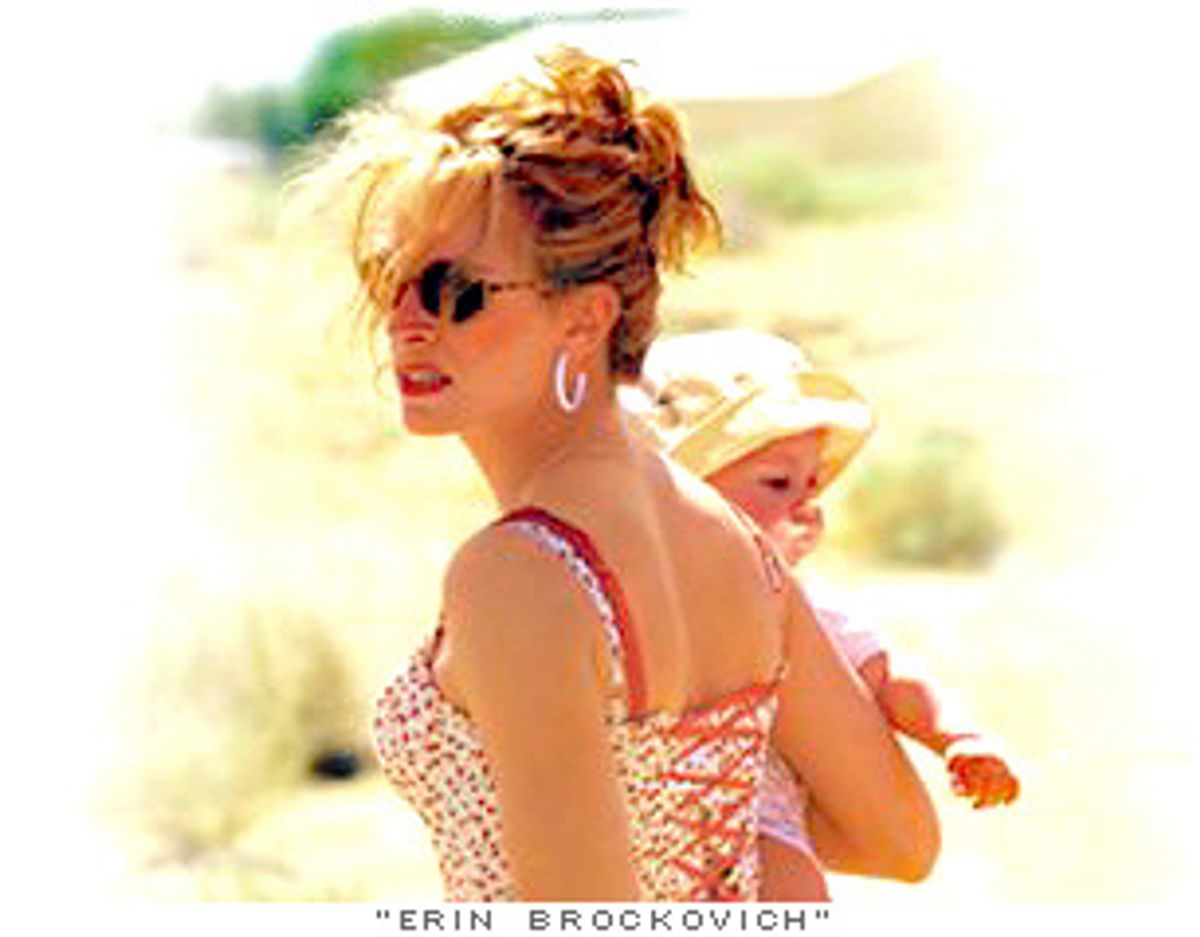
Before interviewing screenwriter Susannah Grant, who broke into the business writing for Fox TV's "Party of Five" and Disney's "Pocahontas," I watched her three live-action films in quick succession. In "Ever After" Drew Barrymore plays a gutsy Cinderella. In "Erin Brockovich" Julia Roberts plays a contemporary Jack (or Jackie) the Giant Killer. And in the new "28 Days," a therapy movie with a pop satiric bent, Sandra Bullock plays a Bohemian witch who turns into a human being. Since I knew that Grant had studied English at Amherst, I asked her whether she majored in myth and fable. No, she laughed, she didn't. "But fairy tales were important to me. Aren't they for any kid? My sister says I spent a good five years of my youth convinced I would grow up to be a princess."
In Hollywood terms, she is one now -- a successful and respected screenwriter who is about to make her leap into feature-film directing. But there's nothing princessy about her or her movies. In "Ever After," Barrymore's Cinderella throws like a boy: She gets Prince Charming's attention with a well-aimed fusillade of apples. As the title character in "Erin Brockovich," Roberts' working-class heroine is part Norma Rae and part Norma Jean, upsetting office peers as well as Ivy League types with her revealing clothes, sex talk and horse sense. In "28 Days," Bullock's alcoholic makes her biggest move toward recovery when she sheds the film world's version of Prince Charming, a glib, romantic Brit.
I started to ask if she'd call herself a feminist. Before I could finish Grant declared, "I have no discomfort with that word! You could call me a 'card-carrying feminist,' if there were a card to carry." On the phone from Los Angeles, Grant comes across loud and clear and free of pretension. Her feminism is an outgrowth of that rarity in creative folk: a healthy childhood. Growing up with her doctor father, schoolteacher mother, two sisters and a brother in Englewood, N.J., "gender judgments were a total nonissue. Whoever opened the door was the person who got there first." With two grandmothers who also worked, "the idea of me doing something useful with my day was just there. Looking back it sounds fairly matriarchal, but at the time I didn't know."
Before entering Amherst, she went to Miss Porter's School in Farmington, Conn. "From the outside, it does look like a lot of well-scrubbed preppy girls, but it wasn't humorless, and it was more radical than it looked. And it was the last time in my life that gender didn't play into anything. It was very 'girly,' very female, but it helped give you the sense that your gender didn't have to get in the way of anything."
After college, Grant spent four years in New York, trying to act and doing low-level journalistic jobs. (For a while, she was a fact checker at Rolling Stone.) But she eventually soured on acting, journalism and New York. "One night I woke up and was really depressed. I lived in this horrible little apartment on the first floor of a building, and it was really hot, so hot that I would leave the door open. I felt that if someone wanted to come in and kill me, I was too hot to care. And I was crying and right outside there was a homeless woman crying, and I felt as if I was in a horrible city where everyone was crying in the middle of night."
Like many East Coast discontents before her, she moved to San Francisco. There she landed a job at KPIX-TV that required two hours of work in an eight-hour day. "There's only so long you can talk on the phone," so she decided to use the rest of the time there to write a screenplay. "I would have more energy after working on a screenplay for four hours than I did before I started," Grant says. Admitted to the American Film Institute, she moved to Los Angeles and discovered a true mentor in screenwriting teacher Jerry Kass, who is now at Columbia. In 1992, she won the Nicholl Fellowship in screenwriting, awarded by the Academy of Motion Picture Arts and Sciences. Part of Grant's charm is that she knows how fortunate she is. "My best advice is: Get really lucky!" Winning the Nicholl "bumped my name up a few notches." Soon she was at work on "Party of Five" and "Pocahontas."
Writing an animated feature is no screenwriter's dream unless she is also one of the sketch artists or animators. But Grant considered it "a really good boot camp. No scene was rewritten fewer than 30 times. But it was a great exercise. I was getting paid, and getting a movie made -- though I don't think I'm temperamentally suited to do [a cartoon feature] more than once." The filmmakers worked closely with American Indian advisors; on the p.c. front "it fared a lot better than 'Aladdin.'" But some American Indian critics still scorned it for turning the adolescent girl into a babelicious screen siren. "Well, I would have made her boobs smaller," Grant admits. "But the guy who did it was a fantastic animator and did a wonderful job. I just would never have given her that bust size." Not that Grant has anything against big-busted beauties; she celebrates one in "Erin Brockovich."
An executive who'd gone from Disney to Fox Family Entertainment -- the same one who'd hired her for "Pocahontas" -- next called on her "to do a version of 'Cinderella' with a Merchant-Ivory feeling to it." Those were her marching orders for "Ever After." But Grant says she "didn't see the point of doing a Cinderella story with the same old themes, without saying something a little different with it. I didn't want to deconstruct the story; I wanted to reconstruct it. I took out magic and used Leonardo da Vinci as a symbol of imagining the impossible, or of seeing the possible in whatever other people think of as impossible."
Was part of her intent to create a Cinderella who didn't need a fairy godmother or a magic pumpkin because she was more self-reliant? "I'm not sure that was conscious -- it may just not occur to me to come up with characters who can't take care of themselves, except for a person like Gwen [the anti-heroine of "28 Days"], where that's the point." A lot of the rough-and-tumble in "Ever After," and all of its gypsy shenanigans, came from Barrymore and the director, Andy Tennant, who wrote the script's final draft with his writing partner, Rick Parks. Grant was delighted with the finished film (an international sleeper hit).
By the time she finished "Ever After," Grant was "dying to do something with contemporary meat and muscle and pace, where you couldn't be languorous and there didn't have to be a certain delicacy to the language." She was exploring properties with Danny DeVito's production company, Jersey Films, when she got wind of the Erin Brockovich story. "First it was out to Callie Khouri ['Thelma and Louise,' 'Something to Talk About']; then it was out to Paul Attanasio ['Quiz Show,' 'Donnie Brasco']." But Grant kept coming back and asking, "Has she passed on it? Has he passed on it?" Grant had never done anything close to the gravelly texture of "Erin Brockovich." But co-producer Gale Lyon knew Grant -- and knew that underneath her Miss Porter's-Amherst pedigree, she had "a foul mouth and a quick temper and could get the character of that woman. I don't dress like Erin, but I'm not Brooke Astor, either."
Grant won the "Brockovich" job -- and, given the way Jersey Films ("Get Shorty," "Out of Sight") operates, the chance to develop a rich story on her own. "The people at Jersey know what they're doing. They've got good taste and instincts, and they believe in getting the script to a really good stage before they attach a director -- the fewer voices the better. Then they bring the director on." She spoke with Brockovich's lover, kids and her boss turned partner, Ed Masry. She also went to Hinkley, Calif., to interview the plaintiffs in Masry and Brockovich's case accusing Pacific Gas & Electric of chromium poisoning. The script presented enormous challenges. She couldn't talk to the plaintiffs about the case itself because, as part of their settlement, they'd signed a nondisclosure agreement. But Brockovich gave her "a lot of research. She had videotaped a lot of the plaintiffs and had notes on everyone she met with; she also had all the documents she got from the water board and, of course, legal documents."
The toughest hurdle was trying to mesh the case chronology with Brockovich's personal history. Yet Grant had a firm handle on the movie's emotional and dramatic core: "What was always really interesting to me, from the beginning, was the radical concept that tits and brains are not mutually exclusive. People are flummoxed by how Erin looks, so she is massively underestimated. She always speaks intelligently, but because she dresses the way she dresses and shows her body, which is gorgeous, people wouldn't credit her intelligence. And that didn't have to do with anything Erin was doing with the people she was working with, or getting information from, or negotiating with -- it had to do with their reaction to her. Her story is about somebody struggling for success, but only on her own terms. A compromised success, to Erin, would not feel like success. That's how she's made up. And I admire that a lot."
I thought the movie's open-ended depiction of Erin's increasing distance from her loving biker boyfriend and her young children was perplexing. (The biker begins to function as a single parent.) But to Grant, the film is probably stronger for not sewing up all its loose threads. Although at times Grant was "hamstrung" by the need to hew closely to reality, she also thinks "it saved us from making more conventional choices." Career leaps and family life, she feels, "rarely do get reconciled." Part of what gives the film its freshness is that Erin definitely doesn't have it all. Her work may renew her self-respect, but something is sacrificed in the process.
Grant found the real-life Brockovich an inspiration in other ways, too. "The producers made it clear that Erin shouldn't do the film if she did not trust us. She was really signing her life away. But she did have writer approval. We got along well and definitely became a team. She was very open" about unloading her gleefully unexpurgated brand of talk and allowing it to set the tone of the dialogue. In the film, Erin doesn't just sprinkle her speeches with an "ass" or a "bullshit" here and a "blow job" there; she also displays a gutsy street wit. When a big-shot lawyer (Peter Coyote) asks, in disbelief, how Erin got all the plaintiffs to sign off on their case, she calmly explains: "Seeing that I have no brains or law expertise, I just went over and performed 634 blow jobs. Boy, am I tired." Says Grant: "That's just a tame version of how she talked."
By the time "Erin Brockovich" went into production, with Steven Soderbergh directing, Grant was in production with "28 Days," with Betty Thomas directing. (Richard LaGravanese did a bit of rewriting on "Brockovich," but not enough to win credit in a Writers Guild arbitration.) The new movie also began when Grant was tossing around ideas with a production executive -- this time with Amy Pascal, chairman of Columbia Pictures. "One of us said, 'What about rehab?' And I said, "Yeah, as long as it's funny,' and Amy said, 'Of course it has to be funny.'" Is rehab a subject that would come up so readily in conversation? "Well, you're always looking for environments that would be interesting for a movie. And what made rehab interesting for me was making it funny."
The movie isn't as fully achieved as either "Ever After" or "Erin Brockovich," and advance notices have been mixed to negative. But complaints that "28 Days" doesn't take rehab seriously miss the point. Do we really need another serious rehab movie? They tend to be like "Clean and Sober": actors' showcases with prefab epiphanies. And "28 Days" is aimed at people who are skeptical of group therapy and groups in general -- people who can see the absurdity of lumping all kinds of people together, yet can still be open to this method's power to cure. The film has a democratic comic mechanism. Bullock's Gwen realizes that her fellow patients see rehab's absurdity, too, but have gotten over themselves enough to appreciate it.
"That's something Betty and I were articulating as we were pulling it together," says Grant. "I spent a week in rehab, and Sandy did, and Betty spent some time there. And the feeling that you have is: It's queer, it's geeky, it's trite -- and sometimes it works. The thing inside telling you that it's so queer and that you're way too cool for it is just your ego -- and it's not healthy. Checking your ego, abandoning it, letting it go, is a huge part of recovery from addiction."
From the start, Grant's strategy was for the central character to have "the same skepticism as the audience. To take this ride, you have to be with someone whose sensibility you share. A true believer would alienate all the cynics, and I figure the cynics are 90 percent of the audience, since this is America, goddamn it! The goal was to earn every softening and every turn, to have it all happen in a real way and not count on the music cues."
The film's comic high points come from its depiction of an entire recovery group gaining a healthy addiction to an absurd soap opera named "Santa Cruz": It fulfills Grant's goal of trying to show therapy happen through collective activity that isn't limited to the therapy room. Its low points are repeated flashbacks to Gwen's traumatic childhood. But even the family melodrama is propelled by Grant's attempt to be true to Gwen's psychology. "I'm not an expert; I'm no psychologist or drug or alchohol counselor. But addiction is a biobehavioral disease and the behavioral part goes back in time. I didn't meet anyone in rehab whose behavior wasn't connected to fears and problems with self-worth stemming from feelings that were really old. And I thought there was something dramatically interesting about having these psychological rubber bands stretched to the snapping point."
I wondered whether there were any bad habits she had to shed before she wrote feature films. "Oh, sure. I was full time on 'Party of Five' for one year, then more like a creative consultant for two years, where I was in the writing rotation but didn't have to go in every day or cover the set until midnight. And there's a habit, a rhythm you get into. We used to joke about it: 'downbeat, bullshit, bullshit, button.'"
That sounds hysterical, but what does it mean? "Downbeat is the music cue; bullshit, bullshit is the stuff happening in the scene; and button is the cute line you use to get out of the scene. We did have a couple of episodes a year that were completely different stylistically, but we never had a writing rotation of more than five. That meant writing an episode in two weeks, revising it in one, shooting it in one and, while you were shooting it, starting the next one. On that schedule, taking a lot of chances is like reinventing the wheel."
Grant needn't worry about that now. Would she tell me anything about her big-screen writing-directing debut? "No!" I protest that she's only giving me the downbeat. "Yes," she chuckles. "You'll have to wait for the bullshit and the button."
Shares