

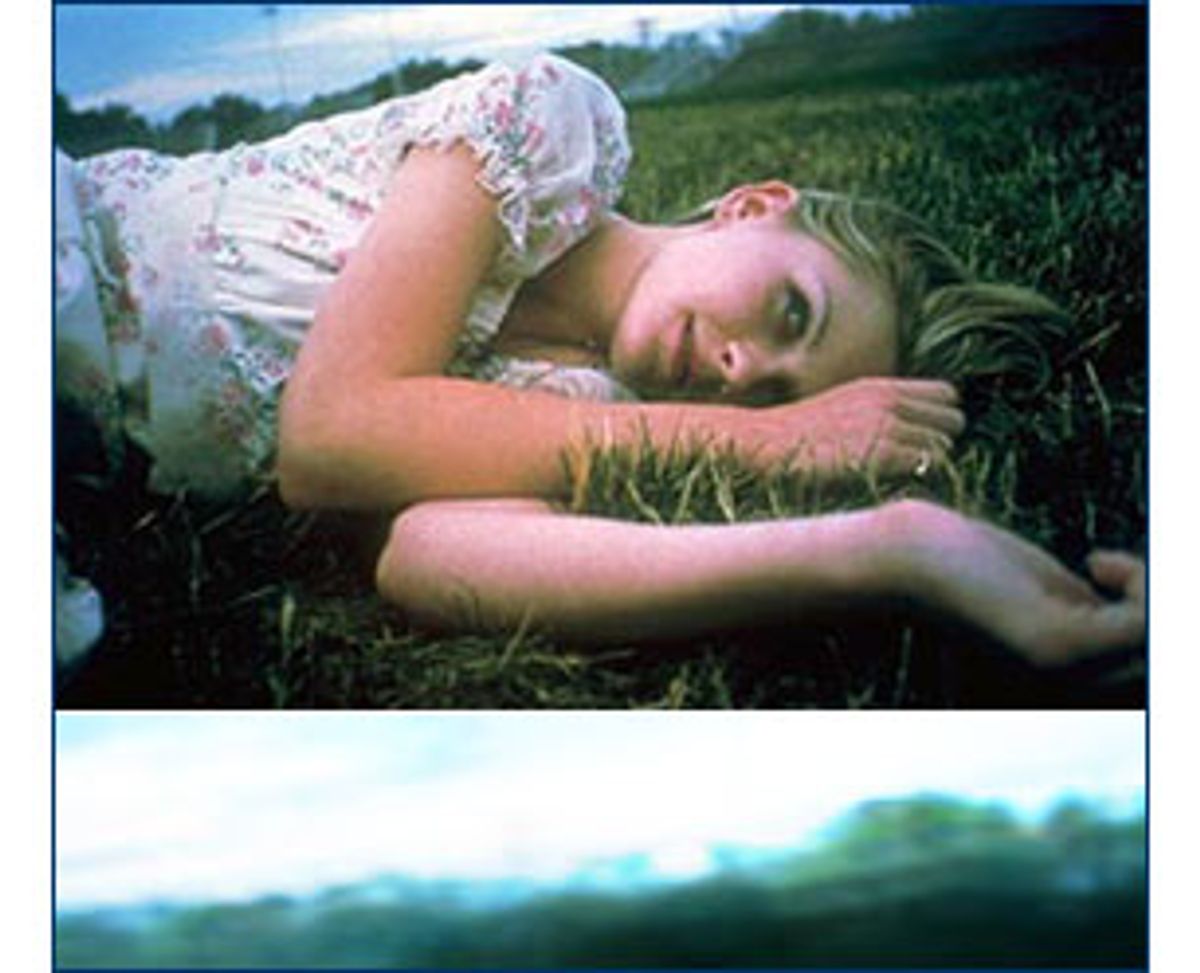
Jeffrey Eugenides' novel "The Virgin Suicides," set in 1970s suburbia, is a creamy, moonbeam-laden love letter to the girls of the day, in their French-cut T-shirts, bell-bottoms and Love's Baby Soft. It's a tender and beautifully written book, one that makes the case once and for all that boys can be a sentimental and perceptive lot, but there's one big problem with it: It's so obsessively detailed that by the end it's almost unreadable.
The book's narrators are a group of boys who've grown into men, but who can't leave their memories of five neighborhood girls, the Lisbon sisters, behind them. If all boys had as many exposed nerve endings as they seem to, we'd live in a world with no skyscrapers and no bridges.
Leave it to a woman to boil all the excess, leaden moisture out of Eugenides' book and leave just the bare-bones poetry. Sofia Coppola's adaptation of "The Virgin Suicides" -- it's her directorial debut, and she also adapted the screenplay -- captures the loveliest visuals and bits of language from Eugenides' book and faithfully, but not slavishly, transfers them to the screen. There's no irony in Coppola's treatment; she nabs all of the book's humor without layering on too many smirks or ironic winks. She connects with the essential purity of Eugenides' story, stripping it down to its bare essentials and cutting straight to everything that's wonderful about it. It's a movie adaptation that's filled with love.
That's not to say that if a man had made "The Virgin Suicides" it would have been a worse movie, but it's safe to assume it would have been a rather different one. I've never been one for ghettoizing, and certainly not canonizing, female artists; it always seemed to me a better idea to look at a work, as much as is humanly possible, for what it is rather than to fixate on what's between the legs of the person who made it.
But there's no denying that men and women bring different sensibilities to their work. And you can't ignore the unusually large number of high-profile pictures made by female directors in the past year or so, among them Kimberly Peirce's "Boys Don't Cry," Mary Harron's "American Psycho" and Bonnie Hunt's "Return to Me," as well as "The Virgin Suicides."
What's always frustrating about the trumpeting of "hot" new female directors is that, as always, the ones who get all the attention haven't necessarily made the best movies. Stacy Cochran is a case in point. Her wry 1992 suburban fairy tale, "My New Gun," made barely a blip on the radar screen, and her next feature, the more delicate and subtly shaded "Boys" (1996), was misunderstood by most of the critics who saw it and went unseen by just about everyone else. Cochran presented a film at Sundance this year that has yet to find a distributor.
There's also a tendency to overlook female filmmakers working in other countries, some of whom have been making subtly terrific movies for years: New Zealander Jane Campion earned lots of attention in 1993 for "The Piano," a foolish if visually lush movie that tapped into the feminist zeitgeist of its time. The success of "The Piano" was treated as some sort of signal that female directors had at last "broken through" -- though through to what, I'm not exactly sure -- and I would have been thrilled if its popularity could have ensured greater international success (or at least attention) in subsequent years for filmmakers like Great Britain's Carine Adler ("Under the Skin"); France's Claire Denis ("I Can't Sleep," "Beau Travail") or Catherine Breillat ("Romance"); or Canada's Lea Pool ("Set Me Free").
The point is, even though it's hard not to notice when a clutch of female filmmakers suddenly appear on the scene, it's never a good idea to lump them into a group that's defined by some broad women's view. But there's nothing wrong with admitting that women are likely to view things differently from the way men do.
Look at Denis' "Beau Travail," an adaptation of Melville's "Billy Budd" set in the Foreign Legion. On its most basic level, "Beau Travail" is a paean to the beauty of men's bodies. But even when Denis, with the help of her terrific cinematographer, Agnes Godard, shows us rippling muscles and sweat-dappled skin, the images are distinctly different from what you might see in gay porn. Denis doesn't sentimentalize or declaw the male form -- she revels in its supple, tigerlike qualities -- but she does view it with a certain amount of tender regard, tacitly acknowledging that there's always a fragility to that shell of skin and bone and muscle, regardless of whether it belongs to a man or a woman.
What's interesting in particular about
"The Virgin Suicides" isn't just that it
was made by a woman, but that it's a
case of a woman's adapting a novel about
a group of young men's nostalgia for the
unattainable girls of their youth. In
the old days, you might have said those
girls were imprisoned in the male gaze.
But Coppola's picture is completely
nonjudgmental about the narrators' love
for the Lisbon girls (although it should
go without saying that love shouldn't be
subject to anyone's judgment).
The picture has a feminine sensibility
in terms of its dreamy languor, the
pearlescent glow that hovers around it
like a nimbus. (It's beautifully shot by
Edward Lachman and features a willowy
score by Air.) But there's also a
clear-eyed precision at work here,
almost as if Coppola subconsciously
wanted to make sure she captured
Eugenides' vision, while also giving a
sense of the Lisbon sisters as real live
girls.
There are five Lisbon sisters, all
beautiful and clear-skinned, with that
straight, fair California-girl hair that
every girl of the era wanted
desperately. Lux Lisbon (Kirsten Dunst) is the
most luscious of them, and sends off
signals that she just may be the most
sexually adventurous.
Cecilia (Hanna Hall), the youngest, is a
sensitive, troubled girl, given to
traipsing around in a tatty vintage
wedding dress, and for reasons that no
one is quite able to fathom she attempts
to slit her wrists very early in the
story; she recovers, only to
successfully off herself shortly
thereafter.
The story is told from the point of view
of a small group of neighborhood boys
(represented by a wonderful voice-over
by Giovanni Ribisi) who worship the
Lisbon girls. The mysterious death only
enhances the sisters' aura. But even
before Cecilia's suicide, the girls had
been carefully watched by their stern,
overprotective mother (Kathleen Turner)
and, to a lesser extent, by their docile
math-teacher dad (James Woods).
After Cecilia's death, the household
becomes even more cloistered, until
local hottie Trip Fontaine (Josh
Hartnett) falls madly in love with Lux
and decides he simply must take her to
the homecoming dance; the only way she's
allowed to go is if her sisters attend,
too.
The real charm of "The Virgin Suicides"
lies in the details, in the way it
evokes both the era and the peculiar
romantic fixations of awkward teenage
boys. The movie gets the suburbs of the
time exactly right, with the trim
split-level houses and impossibly
verdant lawns, the streets lined with
lazy trees (and, in this case, dying
ones -- there are references in the plot
to diseased elms). Rec-room basements
decorated with so much cheerful anxiety
they can't help looking sullen; dens
where family members gather, glassy-eyed
and silent, to watch nature shows.
Coppola's suburbia is partly a
half-remembered dream state and partly
an optimistic interior decorator's
sketch, a conglomeration of how people
lived and how they desperately
wanted to live.
Coppola's just as good, though, at
showing what happens when that idealized
world goes off-kilter. After Cecilia's
death, the Lisbon home takes on a
dullish cast, becoming heavy with grief
and awkwardness. Coppola captures it
with just a few shots: A priest (Scott
Glenn, in a moody cameo) comes to bring
solace to the family and opens the door
to one of the girls' rooms, where he
finds them, silent and listless,
arranged in a haphazard starfish shape
on the floor, a tableau of youthful
beauty rendered lethargic and numbed by
sorrow.
Of course it's the girls, as reflected
in the eyes of the boys who love them,
who sit like queens at the movie's
throne. Dunst's completely
winning Lux, with her velvet-powder-puff
skin and wild-cherry smile, may
represent the ultimate teen-dream ideal,
but she's a believable one. She's a girl
who's so open to the pleasure of sex she
wants everything it has to offer: the
giggling, the teasing, the whole damn
pas de deux.
It's easy to see why Trip -- a
lizard-like charmer in his slim-fit
cowboy shirts and puka shells, an
oversexed creature who charms young
women and old alike -- wants no other
girl. "You're a stone fox," he tells her
with a kind of awestruck dumbness.
Prefab as the compliment is, he makes
you see it's been poured directly from
his heart.
Trip gets three friends together so the
group of them can take the Lisbon girls
to the dance, rescuing them from the
torpor of their too-long-in-mourning
home. The dance sequence sparkles from
the moment the boys pick the girls up at
the Lisbon house: The sisters file down
the stairs in their oddly shaped,
matching homemade dresses, a procession
of fairy tale maidens decked out in
Butterick finery.
The dance itself, featuring a high
school gym that's been halfheartedly
transformed into a glumly festive forest
by the simple hanging of a glitter
curtain in front of the bleachers,
captures perfectly those futilely
hopeful school dances where the
collective wish that something good
would happen hangs in the air like a
toxic cloud.
The forlorn hope of that dance is what
makes it so moving: It's hilarious when
Lux, her sister Therese (the charming
Leslie Hayman) and their respective
dates cluster behind that tinsel curtain
to drink peach schnapps and make out.
But it's still easy to see how they're
hurtling themselves toward something,
any old thing, that might change their
lives. And when Therese beams at her
date and says, "I'm having the best
time," her utter sincerity is
heartrending. Who ever had a good
time at those things? But her simple
declaration represents the way we always
hoped against hope we would.
The music in "The Virgin Suicides"
couldn't have been more perfectly
chosen, not just for the way it evokes
the era but for the way it builds subtle
strata of moods: The homecoming dance,
set to ELO's "Strange Magic" and 10CC's
"I'm Not in Love," takes on a kind of
swimmy surrealism. And it's a delicious
joke when Trip first swaggers onto the
scene to the tune of Heart's "Magic
Man."
The picture's single loveliest sequence
involves not just music but the magic of
record albums. The girls, sequestered by
their parents in their suburban prison,
receive a signal from the boys who love
them: Their phone rings, and when they
answer, Todd Rundgren's "Hello It's Me"
drifts through the receiver. The girls
cluster around their hi-fi to send a
song back, and the
plaintive volley continues: Gilbert
O'Sullivan's mopey "Alone Again
(Naturally)" is countered by the Bee
Gees' "Run to Me," which is followed by
Carole King's "So Far Away," the songs'
plaintive messages traversing the phone
lines like lantern signals exchanged
between lonely sailors.
The whole time, the narrative of "The
Virgin Suicides" is leading up to a
single mysterious act. Yet the story
isn't a mystery at all, but simply the
affirmation of a simple truth: That even
if memories of the people we once loved
(from afar or up-close) are embroidered
and enhanced over time, that doesn't
necessarily make them less valuable or
less "true." In other words,
disillusionment doesn't necessarily
equal enlightenment. In "The Virgin
Suicides," Michael Pari appears as the
older Trip, skinny and decrepit-looking
and wasting away in some bleak
drug-rehab center (and still wearing the
same ultra-fitted cowboy shirts). Pari's
grown-up and burned-out Trip tells the
story, in flashback, of what happened
between him and Lux, and when he asserts
that he never loved anyone as much,
you've no choice but to believe him.
The older Trip is touching not because
he's so down-and-out, but because in
talking about Lux he's momentarily
transformed. You see a glimmer of the
stud he once was flash across his face;
even his body language changes a bit.
Trip never had the ability to see Lux as
the woman she really was. Hanging onto
his dream vision seems to have done
nothing but suck the life out of him --
and yet you wonder, if he'd been able to
thoroughly dismiss her memory, would he
have just shriveled up and blown away
completely?
Some readers (in my experience they were
mostly women) were frustrated with
Eugenides' book for the way it fixated
on the men's view of the women
instead of the women themselves. But
"The Virgin Suicides" isn't simply about
the way men can fall hopelessly in love
with ideals; it's about how they can be
ultimately undone by them, and Coppola
understands that perfectly. She
re-creates their vision for us in all
its beauty, but she also suggests the
holes in it -- the dark spots that dance
in front of you when you've been stupid
enough to stare directly at the sun.
She has compassion for those boys, but
there's no doubt that her heart
really goes out to those girls.
Descending that staircase to greet their
anxious dates, they weren't sorceresses
or fairy queens or succubi. They were
just young girls in bad dresses, waiting
to be understood. Instead, they were
simply loved.
Shares