

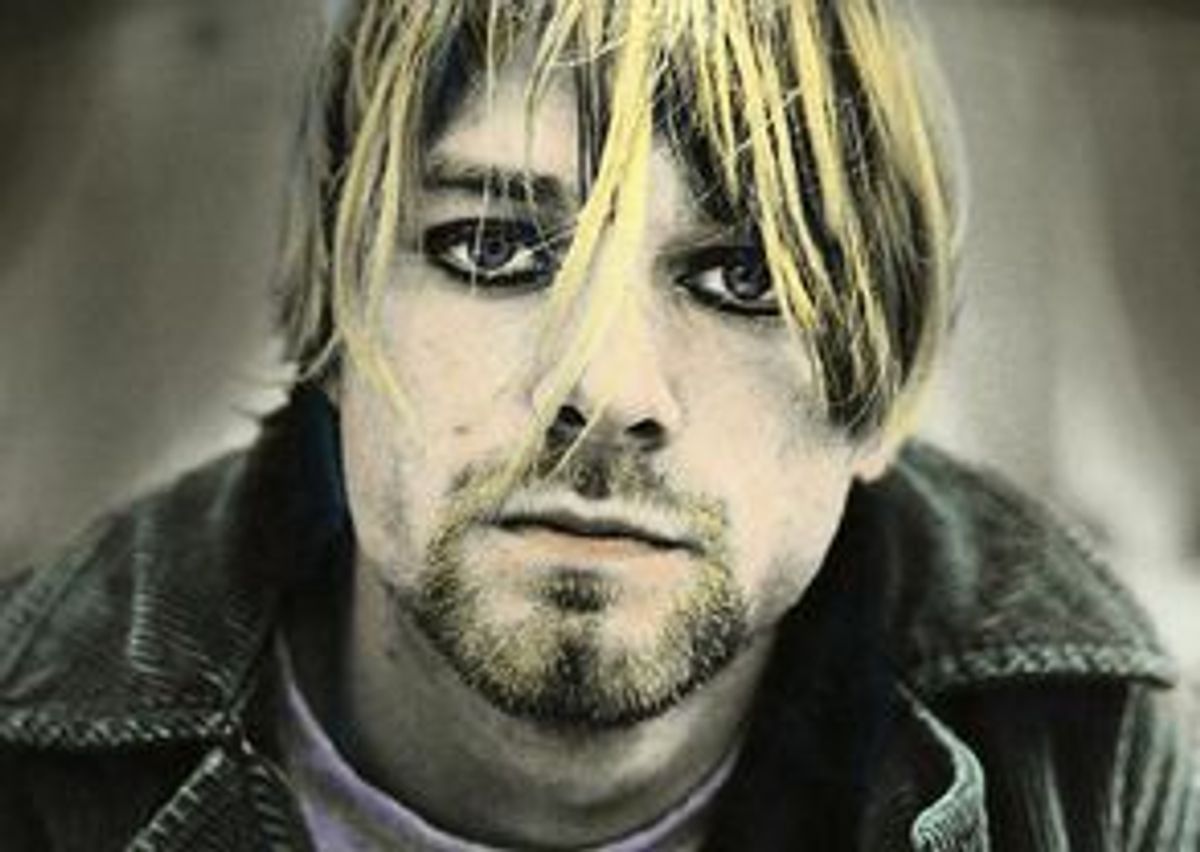
In the early years of the last decade, we watched the concussive career of the rock band Nirvana -- from early word about an explosive new group from Seattle, to the release of the group's epochal "Nevermind" in September 1991, to the wrenching suicide of its leader, Kurt Cobain, on a sad April day two and a half years later. There are a pair of interesting disconnects between what we lived through then and the story offered by a new biography of Cobain, the group's songwriter and singer. The charismatic, talented and troubled Cobain led the group into a furious and extraordinary career that sold millions of records of caustic and uncompromising rock at a time when radio hated it and it seemed like there was no mass market for it. The new biography is "Heavier Than Heaven," by Charles R. Cross; it's a detailed, comprehensive and dispassionate major look at Cobain's life.
By disconnects, I mean that the story Cross tells us reorients us to what was important about Cobain's life and his death. In a couple of ways it's different from what we thought -- or were, in effect, led to think -- at the time.
Cross charts, painfully and for the first time, how Cobain's heroin addiction informed and then dominated the band's day-to-day activities during the period in which most of us cared about them. This is in contrast to the band's first serious chronicler, Michael Azerrad, whose 1993 book, "Come As You Are," was written with the cooperation of the group; despite that access, Cobain's friends apparently covered up the star's problems. Cross has the benefit of the passage of time and the apparent desire of many around the band to finally set the record straight.
It was known that Cobain used heroin; one or two major magazine articles and Azerrad's book during Cobain's lifetime talked about it. Still, it seemed like most of the press -- and MTV -- and even we fans just didn't want to know. It's a little sobering, in fact, now, to watch again MTV's coverage of Cobain's death, and see the channel's agreeable news anchor, Kurt Loder, tell viewers that Cobain had only "experimented" with heroin. You can see various Rolling Stone types bending over backward to assure us that Cobain had said he'd cleaned up. (There's a certain breed of journalist that is always rushing to tell us that celebrities have stopped doing something they, the journalists, had never told us about in the first place.) In the year before his death, Cobain barely toured; the band canceled a lot of shows; controversy swirled around virtually every public appearance the group managed to make. There was a report of an "accidental overdose" in Italy. It all seems plain in retrospect.
The second disconnect had to do with the band's status in -- and Cobain's function as the de facto avatar of -- a world of self-consciously indie rock that had sprung up in America in the 1980s. ("Indie" refers to bands who recorded for independent record labels, those companies unaffiliated with the handful of multinational record distributors. At the time, this type of music and these bands were also identified as "college rock.") In this, purity counted for a lot, and the epithet "major label" was a routine slur.
The indie critique dominated much critical discussion in the late 1980s and early 1990s and in some ways continues to whimper along today; Nirvana wasn't the first of the celebrated indie bands to go to a major, but that didn't make it any easier. Nirvana was criticized for signing with Geffen records, part of, at the time, the huge MCA conglomerate; for remixing -- sweetening the production -- on "Nevermind" in general and specifically the sound of what would become the band's first hit single, "Smells Like Teen Spirit"; and finally, doing similar sonic manipulation of two radio-friendly songs on its last Geffen studio album, "In Utero."
All three of these controversies are covered in Cross' book, but not breathlessly. The casual reader won't miss them because it is plain, in retrospect, that history has passed these concerns by.
But together the two points are something of a cautionary tale, a reminder that in pop culture things really aren't all they seem. The tempest in a teapot of the day dissipates; the jut-jawed statement of principle by the talking head of the moment will soon be forgotten. Does anyone really care, at this point, that "Smells Like Teen Sprit" -- now routinely cited as one of the great singles of rock history -- was made to sound good on the radio? And what's wrong with sounding good on the radio, anyway?
In the unappetizing story of Kurt Cobain, we can see something that puts all that into perspective -- we now know that the self-destruction that we saw was exactly what it looked like, and it eventually came back to haunt us. Cobain's friends and loved ones didn't exactly sit back and watch -- they held confrontations and interventions. Yet, still, his coterie, over and over again, protected him -- and the press, for the most part, went along.
Our age is supposed to be a media-saturated one. Privacy is gone, people claim; cameras and nosy reporters are edging into everyone's lives. So how did Kurt Cobain die right before our eyes?
- - - - - - - - - - - -
By the early '80s, punk had come and gone. Then what came to be called post-punk -- new onslaughts of still rough-edged but more complex bands, like X, from Los Angeles, or Gang of Four, from England -- came and went as well. Besides a fluke or two like the Clash, with "Combat Rock," none of these bands sold any records.
Punk was going to change everything. When it didn't, corporate radio, corporate labels and the corporate press settled into complacency. Besides a few super-duper stars like Bruce Springsteen and Michael Jackson, there was a large group of second-rank multiplatinum artists to keep folks occupied: Call it the Live Aid era, with Sting, Phil Collins, Mark Knopfler and Eric Clapton, from England, joining a bunch of rootsier but presentable Americans like Tom Petty and John Mellencamp to function together as rock's reigning royalty. There were exceptions, like Prince, but that was the status quo of the time.
Then things got worse. In the latter half of the decade a new wave of lite heavy metal alchemized and hit the charts. Even the best of these groups -- Guns N' Roses, say -- were obviously bozos. They looked absurd, and their music was almost comically derivative. The worst were almost unspeakable. (Remember Sebastian Bach, from the group Skid Row, who appeared on stage with a shirt that said "AIDS: Kills Fags Dead"?)
There is bad popular music in any era. (I'll see your REO Speedwagon and raise you a Def Leppard.) But even as Huey Lewis and the News was selling 9 million copies of "Sports," a roiling group of people across the country were adhering to a slightly more elevated set of rock verities, at least as they saw them. R.E.M., the most high profile and ultimately the most successful of these bands, found it in tunefulness, chiming guitars and relatively straightforward business dealings. Others -- a lot of others -- found it in terrifically high volumes, intermittent personal hygiene, various species of what they imagined was antisocial behavior, and, sometimes, actual sonic experimentation.
This period is chronicled in a new book by Azerrad, "This Band Could Be Your Life," which profiles, fanzine style, 13 of the groups from this period. The bands include Black Flag, the greatest of the violent Los Angeles hardcore bands; Sonic Youth, the intelligent New York art rockers; the Replacements, the tuneful, alcohol-drenched Minneapolis combo; and many others. His choice of subjects is unerring, and he got admirable access to the groups he chose. But I got tired of the book after a few chapters.
While the intro and outro aren't bad, the meat of the book is superficial. It doesn't paper over conflicts or financial problems between the bands and their labels, for example, but there's still a way in which the book accepts at face value the band members' view of themselves. In the Black Flag chapter, Azerrad makes a lot of references to the pressure Greg Ginn, the group's founder and bassist, had running his label, the celebrated SST, but you never got a sense of its finances, or how much Ginn was making versus his band mates. In the end, did Ginn end up with a hefty chunk of cash? How are the other group members doing?
The Black Flag story is a truly amazing tale, full of violence and absurdism; Ginn actually ended up in jail for violating a court injunction in a legal fight with MCA. (Now that is indie.) But Azerrad is also a little credulous, as when he says the Los Angeles Police Department was listening in on the label's phones and stationing undercover officers around its offices. It may be true, but the assertion isn't sourced, and it sure sounds like stoner rocker hyperbole. ("And, man, the police were, were, wiretapping us!") A more enterprising reporter would have sourced the charge, gotten comment from the LAPD, or tried to find out if wiretapping warrants were ever issued or carried out.
Still, the story is an inexorable one: These bands soon began popping up on, and then dominating, critics' end-of-year 10-best lists and building up decent (if uniformly tiny by mainstream standards) tour followings, but couldn't get a break from radio, or, for the most part, MTV. And it wasn't clear, at least at first, if they wanted it. The new indie rock had different concerns, including a distrust of technology, and affinity for a lot of things the corporate masters didn't like: American roots music in some cases, and, most broadly, a commitment to volume, dishabille, contrariness generally, and "authenticity."
Ah, authenticity. It wasn't seriousness, exactly -- irony in a fairly watered-down form existed in the work of the wacky Camper Van Beethoven and, certainly, in the psychedelic ferocity of the Butthole Surfers. But bands were for the most part expected to be honest and feel honestly. They were supposed to care about their true fans -- since the members of the bands, it was assumed, were true fans themselves -- and not be in it for the money, exactly.
The everyman stance wasn't a posture. The band members, with a few prominent exceptions, were lowlifes every bit as foul as the members of the audiences that came to see them, and they suffered -- came from broken homes, were abused, felt like losers and despaired -- in just the same way. Some of these groups had singers who howled in fury, like Black Flag's Henry Rollins or Cobain himself; others were just, well, losers. But the message was the same.
Anyway, as time went on, many of these groups found themselves cluttered in a few small benchmark labels across the country, like Sub Pop in Seattle, Touch and Go in Chicago, SST in Los Angeles, Twin-Tone in Minneapolis, Matador and Homestead in New York and many others not as well known. The idea was that they could forge a community and make music without the benefit of the big bad major labels or the big bad national press. They listened to each other on college-rock stations, slept on couches in a nationwide network of fan houses, saw one another's tiny posters on telephone poles and read about one another in a network of national fanzines.
Which brings us to the poignant conundrum at the heart of the indie-rock way of life: How could they demonstrate this outsiderness, this authenticity, in a commercial environment? It was never quite articulated in quite so crude a fashion, but it was a given in that world at the time that there was a special group of true fans of any given band, surrounded by a much larger group of people who weren't quite so worthy.
Indie rock was in effect a series of concentric circles, with each successively larger circle representing an inevitable dilution of the select. Whichever one you stood in, you scowled at the bigger ones. Were you a true indie rock fan, really? At the time, you could hear scenesters disparage Matador, the coolest and contrariest label of the era, as being hopelessly compromised.
What most bands did was draw imaginary lines in their minds: We'll put handbills up, but not posters. We'll do interviews, but never say anything serious. We'll show up for the concert, but go on late to make clear we're not eager-beavers. We'll do some college radio interviews -- and act bored to be there -- but not mainstream ones, and if we do do mainstream radio, we'll act even more bored! And we'll talk to major-label people, if they insist, but get drunk and act like the fuck-ups we are when we meet, the better to have tales with which to regale our fans from the stage that night. And sometimes, to reward our really cool fans, we'll have secret shows, so the uncool people can't get in.
Some of the bands did silly things, but the indie-rock movement in America in the 1980s was something to see. Dozens of great records by great artists came out of it. But in the end, as the years went by, it turned out that the labels, the fans and the fanzine writers exulting in the indie-rock-band lifestyle found themselves deserted by the actual indie-rock bands -- almost all of the best of which eventually departed for major labels.
You can say they were greedy, call them sellouts, think they were misguided. But the thing that drove Kurt Cobain, and the other indie bands, was a dream about pop. Money entered into the equation, of course, and why not? But something else was going on as well. As the 1980s went on, you could feel an interest building in something. It wasn't interest in a new type of music, exactly. But there was an odd sense of a thirst for something ... different. If you were one of these musicians, you could smell that need, and suddenly visualize yourself in a different world, one where kids everywhere jammed to your music, their hearts feeling that they would burst.
The most honest of these musicians admitted that they felt that way as a kid, and that it was a feeling that had driven them to the point they were at. The artists who went to the major labels could feel something hungry, almost animalistic, out in the wilderness, something alive that wanted their music. One of them was named Kurt Cobain.
- - - - - - - - - - - -
The outlines of Cobain's life were well known before Cross' biography. He grew up in a crummy logging town, Aberdeen, in western Washington state. His parents divorced when he was 9. By the time he was 15, he was a lowlife, long-haired, trouble-causing kid from a broken home with a lot of broken emotions and a healthy interest in the scatological and anatomical. He started his interest in rock early on, roadie-ing for a sludge-rock ensemble called the Melvins. He eventually formed his own combo; he paired up, luckily, with a gangling kid named Kris (later Krist) Novaselic on bass; the two became best friends. A few years later -- after recording their first record as Nirvana -- they lucked out and found the astonishing drummer Dave Grohl. (Grohl now fronts the band Foo Fighters.)
Cobain and Novaselic played under the name Fecal Matter but, in an early concession, you might say, to commerciality, ultimately christened themselves Nirvana. They went on to suffer a few years of the casual indignities -- poorly attended gigs, resounding apathy from even the smallest record labels -- kids in bands with big ideas are fated to go through. Cobain finally caught the eye of Jonathan Poneman and Bruce Pavitt, who owned and ran Sub Pop records. Sub Pop, based in nearby Seattle, was a household name in the rock underground of the time for releasing albums by grunge groundbreakers Soundgarden and Mudhoney.
Cross does a good job of explaining the label's odd finances and clever marketing practices. The best of the latter was the Sub Pop singles club, which had underground kids shelling out cash monthly for releases in the moribund 7-inch format. As for the former, at the time it recorded Nirvana's first album, "Bleach," the label, in the midst of a money crunch, got the band to pay its own recording costs. Ah, the purity of indie rock. (The band borrowed the cash for the fabled $600 bill from a friend and never paid him back.)
The band's first album contained a lot of enthusiastic noise, but also a giddy cover song -- the obscure but irresistible "Love Buzz" -- and one oddly Beatlesque tune, "About a Girl." (Playing covers was another theoretical minefield for indie bands. Many rejoiced in blasting through unexpected schlock classics on stage. But adding covers to albums of otherwise original music by unknown bands was an old major-label trick to get some easy airplay.)
Enter Geffen, which in the late 1980s and early 1990s had one of the industry's canniest A&R departments; the company had unloaded about 20 million Guns N' Roses albums on unsuspecting American teens. The label, presciently, had signed Sonic Youth; for Cobain, that made the label legit by association, and he said, frankly, that he was frustrated, as the band toured the country, when fans told him that his album wasn't available in stores. (Both bands technically ended up on a Geffen imprint called DGC.)
Nirvana got out of its Sub Pop contract; the indie label got $75,000 and, Cross says, a 2 percent piece of the band's next two albums, which together ultimately sold in the neighborhood of 15 million copies in the U.S. On paper this was probably worth at least $2 million to Sub Pop -- not to mention the catalog sales of "Bleach," which eventually went platinum. That's not a bad return on an initial outlay of zero dollars. (In 1995, as the post-"Nevermind" alternative-rock sweepstakes began to wane, Sub Pop's moment past, Poneman and Pavitt sold a 49 percent interest in the company to Warner Bros. for $20 million.)
Geffen grabbed the band and paired the members up with producer Butch Vig. Cobain had found something deep within himself to write about, and some bolt of primal musical inspiration to frame his thoughts. Vig made the songs Cobain gave him roar. The best of this was "Smells like Teen Spirit." The phrase was from an ad for a feminine deoderant. Kathleen Hanna, of the Seattle riot grrrl band Bikini Kill, had written "Kurt smells like teen spirit" on the wall in Cobain's bedroom; it was a reference to another member of Bikini Kill, Cobain's girlfriend at the time, Tobi Vail. Cross captures Hanna's signifiers perfectly: "Kathleen was taunting Kurt about sleeping with [Vail], implying that he was marked with her scent." Cross, making the case for a deep sexual element in the song, says Cobain is referring to Vail in the lyric, "She's overbored and self-assured." "Smells Like Teen Spirit" became the first track on the album, kicking it off with a solitary, low-volume guitar riff; the stunning assault that kicked in on the fifth measure catapulted Nirvana, and Cobain, into the consciousness of a generation.
Songs this loud, this unrestrained, were seldom heard in America at the time. There was criticism in some quarters about how a talented remixer named Andy Wallace had fiddled with some of the songs to improve their radio sound, but that didn't stop "Nevermind" from becoming the most sensational album release of the decade. Cross says that sales peaked the week after Christmas as kids shelled out holiday gift money -- or traded in other records they'd gotten -- for "Nevermind." During the second week of January, the band knocked Michael Jackson's "Dangerous" out of the No. 1 spot on the Billboard album chart. The band played "Saturday Night Live" that same week.
Cobain was living amid a squalor that transcends most rock band tales. He crashed with various friends in various filthy apartments. While it appears he never actually lived "under a bridge," as his personal mythology put it and as he sang in the powerful "Nevermind" song "Something in the Way," it's also true that the reality wasn't much nicer: He had so run out of options in the months riding up to the release of his Geffen album that as late as the summer of 1991 he was literally living out of his car when he wasn't on tour.
He hooked up with Courtney Love the month after "Nevermind" was released. Love was a remarkable self-made underground demistar, with her own band, Hole, and a checkered past; like Cobain she'd virtually lived on the streets. (Unlike him, she had a small trust fund to help her out.) Love in many ways was an accident looking for a place to happen, generally to someone else, yet she had a sparkling intelligence and was an undeniable onstage presence. She was a sometime junkie as well but lacked, fortunately, Cobain's lacerating tendency toward addiction. While Novaselic has gone out of his way to note that Cobain was an addict before he met Love, to most of the rest of the members of the band's coterie she symbolized the drug; Cross says Novaselic's wife, Shelli Dilley, was particularly appalled at what Love represented. Cobain and Love's marriage, in February 1992, in Hawaii, marked the effective end of Cobain and Novaselic's friendship. The happy couple had a daughter, Frances Bean, that September; while Love screamed in her hospital delivery bed Cobain was vomiting helplessly in detox in a nearby room.
A collection of B-sides and such, "Incesticide," was released, contrarily, a few days before Christmas 1992. (Most Christmas releases come out in October, to allow plenty of buying time.) It featured an extraordinary original song, a neck-snapping bit of childhood-separation fear called "Sliver." ("Grandma take me home!/Grandma take me home!" the head-snapping chorus repeats; thematically, it could have appeared on "Plastic Ono Band," John Lennon's primal scream album.) But aside from some fun covers, there wasn't much else of interest on the album.
A Vanity Fair profile of the couple appeared the month the baby was born; it gleefully compared Cobain and Love's marriage and lifestyle to the fateful one of Sid Vicious and Nancy Spungen. (Love had even had a bit part in the film "Sid and Nancy.") The most damning passage was Love's admission that she'd done heroin after she knew she was pregnant. The pair denied the story, but ended up losing custody of their child for a time. They demonized the writer, Lynn Hirschberg, for a year; Cobain explicitly threatened to kill her several times. After Cobain's death Love admitted that the allegation had been true.
For the band's studio follow-up to "Nevermind," Cobain chose Steve Albini, an acerbic fanzine writer, recording artist and producer, to safeguard the group's purity after the Andy Wallace "Nevermind" remixing contretemps. The album, "In Utero," begins with the line, "Teenage angst has paid off well/ Now I'm bored and old," and contains Cobain's most beautiful songs: "Heart-Shaped Box," "Dumb," "All Apologies" and "Pennyroyal Tea."
But Albini clashed with Love -- he later called her "a psycho hose beast" -- and paid Cobain back for his largesse as the album neared release by telling a reporter that Geffen was forcing the band to make changes in the record's sound. The truth was probably somewhat different, but the Albini charge eventually found its way into Newsweek and forced the band to take out a full-page ad in Billboard saying it wasn't true.
But Cobain had bigger problems. His heroin addiction had put him into a downward spiral. The Cobain-Love marriage, with an infant daughter in the mix, became a disgusting melange of gutted hotel rooms, domestic-abuse police calls, stints in rehab, and lots and lots of heroin. Cobain walked out of a Los Angeles rehab center on Friday, April 1, 1994, and disappeared. Love and his friends and family spent agonizing days looking for him. He shot himself in a greenhouse behind his suburban Seattle home on Tuesday, April 5; his body was found three days later.
- - - - - - - - - - - -
Heroin didn't kill Kurt Cobain. Cross tries his best to draw together the various threads that contributed to his demise: The addiction; an obvious but, it seemed, fully undiagnosed depression; and a mysterious and seemingly untreatable stomach ailment that troubled him chronically. (Azerrad says that Cobain's mom had had a similar ailment when she was younger; neither author goes out of his way to figure out what in the end the ailment might have been.)
Cross, who's written previous books on Bruce Springsteen and Led Zeppelin, has spent his career in Seattle; his editorship of the music magazine the Rocket let him watch Nirvana's career from the beginning and gave him unique access to the major characters of his story. His book is a rare thing -- a rock biography that's strongly written, looks at the world through open eyes and doesn't assume its audience is full of idiots, yet retains an unspoken but always present moral grounding. His research makes for careful judgments, the narrative throughout seems persuasive, and he leaves few questions in the reader's mind.
He has an eye for the absurdities of the rock-star lifestyle. Love is one of his best sources, and she perhaps comes off here better than a lot of the people who hate her would prefer. But he does pause from time to time for an elegant skewering, as when he mentions Cobain's professed fondness for the writings of Camille Paglia. "This was one of the many influences Courtney affected," he writes. Later we see Love go into her own rehab -- a special star-friendly version called "hotel detox."
And his sources say the things that hurt: At the final intervention of Cobain's life, Cross notes how most of the friends and managers there really couldn't face Cobain, couldn't actually deliver the condemnations and threats they were supposed to. It raises the possibility that Cobain's circle never really did the one thing that might have saved his life: Articulate a threat to publicly disassociate themselves from the star en masse, and point out, in the process, that he'd become exactly the sort of excess-driven rich rock icon his music was supposed to have been an antidote to. Instead, Cobain could point to his own wife, a junkie as well.
Indeed, the confrontations never had an effect and the rehabs didn't either. The ironies, by contrast, got richer. At his last stint, Cobain arrived at the facility right after Eagle Joe Walsh had left; he hung out in the center with Gibby Haynes, from the Butthole Surfers. In the punk world, no group was lamer than the Eagles, and no underground band had more raunchy credibility than the Buttholes, as they were known. Cross doesn't say whether Haynes and Cobain reflected on the clichés they had become.
Cross' book isn't perfect. I wish he referred to the characters by their last names. Use of first names -- Kurt and Courtney, Krist and Shelli -- I think diminishes the subjects. And while he's generally admirably detached, you can see him, once in a while, lose perspective. The tale of how Cobain and Love nearly lost custody of their daughter is told with too much sympathy for the Cobains. They were junkies, and not gentle ones, either. Love did do heroin after knowing she was pregnant. The arrangement they finally adopted, hiring a friend with no child-raising experience as a nanny, doesn't speak much for their judgment either. (They couldn't bring an outsider into their druggy world; it was just another bit of enabling for the pair's self-destructive lifestyle.) Cobain at the time was barely able to show up for a sound check, much less raise a kid. His behavior after the article was published -- brandishing guns and threatening to kill Hirschberg -- merely underlines the point that his judgment was impaired.
And finally, once or twice Cross skates over a more interesting story. The Albini-"In Utero" contretemps, for example, is mentioned only in a short paragraph in the book. Clippings I have from the period tell a more complex story. It was a terrible embarrassment to Cobain, yet he was always unapologetically honest about what exactly did happen. Albini seems to have had an agenda to keep the band from going too soft; one of the producer's assistants, in a Chicago magazine profile of Albini, once described Albini doggedly trying to stop the band from adding ornamentation to the songs: "Kurt would say, 'I want to do a guitar overdub,' and Steve would explain to him for a half-hour why it wasn't a good idea, using all these weird technical terms. And Kurt would say, 'Well, that may be so, but I still want to do a guitar overdub.' And Steve would explain to him again why he shouldn't do it. The last line of any of these lectures is always, 'But you're paying me, so I'll do what you want. I have to put in my two cents because you're paying me.' But his two cents turns out to be, you know, five hundred dollars."
Cobain himself at the time forthrightly explained that he, not the label, had a problem with "In Utero": "I just could not put my finger on it," he said. "I called up Steve, and I basically asked him for some advice, like 'Why don't I feel the same emotion I did on "Nevermind" or "Bleach"?' It took me a long time to realize the vocals weren't loud enough, and the bass guitar was almost impossible to hear." This rings true to this listener; whether Cobain actually told Albini that Geffen was threatening not to release the album (perhaps as a way to cover up his own opinion), we'll never know. For his part, Cobain in later interviews at the time acknowledged that his Geffen A&R person didn't like the tracks, but went out of his way to reiterate his own displeasure with them and to say, "There was never any sense of a threat like, 'We're not going to put this record out,' because they can't." (The band had the rock equivalent of final cut on its releases.) In the end, Nirvana brought in R.E.M. producer Scott Litt, who remixed "All Apologies" and "Heart-Shaped Box."
The story is a illustration of the indie mentality gone wild. Cobain is certainly the most uncompromising major star in rock history; and yet here he was forced to fight a rear-guard action to defend his purity -- forced, humiliatingly, to take out a big ad, backed by his big major label, trying to limit the damage being done to his reputation. The irony is that the argument can be made that what Cobain needed at the time was someone to help him tone down the album even more. In Albini's defense, it must be said that others of the album's softer songs -- "Dumb," for example -- sound just fine. But in the end "In Utero" is an irritating work of brilliance, with unforgettably wrenching and passionate songs like "Heart-Shaped Box" and "Dumb" desperately gasping for air between too many tracks (far more than on "Nevermind") whose unrelieved clamor and sophomoric lyrical ugliness ("Her milk is my shit/ My shit is her milk") seem little more than sops to the rock underground.
- - - - - - - - - - - -
Was Cobain really that good? Was he really that important?
A lot of "Bleach" is noisy and boring; too many songs on "In Utero" are, too. But Cobain's lyrics -- naive and sophomoric but sometimes containing unaccountably beautiful poetry rife with disturbing body-part imagery -- can have a rare force; when mixed to his instinctual understanding of dynamics and strangely unforgettable way with a guitar riff, the mixture could produce songs of almost unprecedented gorgeousness and power.
"Smells Like Teen Spirit," the song that kicked off the "Nevermind" selling spree, accomplishes something other songs try to do but don't achieve, which is at once wear its influences on its sleeve and turn them into dust. There's lot of the spacious, disturbing sound of the Pixies in "Teen Spirit"; its potency comes partially from the way that that aural space mixes with the song's dense central riffs, which are right out of the Blue Oyster Cult's "Godzilla." Beyond that, there's a very heavy bottom, vaguely reminiscent of the one in Jimi Hendrix's cover of "All Along the Watchtower." That mixture, Grohl's brutal drumming, and the song's crushing dynamics -- where the ominous casualness of the verses are pulverized by the assault of the chorus -- make the backing track articulate and persuasive to this day.
Having accomplished that setting, Cobain then did something else that very few rock acts care to do: He told his audience something it didn't want to hear. Did the moshing kids -- and the moshpit at a Nirvana concert had a churning ferocity -- see themselves in the chant: "With the lights out, it's less dangerous/Here we are now, entertain us/I feel stupid and contagious"? It's one of the most bruising critiques of the rock mass audience since "Like a Rolling Stone." Did the dancers feel the sting of his mocking words: "Our little group has always been/And always will until the end"?
And yet, much more than Bob Dylan, Cobain plainly includes himself in his indictment. Not yet a star, he still seemed horrified by that audience; it was something he plainly saw himself part of as well, as stupid and contagious as his fellows, in the song's closing litany of "A mulatto/ An albino/ A mosquito/ My libido/ A denial/ A denial/ A denial ..."
In the end, Cobain used his uncommon charisma and neck-snapping command of a rock riff to become a star. The story would be only mildly interesting if that's all that had happened. But because he was a peculiarly uncompromising, particularly arresting star who happened to make a very good record at the end of a decade in which an odd unprecedented cultural pressure had been building, something else happened as well. Nirvana and Cobain ended up effectively yanking an entire industry leftward and opened up '90s rock into a dazzling kaleidoscope of unconventional artists.
Their influence has only something to do with grunge, which has become more or less a footnote in the history of rock. Nirvana was bigger than grunge rock. The word "epochal" is misused a lot when it comes to rock 'n' roll, and particularly rock 'n' roll albums. But remember that, when "Smells Like Teen Spirit" hit radio, many major radio stations wouldn't play it. It was too loud, too aggressive and too confrontational for the average AOR station's sound.
It seems almost implausible now, but many stations were actively hostile to the new "alternative" bands. Through an odd chain of circumstances I was interviewed on a big St. Louis AOR station the morning after the 1992 Lollapalooza show, which featured the Red Hot Chili Peppers, Soundgarden and Pearl Jam. It took me a while to realize that the morning zoo gang on the station considered the show a massive punch line.
Yet the force of "Teen Spirit," and "Nevermind," was unrelenting. The album sold 100,000 copies a week for much of the year. Sure -- Garth Brooks or Shania Twain do that too, but they're not purveying confrontational music. Radio began to crack under the pressure -- and soon, some of those hostile radio stations didn't exist anymore. In many cities, conservative AOR outlets were supplanted, and in some cases handily replaced, by a new crop of alternative stations; within a year or two after the release of "Nevermind," even bellwether AOR stations were wounded, as, punch line or no, the Chili Peppers, Pearl Jam and Soundgarden became staples of AOR programming for the rest of the decade.
You can sneer at a movement that puts J. Mascis on the charts, and sure, in the end, a couple of media conglomerates merely had to do a few format revisions. I'm with you on both points. But there was one twist: That thirst those bands could sense. It wasn't for something in particular. It was for something different. The stations, and the record companies, had to accept that odd was selling, and so they went looking for odd. A lot of bad bands got record contracts, but a lot of good ones did as well; and this openness brightened the pop palette of the '90s in all sorts of ways. To pick an obvious one, consider whether the Breeders, Liz Phair, Hole or Belly would have received airplay or MTV attention before 1992.
In other words, the band forced the industry to institutionalize openness. Nirvana didn't do it alone, of course; besides the 10 years of experimentation that came before them, the architects of rap, too, had strikingly pushed the boundaries of pop; and so, of course, had R.E.M., who by the time of "Nevermind" were a refreshing, if not sonically daring, presence on radio. But for the decade of what is now known as the post-"Nevermind" era, the record companies, and radio, were forced to look for the next new thing.
This unaccustomed state of affairs created new outrages, of course -- with industry people and too many journalists running around declaring that the next Big Rock Thing was, say, "electronica," whatever that was, or "post-rock," whatever that was. And from today's perspective, 10 years on, we can see rap was the truly revolutionary cultural form, that boy bands will always be with us, and that crossover country can still generate more record sales than just about anything.
And let's even stipulate that at least part of what Nirvana represented was merely a great resentful roar of masculine rawk, and who cares about that anyway?
But that is to overlook the metaphor that Nirvana, to this day, represents: The assault can be made, and that revolution in pop can be accomplished. There's a case to be made that this battle, this ongoing reinvention and revitalization, is one of the things that makes rock 'n' roll what it is. The Clash wrote a song, "Hitsville U.K.," about this phenomenon: "The mutants, creeps and muscle men/ Are shaking like a leaf/ It blows a hole in the radio/ When it hasn't sounded good all week."
In songs like that, rock imagines its future. Today, things are calmer, and even the adventurous acts -- Beck and Moby come to mind -- have perfected the art of industry game-playing without really seeming to. But now we know that in the background there are always some new rough beasts running around, and not even Kurt Loder is going to stop them from coming.
In this way, Cobain is an odd rock martyr. The indie rock world that spawned him was in almost all its practices charmingly innocent; it worked as long as it did because, in the end, few people cared for the anti-pop music so many of them purveyed. When a few people with that dream of pop entered the equation, it heightened a few of the contradictions of the world, but it still stood.
But Kurt Cobain was fated to discover that the train he'd gotten on couldn't be stopped. The corporate rock world, which he joined voluntarily, simply has no reason to halt it once it's going; there's not even really a way to describe such an act. And Cobain was ambivalent about it anyway. One day he was enraptured with his success; the next night he was horrified. It's not clear if his images of how stardom should be simply didn't connect with the realities of it, or if in the end he did understand what was happening but felt guilty about it.
If the band Nirvana can be a metaphor for a victory that transcends its time, Cobain's life is a metaphor for the one key theoretical weakness in the indie rock ethos: You can't be semi public. There was a patina of falsity in the rock world at the time. To a young and overearnest would-be rock star, it's pathetic to repeat, night after night, a shtick that begins "Hello, Seattle/Dubuque/Tallahassee!" and ends with your biggest hit, just before the encore. A lot of professional musicians do that, night after night, and, after they become famous, they take the next step, and the step after that. And soon the star is smiling for the talk shows, telling People magazine that it was time to get back to his roots for the new album, and, no, he and Jennifer Aniston are just close friends. Then you hook up with a beer company for tour sponsorship, bringing in a few outside songwriters at the suggestion of your label and all of a sudden you're Aerosmith, or Mick Jagger.
Cobain never could deal with the compromises. He never was able to grow up to understand that even if you're sick of playing your hit, it's even more pathetic to go out and collect people's money and not play it. And to have contempt for that uncomplicated desire, which of course is a species of the one he himself had as a kid, is to have contempt for oneself.
Cobain had made the decision to put himself in a position to go large, but never, apparently, figured out what that meant. He was perhaps the frailest star ever to face such intense public interest. Cross' book is spotted with more than enough examples of Cobain being something, one suspects, he didn't want to be. He learned to smile and lie in public, and he knew, deep inside, he had become a different person.
He said so in his suicide note: "The worst crime I could think of would be faking it and pretending as if I'm having 100 percent fun. Sometimes I feel as if I should punch a time clock before I go out on stage." Later he wrote of "the hateful death rocker I have become."
Did Cobain die of shame? Has ever such a star surrendered in this way? You want to point, feebly, at what Cobain had going for him. Besides the talent, the wife, the kid, the fans, he seemed to have something rare -- the capability to transcend himself and his origins, first by wrenching himself out of his dismal upbringing and then by facing down the elements in the subculture that spawned him who didn't share his dream about pop. We expected everything of him in the future. We just didn't expect the one unthinkable thing, something the 27-year-old suspected and then convinced himself of -- that a future was the one thing Kurt Cobain didn't have.
Shares