

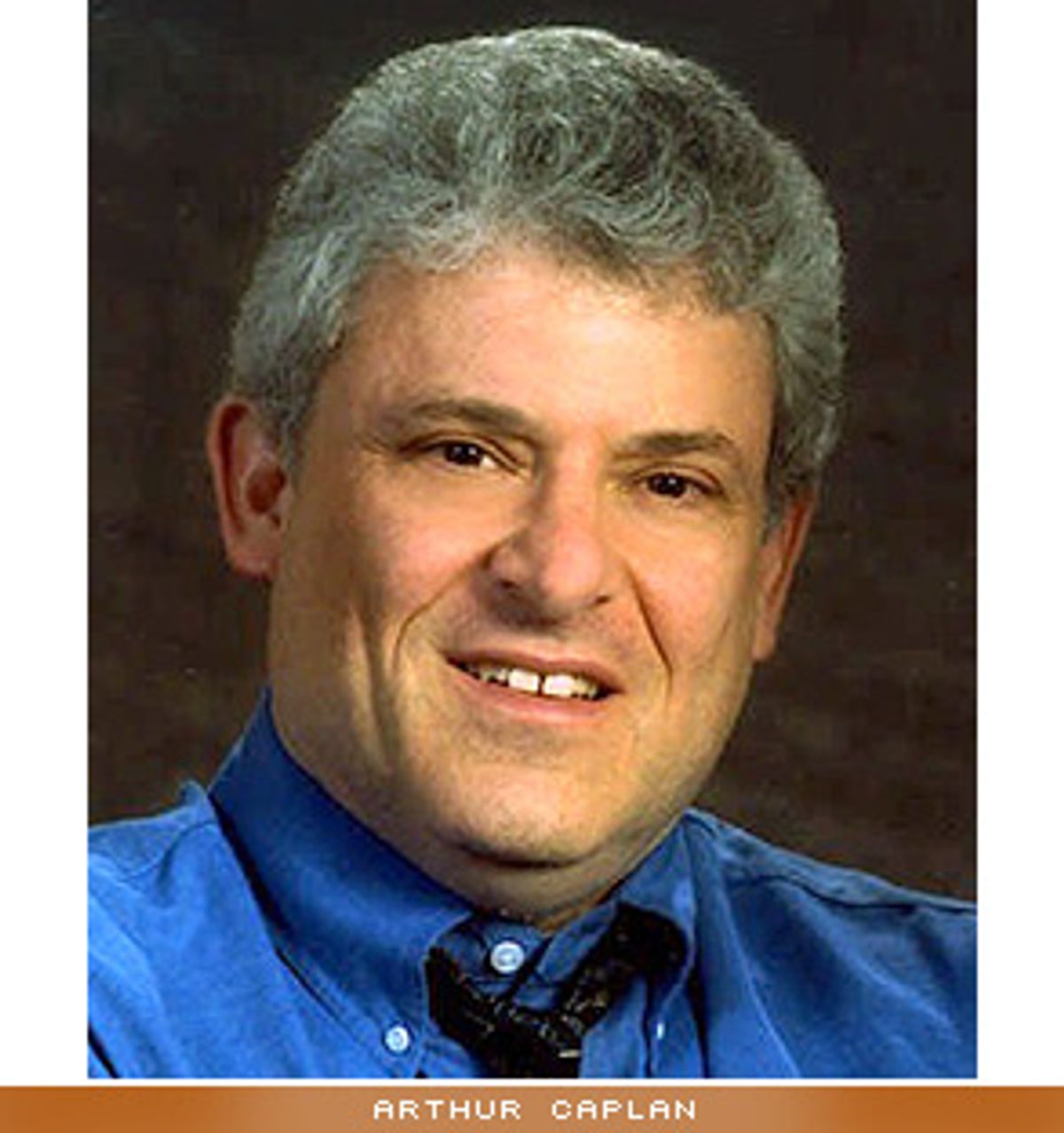
For years, Arthur Caplan has been the nation's best-known medical ethics dispenser. The extroverted director of the Bioethics Center at the University of Pennsylvania is the go-to guy for researchers, hospitals, businessmen and journalists looking for sound moral thinking or just a sound bite.
Last week, Caplan, 50, earned the dubious distinction of being the first prominent bioethicist to get sued for his advice. The father of Jesse Gelsinger, an 18-year-old from Arizona who died a year ago during experimental therapy for his inborn metabolic disorder, named Caplan in a lawsuit against several Penn doctors and two hospitals.
Some bioethicists worry that the lawsuit could stifle ethical debate. Many feel that it represents a coming of age of sorts for bioethics, an academic field that began in the 1960s and whose influence has exploded along with changes in medical technology.
"Over the past five to 10 years, people have begun to realize that bioethics is developing into a discipline. Maybe one of the signs of reaching that status is getting sued," says Gilbert Mailaender, a bioethics professor at Valparaiso University in Indiana.
In the past 30 years, bioethics has become a new priesthood, replacing the clergy in the provision of advice about life-and-death issues. Working out of more than 150 U.S. academic centers, bioethicists help doctors and researchers make difficult decisions such as whether to resuscitate brain-damaged preemies or how to keep patient records private while examining DNA. Bioethicists' wisdom is sought by Congress on cutting-edge issues like human cloning, embryo research and artificial intelligence. In 1995, President Clinton created the National Bioethics Advisory Committee as a standing debate club for biomedical questions.
Most recently, bioethicists have played a crucial role in efforts to reform institutional review boards or IRBs, the overworked university panels that are sometimes criticized for their lack of independence from the researchers they oversee. IRBs are required to examine all federally funded research designs for safety and worthiness.
It was the Gelsinger case that propelled IRB reform. And ironically, Caplan has done as much as any bioethicist to push the IRB reform agenda, especially in assuring informed consent -- the requirement that researchers fully explain the possible risks and benefits of an experimental therapy to their subjects.
While Gelsinger gave informed consent, the complaint charges that researchers left out a few crucial details on the possible risks involved in the study. These risks, the family claims, might have swayed Gelsinger from participating. Making sure patients are capable of understanding the risks is why Caplan gave the advice he did: Enroll only consenting adults.
Initially, gene therapy researchers at Penn planned to carry out their experiments on fatally ill babies suffering from the rare metabolic disease ornithine transcarbamyulase deficiency. Caplan advised against it. Older, healthier children or adults were more appropriate research subjects, he argued -- babies can't give informed consent, and their parents are too grief-stricken to give fully reasoned informed consent.
Paul Gelsinger charges in his complaint that Caplan's advice led to the recruitment of his son for the gene therapy trial -- and thus indirectly killed him.
In an interview this week, Caplan says he gave the advice in "informal, in-the-hall chats" and that he stands by his line of thinking. It is, he says, in keeping with the regulations governing research on human subjects. Indeed, informed consent is required in a safety-phase study like the one in which Gelsinger died. Ethics deliberating bodies like the NIH's Recombinatory DNA Advisory Committee (known as the RAC) have gone over this ground for decades.
"I said that if you're going to do risky research, you can't use people who can't consent -- the mentally ill, babies, retarded people," Caplan said in an interview this week. "A study of this type is for safety only -- it's not beneficial to the subject."
There's little doubt that Caplan's case is strong. But he has become such a public figure that the suit has generated a little schadenfreude, as well as generalized debate about the directions bioethics has been moving in recent years.
Caplan directs a staff of 40 at what is probably the largest bioethics center in the world. It offers advice to everyone from biowarfare experts to biotech companies to patient advocacy groups. Caplan has been profiled by Time and People, earns upwards of $250,000 in salary alone and appears on TV almost as often as Jesse Ventura did when he wore tights.
Some colleagues think Caplan is a bit glib. "There were a lot of smirking bioethicists when they heard the news," one colleague said. And for conservative doctors and researchers who view bioethicists as airy-fairy gasbags with their heads in the clouds, Caplan is a lightning rod.
"I think this case demonstrates a weakness of bioethics as it's practiced by Art Caplan," says Henry I. Miller, a longtime FDA official who is now a fellow at the Hoover Institution. "He allowed the canons of the field to get in the way of common sense."
Caplan's advice may meet the criteria of informed consent, but it defies common sense, says Miller, who thinks the experiment should have been done on critically ill babies, not Gelsinger, who had his condition under control before entering the trial.
"When you're about to test a speculative and potentially dangerous medical intervention, you try to do it on people who are unlikely to be worse off than if they hadn't undergone the intervention," Miller says.
Caplan can't escape responsibility for the death, Miller says. Although it was up to Penn's Institutional Review Board to approve the research design he recommended, "When the great Arthur Caplan holds forth, I think the IRB would have to take his comments very seriously."
George Annas, a friend and colleague of Caplan's who teaches at Boston University, concurs; a smart lawyer could argue that a researcher or IRB might face repercussions if they ignore advice from someone like Caplan.
"He's quoted in the New York Times every day and now he tells us he didn't think they'd take his advice seriously? Who's he kidding," Annas says. "But he didn't give bad advice. It was good advice."
Mailaender thinks it may have been inevitable for a high-profile ethicists like Caplan to get sued. "If you accept a certain institutional responsibility and aren't just writing articles about bioethics," he says, "you can't expect to have immunity from this kind of thing."
Caplan is not the first bioethicist to be sued. In 1983, a semi-paralyzed patient named Elizabeth Bouvia sued a hospital ethics committee after they said she should be force fed. Her case was dropped after a court ruled the feeding tube had to be removed. Bouvia had wanted to commit suicide by starving herself, but relented, deciding it was too slow and painful.
While there are obviously those who share Miller's point of view, years of bioethical deliberation support Caplan's advice, say colleagues.
"When I was on the RAC there were very strong debates about gene therapy trials and it was the widely held view that if you could do research with someone of consent age -- if not a full adult, at least an older child -- it was preferable," says Alexander Capron, a legal scholar at the University of Southern California.
"It would probably have been illegal, or at least against regulations, to use infants in this study," says Paul Root Wolpe, a sociologist at Caplan's center.
Caplan had no relationship with Gelsinger and no official duty to him, and thus there is no basis for malpractice, adds Annas.
Still, academics at bioethics centers around the country worried that the lawsuit could interfere with the intellectual give-and-take that ethicists engage in at hospitals and universities every day.
"This business adheres to the ethos of the medical culture; it's not unusual to get a curbside consultation -- you run into somebody or call them on the phone and give advice off the top of your head," says Alan Meisel, a law professor who directs the bioethics center at the University of Pittsburgh. "This lawsuit could have the effect of discouraging that process. It will lead people to get more formalized advice."
But in taking on a high-profile bioethicist, the lawsuit could also have a salutary effect in that it opens the door for discussion of some new bioethics practices that some view as questionable.
Caplan, the Gelsinger complaint points out, had a somewhat unusual relationship with Penn's Institute for Human Gene Therapy. Penn had hired Caplan away from the University of Minnesota in 1993 as part of then-medical school dean William Kelly's attempt to build the nation's leading gene therapy program.
Kelly was also responsible for hiring Jim Wilson, the gene therapy researcher whose experiment with Gelsinger went awry. (Kelly and Wilson were both major stockholders in the company that funded the research, a relationship that has been central to the controversy over Gelsinger's death).
Although Caplan heads the bioethics center, he was technically a member of the Molecular and Cellular Engineering Department, which Wilson chaired.
"That's why he was brought to Penn -- to provide Wilson's group with ethical cover, well, that's too harsh, with ethical background. So his advice [on the trials] was casual, but it's not like it didn't mean something important," says Annas.
Caplan is not an M.D. -- his Ph.D. is in philosophy. It is uncharacteristic for such a bioethicist to have a faculty appointment in molecular biology -- or in surgery, Caplan's department when he was at Minnesota. But Caplan makes no bones about wanting to give advice from inside the beast; in fact, he's a bit dismissive of strict armchair bioethicists.
"There's a tendency to puff up your chest and say, 'I'm the professional ethicist and must be reckoned with.' But no one elected us, no one decided the nation was desperate for ethical gurus," he says. "And you're going to have a harder time tracking genetics from the door of the philosophy department than from inside the medical school."
For the same reason, Caplan is among the growing number of bioethicists who have agreed to join the boards of biotechnology and pharmaceutical companies, which are increasingly creating in-house bioethics panels. Whether this is just window dressing or represents a trend toward greater corporate responsibility among companies toying with the building blocks of life is a topic of anxious discussion among bioethicists.
"There's a recognition that the things they're doing have impacts that they want raised and factored into their business models," says Michael Warner, bioethics counsel for the Biotechnology Industries Organization. "It's to their credit. They don't want to go blindly pressing ahead. They want somebody to challenge them a little bit or help them work through issues and think about them in a constructive way."
Caplan sits on the scientific board of Celera, the company that beat the government in the race to spell out the human genome, and on a similar advisory panel for Dupont.
In his work with these companies, Caplan operates with a clear set of rules. He will do private consultations, but if firms want to use his name to burnish their image, he demands the right to talk about and publish what he hears inside the company.
Still, any collaboration of this type can put a bioethicist's reputation at risk.
"Having bioethics committees paid by the corporations whose ethics they're examining is having mice guard the cheese," says Ben Mitchell, who edits the journal Ethics and Medicine at the Center for Bioethics and Human Dignity outside Chicago.
In 1998, after announcing that researchers it funded had derived stem cells from fetuses and embryos, the Menlo Park biotech firm Geron created a panel of high-profile ethicists to review the research. Embryonic stem cells have enormous potential for curing disease -- but they come from dead embryos.
The Geron panel, headed by Annie Lebacqz of the Pacific School of Religion, held lengthy deliberations before issuing a report that stem cell research could be performed ethically but "must be done with respect for the embryo" and "in a context of concern for global justice."
Other bioethicists lampooned the report as toothless ethical whitewash. Embryos that are destroyed can't by definition be treated respectfully, they pointed out -- and it was pie-in-the-sky to expect a private company to worry about social justice.
The panel's statement "was not even drafted until the research was complete ... it seems to have been created to provide an ethical rationalization rather than as ethical guidance for research," said an article published in the journal Nature Medicine.
That article's co-authors: George Annas and Arthur Caplan.
It's a complicated business. "You're between a rock and a hard place," says Caplan. He acknowledges that if Celera came out with an ethically questionable policy on, say, gene patenting, "I would be stuck. I could claim to have launched a valiant defense from inside, but people would still say I was implicated."
Annas, who isn't a shy fellow, suggests that his friend has gone a little too far in impersonating a doctor. But like any good bioethicist, Annas can argue the issue from both sides.
"Art's not a surgeon. He's not a molecular biologist," he says. "Of course he argues that the only way you get taken seriously is to be inside. Because to a lot of these doctors we're just academics, airy-fairy types who have nothing to do with reality."
And Annas thinks it's important not to shy from contacts with industry, since that's where a lot of the ethical action is. The question is, how to do it -- and bioethicists haven't settled on terms. Annas says he has consulted with four biotech companies in recent months, but he wouldn't accept compensation.
"I think ethicists are supposed to cause trouble, that's their jobs. They're supposed to question the reigning paradigm. If they can't make you ask questions, they're not doing their job. But are big pharmaceutical companies going to hire you to ask questions? They know what they're doing. All they can possibly be looking for is ethical cover."
Caplan shrugs off the criticism. "There's a push on to say we bioethicists are a bunch of mighty ayatollahs but we're really just mighty mosquitoes," he says. "In the end, all a bioethicist can do is yammer."
At least until they get swatted with a lawsuit.
Shares