Editor: Mark Schone
Updated: Today
Topic:

2009 Elections

Get ready for the Grand Old Tea Party takeover

The loony wing of the Republican Party prepares for a big day in Tuesday's elections
AP photo
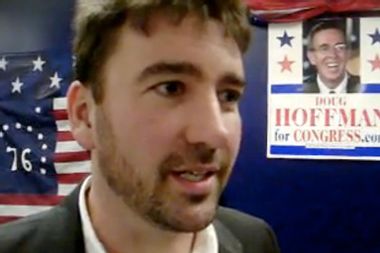
New York's 23rd District House race candidate Doug Hoffman speaks to the press in Syracuse, N.Y., on Oct. 29.

WASHINGTON -- The whole thing may have started with a rainy April rally in Washington's Lafayette Park. But by the time the first wave of elections since President Obama took office are over, Tuesday could wind up being the day the Tea Party movement left the fringe and went mainstream. (Or at least mainstream-ish.)

Grass-roots conservatives are crowing already about a House special election in New York's 23rd District, mostly because a national movement forced out the Republican Party's officially endorsed candidate, Dede Scozzafava, in favor of a more ideologically pure choice, Doug Hoffman. Polls show Hoffman is now likely to beat Democrat Bill Owens, even though Scozzafava wound up endorsing the Democrat. The lesson the Tea Party types are taking from all this? They won the battle for the soul of the GOP.

"Conservatives are awake," said Fox News Channel's Glenn Beck on his show Monday. "This is an example of a Republican Party apparatus that is wildly out of touch with its base," said Marjorie Dannenfelser, president of the Susan B. Anthony List, a Bizarro version of EMILY's List that usually supports conservative women who oppose abortion rights, but strongly backed Hoffman in the New York race. "This will bring about more conversation and potentially more cooperation -- or there will be some folks that don't keep their positions."

If that sounds like a threat, it's supposed to. A year after Obama was elected, the conservative base has decided the answer to the GOP's problems is to purge the party of any shred of moderate impulses. The likely results of two other high-profile elections Tuesday won't do much to change that; conservative Bob McDonnell is expected to win Virginia's gubernatorial race, and the New Jersey race between incumbent Democrat Jon Corzine and conservative Republican Chris Christie may come down to the wire, with a more moderate independent candidate drawing off some votes. If things go well for the GOP Tuesday, they could sweep all three of the most-watched contests (and don't put it past them to claim credit for New York Mayor Mike Bloomberg, on pace to win a third term, even though he ditched the GOP brand).

Which is why establishment Republicans now seem a bit like they just discovered that the beat-up old car they've been driving actually has a hidden turbo button that triples its speed. With the party sitting on the smallest minorities in Congress it's seen in years, the GOP will take good news anywhere, even if it comes with a hefty side order of crazy. The moment Scozzafava quit the New York special election on Saturday, national Republicans rushed to endorse Hoffman. Sure, they were weeks behind the grass-roots base, but why quibble over details?

"Let your voice be heard, join the movement to bring real conservative change," a new Republican National Committee radio ad commanded upstate New York. "Tell the politicians, no more, we won't let you bankrupt America. We need conservative leaders who stand up for our values." (Strictly speaking, they couldn't say, "Vote Hoffman," because the GOP candidate, Scozzafava, is still on the ballot.)

But privately, Republican operatives were a little more wary of the surge of Tea Party-inspired support. "This was a uniquely screwy situation," one congressional GOP leadership aide said. Though the party dumped hundreds of thousands of dollars into Scozzafava's campaign, officials were quite happy to blast her once she quit the race. "Her inability to fundraise obviously created a huge vacuum," another Republican aide said. "She couldn't put herself in the position to even split the vote ... You cannot take advantage of the environment as a Republican candidate if you are for the stimulus."

That was only one of the heresies that drove the right wing away from Scozzafava, though. She was also pro-choice, and years ago, she had accepted an endorsement from the Working Families Party, which conservative bloggers have declared the political arm of a sinister ACORN-led conspiracy to lead the U.S. into socialism. The establishment GOP rush to embrace Hoffman on the eve of the vote makes things a little awkward; some of the bloggers who first touted Hoffman are now busy attacking top Republicans for not coming around sooner.

Other activists say they feel like they're just coming into the height of their influence. Jacob Roecker, the founder of 912candidates.org, one of the groups that endorsed Hoffman, said other Republicans could be in trouble next year -- look at Florida, where conservative Marco Rubio is picking up energy the way the movement that powered Hoffman did, or Roecker's own Oklahoma, where conservatives hope to challenge longtime Rep. Tom Cole, a member of the GOP House leadership. "It's not the third-party candidate spoiling the race -- it's the traditional candidates who are spoiling the race for those who actually believe in something," Roecker said about Hoffman and Scozzafava. Though the name of his group was inspired by Beck's own 9/12 Project, Roecker said it's gotten better than just one talk show host. "[Beck] can't put in enough hours during his week to keep up with what all of us are doing," he said. "I don't think it's his anymore. We still look up to him, but I don't think it's his anymore -- I think it's ours."

Meanwhile, for Democrats, the spectacle of Republican in-fighting over races the GOP is likely to win is a decent silver lining. The GOP has held the New York seat for decades; when Obama tapped the previous lawmaker, Republican John McHugh, as Army secretary, that opened up the possibility of flipping it, but it's not as if the House Democratic majority depended on winning.

And since the Democratic strategy ahead of 2010's much broader elections is basically to paint all Republicans as acolytes of Beck, it might not be the worst thing in the world if Hoffman won. "No matter who wins tomorrow, it's bad news for the Republican Party," one Democratic official said. "If the Democrat wins, then the factions within the Republican Party -- there's going to be mutual recrimination. If Hoffman wins, the extreme wing is going to be completely emboldened, and the moderate wing is going to be completely alienated and they're going to bolt."

Yes, there's a heavy dose of advance spin built into that message. Yet even if Republicans sweep Tuesday, there's also some truth mixed in. The GOP still hasn't figured out entirely how to handle life in the Obama era. But Election Day 2009 may provide a good clue for what strategy they try next.

Hoffman concedes NY-23 race -- again

The conservative favorite had retracted his concession, but won't challenge the final results

Last week, third-party candidate and eventual Republican favorite Doug Hoffman announced that he was retracting the concession he'd made on election night. The right's favorite bogeyman, ACORN, had stolen the special Congressional election and thus New York's 23rd district from him, Hoffman said.

But as absentee ballots were tallied, it quickly became clear that Hoffman had no shot at victory in the initial count, and probably couldn't win a challenge, either. So on Tuesday he conceded one last time.

In a statement noticeably free of the accusations of theft and fraud that had accompanied his un-concession, Hoffman said:

Yesterday, the remaining ballots were counted in the 23rd Congressional District special election. The results re-affirm the fact that Bill Owens won.

Since, the morning of November 4th, many of my supporters have asked me to challenge the outcome of this race. Their concerns centered on the veracity of the new voting machines used, for the first time, in the majority of the eleven counties that make up the Congressional District. Over the past three weeks, we nearly cut Bill Owens' lead in half. Sadly, that is not enough.

The shift in support since election night highlights one fact; the Boards of Elections, both state and county, need to work closely to ensure the seamless use of these machines in the 2010 statewide and midterm elections.

I would like to thank my supporters for everything they did over the past four months. They proved that average Americans can stand up and make their voices heard, all the way from Watertown to Washington. They proved that the voters are sick and tired of wasteful government spending, high taxes and an ever growing deficit. And most importantly, that when it comes to politics: principles do matter.

While we may have lost the election, this race proved that Americans are sick and tired of the status quo in both Albany and Washington.

Hoffman decision on election challenge this weekend

Victory's out of reach for now, but the conservative candidate may try to overturn the results

Doug Hoffman, the Conservative Party candidate who lost a close race in a special election for an upstate New York Congressional seat earlier this month, has already retracted the concession he made on election night. Now, though, he has to decide whether he'll try to challenge Democrat Bill Owens' win in court.

A spokesman for Hoffman, Rob Ryan, says Hoffman will be making that decision "over the weekend," according to CQ Politics' Emily Cadei.

Over the past two days, after Hoffman officially unconceded, victory in the current count has become mathematically impossible for him. The third-party candidate had hoped to gain on Owens during the tally of absentee ballots, but as the count stands now, it's actually Owens who's picked up a net of 61 votes during the process.

There was some measure of hope for Hoffman's supporters on Thursday, though, due to a report in a local publication that a virus had affected voting machines. An election watchdog has debunked that claim, however.

How the GOP got its groove back

Republicans look ahead to 2010, without bothering to figure out whether they've solved their problems first
AP
Minnesota Gov. Tim Pawlenty, left, and Mississippi Gov. Haley Barbour

CEDAR CREEK, Texas -- Finding the epicenter of the looming Republican comeback is pretty easy, at least this week. As it happens, you can drive there from Austin-Bergstrom International Airport in less than 30 minutes, and with only two turns. Once you get to the massive golf and spa complex with signs warning pedestrians and bicyclists to stay off the road, you're in the right place.

Here at a fancy resort on the outskirts of Austin, Republican governors and the corporate sponsors who love them gathered to celebrate their recent victories and look forward to what -- they're quite sure -- will be many more to come. "I was chairman of the party 16 years ago when we were last similarly situated," said Mississippi Gov. Haley Barbour, the chairman of the Republican Governors Association, who was chairman of the Republican National Committee when the GOP swept to control of Congress in the 1994 elections. "This feels better this early than it did then."

Win a couple of odd-year gubernatorial contests, it turns out, and the future suddenly looks a lot brighter. Bright enough, in fact, that the RGA had no problem Thursday morning showing attendees a "Saturday Night Live" clip spoofing Fox News Channel's coverage of the 2009 elections. The point of the skit was that the GOP and its friends at Fox were delusional, giddily declaring the 2008 elections overturned on the basis of two statewide elections with low turnout -- which the speakers at the RGA conference then proceeded to come close to doing themselves. It wasn't clear how intentional the irony was.

"For all the hype, [2008] was not a transitional campaign, it was not a transitional year," GOP pollster Ed Goeas said at a panel about the 2010 elections, after promising to pick apart some of the "many" myths about President Obama's victory a year ago. "After $700 million being spent by the Obama campaign, it was not a new electorate."

That was, in essence, the message of the RGA conference: So what if the only thing voters like less than the Democrats in Congress might be the Republicans in Congress? Who cares if the GOP has been reduced to a rump minority in the House and Senate, left on the sidelines with not much more to do than root for Democrats to fight among themselves? In politics, what matters is momentum, and right now, Republicans -- and quite a few Democrats, especially in private -- think they have it.

So Bob McDonnell and Chris Christie, the winners in Virginia and New Jersey a few weeks ago, were hailed as the heralds of a new GOP majority -- a majority of governors, granted, which doesn't really mean anything in terms of being able to pass legislation or implement policy on a national scale, but a majority nonetheless. (Both winning candidates demurred when asked whether Obama fatigue had helped them to the statehouse; it was local issues that won the day, they insisted.) No one mentioned that the party in the White House almost always loses the New Jersey and Virginia elections the year after a presidential race.

And Barbour came armed with a new poll by Zogby International that showed Obama's approval ratings and reelection numbers were perilously low in states with competitive gubernatorial races on tap for next year. Hawaii Gov. Linda Lingle said there was no reason the GOP shouldn't aim to win every single state. "There's no state that we can't win," she said. "Talking to a Republican from Hawaii -- the first Republican elected in 40 years -- I'm telling you, we could win in every state."

But the most telling numbers may have been the ones Barbour touted a little later, in a press conference, after he'd shared them with governors and Republican loyalists Thursday morning. Forget the polling; what really got the RGA excited was another kind of stat. "We spent $23 million in 2006," Barbour said. "We're going to start 2010 with $25 million in the bank."

Raising and spending money is, after all, the main thing a group like the RGA does. Which is why the big "Victory Barbecue" on Wednesday night was sponsored by the Corrections Corporation of America, whose Web site proclaims it's "the private corrections management provider of choice for federal, state and local agencies." And why Indiana Gov. Mitch Daniels apologized to "the vendors in the room" for boasting of his love of bidding state contracts out using reverse auctions. Everywhere you looked, corporate sponsors popped up. A mining company, an information technology company and a supply chain logistics company teamed up with CCA and the liquor lobby to sponsor a bash at Cindy's Gone Hog Wild, a bar down the road from the conference resort. A "trunk show and fashion boutique" was set up in one hallway Thursday afternoon, so attendees could take a break from hearing about the Obama administration's nefarious healthcare reform plans to get a little shopping in. (The governors, meanwhile, headed out for some skeet and trap shooting on the resort's grounds.)

That's not to say Democrats will have it easy next year, especially if the economy doesn't recover faster. Incumbents in either party are likely to struggle; fairly heavy losses in the House and Senate are probably on the horizon, though Democrats took so many seats in 2006 and 2008 that their majority in both houses is likely safe. Midterm elections almost never bring good news for new presidents, just like the New Jersey and Virginia results.

But the GOP crowing in Texas this week doesn't mean Republicans have it all figured out again, either. The candidates on the Republican line in major races next year may include Ohio's John Kasich, who was the House Budget Committee chairman after the 1994 elections; New York's Rick Lazio, who tried, and failed, to beat Hillary Clinton for the Senate in 2000; and Iowa's Terry Branstad, whom you may have heard of because he already served as governor of the state from 1983 to 1999. That lineup doesn't exactly scream out "new and improved," no matter how much Barbour talked up the GOP comeback.

"One of the things that really does separate this Republican Party from the Republican Party of 1993 is that this one is utterly devoid of ideas," said Nathan Daschle, the executive director of the Democratic Governors Association, the RGA's counterpart. "You can say a lot of things about Newt Gingrich, you can say a lot of things about the Republican Revolution; one thing you can't say is that it lacked some kind of ideological base or agenda."

By contrast, Barbour boasted Wednesday that Republicans in New Jersey voted for a moderate, Christie, and in Virginia, they voted for a conservative, McDonnell. The main thing they had in common was their party label. As GOP governors gathered to bash the healthcare reform bill Thursday morning, they ran through the same litany of Republican "solutions" to the problem that their comrades in Washington have offered for months -- tort reform, insurance portability, tax credits. Their most famous ex-governor, meanwhile, was running around on a book tour, talking mostly to tea party types who won't exactly help win swing voters over. Minnesota Gov. Tim Pawlenty, who's supposed to be a rising star in the party and is planning a run for president in 2012, stuck to bland pronouncements as he moderated a domestic policy panel on Wednesday. "Citizens are being asked to live on the same amount of money, or less, than they did last year," he said. "They think it's reasonable that government should tighten its belt as well." No one at the conference could open his or her mouth without declaring the states to be "the laboratories of democracy" -- Louisiana Gov. Bobby Jindal must have said at least a half-dozen times that unlike Washington, states can't print their own money. It was not, all in all, a rousing display.

What next year's elections may offer increasingly alienated voters, then, could be a choice between the Democrats, complete with their infighting and chaotic majorities -- who may not have done enough yet to fix the problems that they confronted upon walking into office -- and the Republicans -- who were the ones who helped mess things up in the first place. If the RGA gathering was any evidence, though, the GOP is aiming to win that choice by default. A win, after all, is still a win.

Victory slips from Hoffman's grasp again -- blame ACORN!

It's still possible the conservative could challenge the results of a special election, but for now, he's lost

Quick! Someone look for ACORN operatives; check around every corner, under every cushion, down every alley -- they must be somewhere, because Conservative Party candidate Doug Hoffman now has no chance of winning the special Congressional election held in upstate New York earlier this month without a recount.

Late Wednesday, Hoffman retracted his concession, charging ACORN and other nefarious actors with having stolen the election from him. He'd gotten a glimmer of hope because of corrected vote totals that showed Democrat Bill Owens with a smaller margin of victory than was originally reported, and because absentee ballots hadn't yet been counted.

But Hoffman's chances of prevailing, even after the new numbers were in, were always slim. And on Thursday, victory for the conservative favorite officially became mathematically impossible: With 3,072 absentee ballots remaining uncounted, Owens led by 3,105 votes.

Hoffman's campaign hasn't ruled out the idea of challenging the results, though even his spokesman has always sounded skeptical about the idea of a comeback win.

Hoffman retracts concession, says ACORN stole election

The conservative candidate worries about "scheming behind closed doors"

The fervor in conservative ranks for an unknown candidate running in a special Congressional election in upstate New York was never really about Doug Hoffman the man, at least not as much as it was about Doug Hoffman, expression of the right's id. Who he actually was, what he actually believed and whether he had any real political skills, these were secondary questions at best, after what really mattered: He was more conservative than Dede Scozzafava, the official Republican candidate.

Hoffman and his supporters did succeed in pushing Scozzafava out of the race just days before the election was held, but on Election Day, it all seemed to be for naught, as Hoffman lost to Democrat Bill Owens.

But since then, it's become clear that vote totals in some parts of the district weren't reported accurately the night of the election, and Owens' margin of victory shrunk as a result. So now, after having been pressed by Glenn Beck, Hoffman has another chance to be that raw expression of conservative id.

In a message to supporters released Wednesday night, Hoffman officially withdrew his concession, saying he'd now work to stop the election from being stolen by a collection of nefarious figures.

An excerpt:

As evidence surfaces, we find out that reported results from election night were far from accurate. ACORN and the unions did their best to try and sway the results to Obamacare supporter Bill Owens.

I was forced to concede after receiving two pieces of grim news - - down 5,335 votes with 93 percent of the vote counted on election night - and barely won my stronghold in Oswego County. On Election Night, the information we received was far different from what we received this week!

Rest assured, they will not succeed, and I am therefore revoking my statement of concession.

That is why I am writing you today. Recent developments leave me to wonder who is scheming behind closed doors, twisting arms and stealing elections from the voters of NY-23.

I'm sure you are as dismayed as I am to learn of the mischief that took place in Oswego and neighboring counties. We know this would not be the first time for the ACORN faithful to tamper with democracy.

This is fanciful, to put it mildly. First of all, despite the corrected vote totals, it appears clear that Hoffman can't win, even after all absentee ballots have been tallied. And the accusation that ACORN is somehow behind the vote counting -- that it is working behind the scenes at election boards is just ludicrous.

The impulse on the right to see ACORN as responsible for every evil in the world has now apparently gone so far that this accusation doesn't even relate to the one usually leveled at the group, that it's working to register non-existent voters in order to cast fraudulent votes in favor of Democrats. (That accusation, too, is false.) Beyond that, there's this simple thing to remember about ACORN: It works in urban areas. The district in which Hoffman ran is decidedly not ACORN territory.

Does Sarah Palin make GOP governors nervous?

The two newest Republican governors offer weak explanations for why they didn't campaign with the former Alaska one

CEDAR CREEK, Texas -- Republican governors gathered outside Austin Wednesday to crow about their two newest colleagues in Virginia and New Jersey. But one of their newest ex-colleagues was also busy Wednesday, kicking off her book tour. And like anywhere in politics lately, Sarah Palin was inescapable at the Republican Governors Association meeting.

Both of the GOP candidates who won gubernatorial elections this month, Bob McDonnell in Virginia and Chris Christie in New Jersey, had avoided Palin during their campaigns. And yet the crowd she drew for a book event in Grand Rapids, Mich., made it clear that Republicans can't really afford to alienate her supporters. So McDonnell and Christie offered some wan excuses for why they hadn't embraced Wasilla High School's most famous alumna as they sought office.

"The people I asked to come in to campaign for me were either someone like Mayor [Rudy] Giuliani, who I had known for the better part of a decade, or two governors who had faced the same kind of things and could talk about those issues in an intelligent way to show how Republican ideas had fixed those fiscal problems in their states," Christie said. Those two governors were Mitt Romney, the ex-governor of Massachusetts, and Minnesota's Tim Pawlenty. Presumably, Christie didn't mean to imply that Palin wouldn't have been able to talk about issues in an intelligent way.

McDonnell said it was just a matter of the schedule. "She was in such incredible demand, frankly, for the longest time we were just not able to work out anything for her to come in," he said. "And then, after she decided to leave office [in July], we had pretty much already arranged all of the folks that we had for the home stretch for fundraisers -- including several current and former governors -- so we pretty much had our strategy set at that point." Because, you know, campaigns tend to plan everything out months in advance and not make any last-minute additions to the schedule once it's set.

The RGA, though, isn't above using Palin to raise money, even if its newest members were a little wary of how the independent voters they were trying to appeal to would respond to her. Mississippi Gov. Haley Barbour, the group's chairman, told reporters Tuesday that the RGA was happy to accept Palin's offer to sell them a number of copies of her new book, "Going Rogue," at a discounted price -- the better to auction them off to donors with.

Page 1 of 8 in 2009 Elections Earliest ⇒

2009 Elections in the news

Loading...

Currently in Salon