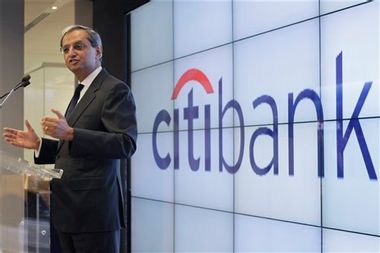
The blogosphere is having a field day with the news that Willem Buiter, the caustic London School of Economics professor who has delighted in launching blog posts like grenades throughout the course of the global financial crisis, has been named Citigroup's Chief Economist.
A staunch critic of bailouts, Buiter has been especially vicious towards Citigroup; in April he called the financial institution "a conglomeration of worst-practice from across the financial spectrum" and in June he described the decision by U.K. finance minister Alistair Darling to appoint former Citigroup CEO "Win" Bischoff to "to co-chair the writing of a report on UK international financial services" as "the most ridiculous appointment since Caligula appointed his favorite horse a consul."
I'd like to suggest my own contribution from the Buiter archives. In September 2007, Buiter took issue with what he characterized as then-Financial Times columnist Larry Summers' "never seen a potential bail out he did not like" predilection in a blog post titled "Support Markets, Not Banks."
I cannot think of a single financial institution that is too big to fail, in the sense that it would damage some systemically important social institution.... I recognize the upside of bail-outs for those who arrange them: they look like movers and shakers, making and shaping events. It's heroic, in an industry where heroism can be rarely displayed. But in all of the examples mentioned above, the bail-out did more harm than good.
So now Buiter will be taking a paycheck from one of the very biggest of the bailed-out too-big-to-fail institutions. Which means, whether he likes it or not, Buiter is being bankrolled with the support of the American taxpayer... and implicit backing of Larry Summers. If Citigroup hadn't been bailed out, would Buiter have gotten this job?
Disclaimer: I chose not to read "On the Brink," former Treasury Secretary Hank Paulson's memoir, because I suspected it would not be worth my time. After reading the early reviews, ranging from Max Abelson's annihilation of the book in the New York Observer to Daniel Gross's far more gentle treatment in the Washington Post, I feel confident I made the right call.
Gross writes that "On the Brink" provides "plenty of excellent color and detail," but "a surprising inability to see the big picture." And much of what he does tell us, we already knew. For example:
John McCain comes off worst of all: impulsive, ill-informed and counterproductive. "This was crazy," Paulson writes of McCain's decision to suspend his campaign in late September 2008 and demand a White House meeting on the bailout. At the climactic meeting in the Cabinet room, Obama spoke for the Democrats, delivering a "thoughtful, well-prepared presentation." But McCain? "When it came right down to it, he had little to say in the forum he himself had called."
We waited a year and a half for an insight that was apparent the week it happened?
Abelson observes that "On the Brink" "gives the spectacularly unsettling sense that world history is decided by an assortment of guys who are improvising, and may not be particularly good at it." This almost makes me think the book might be worth reading, after all, because understanding the improvisational nature of reality might be unsettling, but is also important. Nobody's got a plan -- they're just making it up as they go along!
But the kicker does not lend itself to enthusiasm:
Not only did Mr. Paulson "not have time for regret, recriminations, or second-guessing," but he doesn't use the newfound power of hindsight.... Surely he has more sophisticated and subtle insights into the ugliness of American finance, but he keeps them to himself. "
But if you are in the mood for a good, long, meaty read, I second Felix Salmon's recommendation to read Moe Tkacik's opus distilling the essence of the financial crisis in The Baffler.
Tkacik pulls together elements of 13 different books (but not including "On the Brink") on the crisis into a masterpiece, and I say this not just because she coins the phrase, "soft bigotry of subprime moral standards." She does a really good job of trying to figure out what it all means, and finishes with a great flourish.
And that is why so many journalists, economists, intellectuals and financiers now scramble to churn out books that for the most part read like the memoirs of people trying to make themselves feel less stupid. The current financial system was constructed to make us all feel stupid, and in the process of building it the architects allowed themselves to become stupid as well. That ignorance begat infantilization, which bred cowardice and systemic moral decay. The only sustainable way out is to reacquaint ourselves and our fellow citizens with the wisdom of asking stupid questions.
Richard Shelby, the ranking Republican member of the Senate Banking Committee, responds to Chris Dodd's declaration of of reaching an "impasse" in his efforts to craft bipartisan consensus on financial regulatory reform.
"There are two bedrock principles on which I will not compromise: the safety and soundness of the financial system and taxpayer protection against bailouts. I fully support enhancing both consumer protection and safety and soundness regulation. I will not support a bill that enhances one at the expense of the other, however. In order to strike the appropriate balance they must be integrated with each other, not separated from each other.
"Consumer protection is not the only issue that remains unresolved. We must craft a resolution regime that ensures taxpayers will never again bear the losses for risks taken in the private marketplace. I will not agree to any legislation until I am satisfied this goal is also achieved. "
The smartest thing to do would be dismiss Shelby's statement as mere boilerplate. Who could disagree with the principle that taxpayers never again bear the costs of bailing out Wall Street? Heck, if that's all that slowing progress down, I'm sure good men and women of sturdy resolve can come up with a satisfactory solution.
However, as Simon Johnson never tires of reminding us, simply coming up with a "resolution regime" for financial institutions run amok isn't going to solve the fundamental problem of having too-big-to-fail banks in the first place. If they're too big to fail, no "resolution authority" is going to simply wave away the damage that their collapse will do to the larger economy, no matter how smoothly their dissolution is handled. If we want to keep taxpayers from footing the bill, then we've got to reduce the size and interconnectedness of these institutions. But that, alas, doesn't seem to be the kind of thing that either Democrats or Republicans have the stomach for.
In the grand tradition of his predecessor Eliot Spitzer, New York State Attorney General Andrew Cuomo is generating tons of publicity by whacking Wall Street with a big fat stick. But even if you are predisposed to dismiss the civil fraud suit his office filed Thursday against former Bank of America CEO Kenneth Lewis and former chief financial officer Joseph Price as political grandstanding designed to smooth Cuomo's path into the governor's mansion this November, the 90-page lawsuit still makes for some great reading.
We've got BofA executives, in sworn testimony, directly contradicting previous sworn testimony and then failing to "recollect" their earlier conversations with state investigators. That's kind of ballsy. We've got a BofA treasurer worriedly telling CFO Price that he didn't want to be talking some day in the future about the topic they were then discussing -- huge losses at Merrill Lynch -- "through a glass wall over a telephone." And we've got a mysterious smoking gun: the summary firing, without explanation, immediately following a shareholder's vote to approve BofA's acquisition of Merrill, of BofA's general counsel Tim Mayopoulos; the man, as described in the suit, "who knew too much."
The lawsuit charges Lewis and Price with a dazzling switcheroo.
In order to complete its deal [to acquire Merrill Lynch], Bank of America's management misled its shareholders by not disclosing massive losses that were mounting at Merrill Lynch so that the shareholders would vote to approve the deal. Once the deal was approved, Bank of America's management manipulated the federal government into saving the deal with billions in taxpayer funds by falsely claiming that they intended to back out of the deal through a clause in the Merger Agreement.
If true, that's a nice piece of work. First you hide the extent of how badly Merrill is hemorrhaging cash, so as to avoid scaring off your shareholders. Then, just one week later, you tell the federal government to fork over a cool $20 billion or you'll try to walk away from the deal. Making the matter even messier, you fire the guy most likely to advise that you should have disclosed Merrill's losses before the vote, and there's a paper trail indicating that your lawyers had advised you that you most likely would not be able to get out of the deal citing the Merger Agreement clause mentioned above. So, basically, you lied to your shareholders and then extorted the government with a brazen bluff.
On the disclosure issue, judging by the facts detailed in the complaint, Cuomo's case looks strong. There was ample evidence in the week before the shareholder's vote that Merrill's losses were accumulating at a startling pace. Mayopoulos told investigators that after consulting outside counsel, he had recommended disclosure, but then had changed his mind after becoming convinced that Merrill's probable losses were not out of range of what they had been over the past year. But the lawsuit alleges that Price and Lewis kept him in the dark as to the rapidly worsening state of Merrill's finances. And shortly after Mayopoulos found out how bad the numbers really were, he was fired.
Oddly, CFO Price can't remember a crucial meeting in which Mayopoulos recalls discussing the disclosure issue:
Question: On Monday, December 1st there is an entry for 2:00 with Tim Mayopoulos and Greg Curl. Do you recall that conversation looking at your calendar of that meeting?
Price: I do not recall the specifics of that one.
Question: Do you know if it related to Merrill Lynch?
Price: I don't recall.
Question: Do you know if disclosure issues regarding Merrill Lynch came up at that meeting with Mr. Curl and Mr. Mayopoulos?
Price: I don't recollect the meeting.
Call me cynical, but Mr. Price sounds like a man with something to hide. Gregory Curl, BofA's head of corporate development, does Price one better.
Question: How is it that in April you testified that you had a specific conversation with Mr. Herlihy about disclosure, and today you testified about none?
Curl: I don't recall that conversation about disclosure.
Question: Earlier today, on the topic of disclosure, you said, "That's not part of my world," correct?
Curl: Correct.
Question: How was it part of your world on April 10, 2008, when you testified about it?
Curl: I don't recall the conversation on December 3rd. I may have been mistaken. I don't recall that conversation on the 3rd.
It's one thing to have a fuzzy memory of a meeting or a phone call. It's another thing to contradict your own previous sworn testimony with a sudden bout of forgetfulness.
So what about the second part of the story -- the attempt to strong-arm the feds? Ken Lewis' story is that Merrill's losses didn't start to accelerate wildly out of control until the week after the shareholder's vote. Here's where the case gets a bit murky. BofA's position is that Merrill reported an addition $7 billion in losses in the week after the vote. But the lawsuit claims Merrill only registered $1.4 billion in new losses during that week. I foresee plenty of billable lawyer's hours accumulating while settling that question.
Almost lost in the narrative is one of the most shocking aspects of the whole affair. Just before the shareholder vote, Merrill accelerated paying out a mind-boggling $3.57 billion in bonuses -- to reward employees for the worst year in Merrill's history.
On top of everything, the Bank failed to tell its shareholders that, in addition to buying a company that would have destroyed the Bank without taxpayer aid, it was going to permit that company to pay the $3.57 billion in bonuses in a manner and at a time completely inconsistent with its prior practice.
The closing months of 2008 were a crazy time when all kinds of decisions, by both government officials and financial institution executives, were being made ad hoc and on the fly, on little sleep and under incredible pressure. One can even argue that despite the alleged fraud and extortion, the right outcome occurred -- if Merrill Lynch had not been bought by Bank of America, it surely would have followed Lehman down the drain, further imperiling the global economy.
But that's hardly an excuse for failing to disclose pertinent financial information to your shareholders, or attempting to squeeze the federal government during a moment of great national economic peril. It will be very interesting to see how this case proceeds.
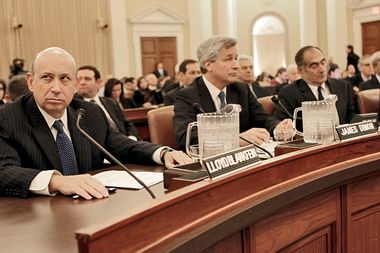
Senator Chris Dodd, the chairman of the Senate Banking Committee, scolded Wall Street representatives at a hearing Thursday for sending “an army of lobbyists whose only mission is to kill the common-sense financial reforms” needed by the public. “The fact is,” Dodd said, “I am frustrated, and so are the American people.” He charged that Wall Street’s intransigence was the reason for Congress’s failure to pass any bill to regulate the Street. “The refusal of large financial firms to work constructively with Congress on this effort borders on insulting to the American people who have lost so much in this crisis.”
In other words, it isn’t Congress’s fault. It isn’t the Senate Banking Committee’s fault. It certainly isn’t Dodd’s fault. The reason more than a year has passed since the biggest bailout in the history of the world and nothing has been done to prevent a repeat performance -- even as the biggest banks are doling out more than $30 billion of bonuses, even as Goldman Sachs is awarding its big traders $16 billion in bonuses (more than the $13 billion Goldman collected from taxpayers via the bailout of AIG), even as AIG itself is handing out bonuses -- the reason is … what, exactly, Senator? Because the Street has sent an army of lobbyists to Capitol Hill?
Call me old-fashioned, but I thought Congress was in charge of passing legislation, not Wall Street.
Dodd left out the most telling detail, of course. Wall Street is where the campaign money is. Dodd of all people knows that. He’s been on the receiving end of lots of it over the years.
Wall Street firms and their executives have been uniquely generous to both political parties, emerging recently as one of the largest benefactors of the Democratic Party. Between November 2008 and November 2009, Wall Street firms and executives handed out $42 million to lawmakers, mostly to members of the House and Senate banking committees and House and Senate leaders. During the 2008 elections, Wall Street showered Democratic candidates with well over $88 million and Republicans with over $67 million, putting the Street right up there with the insurance industry as among the nation’s largest equal-opportunity donors.
Some Democrats are quietly grumbling that all the tough talk emanating from the White House in recent weeks -- the President calling the Street’s denizens “fat cats” and threatening them with limits on their size and the risks they can take, even waiving a watered-down version of Glass-Steagall in their faces -- is making it harder to collect money from the Street this mid-term election year. And the Street is quietly threatening that it may well give Republicans more, if the saber-rattling doesn’t stop.
Congress isn’t doing a thing about Wall Street because it’s in the pocket of Wall Street. Dodd’s outburst at the Street is like the alcoholic who screams at a bartender “how dare you give me another drink when all I’ve done is pleaded with you for one!”
Dodd is right about one thing. The American people are frustrated, and the failure of Congress to pass real financial reform is insulting. But in trying to place responsibility for this appalling failure on Wall Street, Dodd insults us even more.
Executives in AIG's financial products division are getting $100 million richer, and the White House pay czar calls the bonuses "outrageous."
However, Kenneth Feinberg said the payments are contractual obligations entered into years ago. And he pointed out that AIG executives have pledged to repay $39 million out of $45 million in previous bonuses to the U.S. Treasury.
The insurance giant was hit hard by Wall Street's meltdown in 2008 and still hasn't repaid all of the $180 billion the government gave to rescue it from financial disaster. Feinberg told ABC's "Good Morning America" on Wednesday that he is using whatever leverage he has to get that money returned to the taxpayers.
Feinberg said the contracts that obligate the company to pay the bonuses expire in March.
Banks borrowed less from the Federal Reserve's emergency lending program over the past week, another sign that strains on private credit markets are easing.
Commercial banks averaged $14.86 billion in daily borrowing for the week that ended Wednesday, the Fed reported. That was down from $15.1 billion in average borrowing for the previous week.
Banks have been scaling back their use of the Fed's emergency discount loan window as the financial crisis has eased. At the peak of the crisis, which struck with force in the fall of 2008, banks' daily borrowing from the discount window reached $110 billion as banks found their normal sources of credit frozen.
We own the banks. Now what do we do with them?
As the majority shareholders in failing banks, the American public should push management to cut executive compensation and make more loans to Main Street.
By Robert Reich, Salon
Who caused the economic crisis?
Economist Simon Johnson and "Obamanomics" author John Talbott say there's plenty of blame to go around.
By Simon Johnson and John Talbott, Salon
Does Obama's plan for Wall Street measure up?
Take a wild guess.
By Robert Reich, Salon
The $1 trillion game of chicken
Getting to the bottom of the government stress tests.
By Andrew Leonard, Salon
NPR's Planet Money podcast
A cogent, entertaining way to keep up with the increasingly complex financial crisis.
NPR
Bailout blues: why bank nationalization makes sense
Maybe nationalization is not such an incendiary notion after all.
By Ruth Conniff, The Progressive
The quiet coup
Recovery will fail unless we break the financial oligarchy that is blocking essential reform. And if we are to prevent a true depression, we’re running out of time.
By Simon Johnson, The Atlantic