

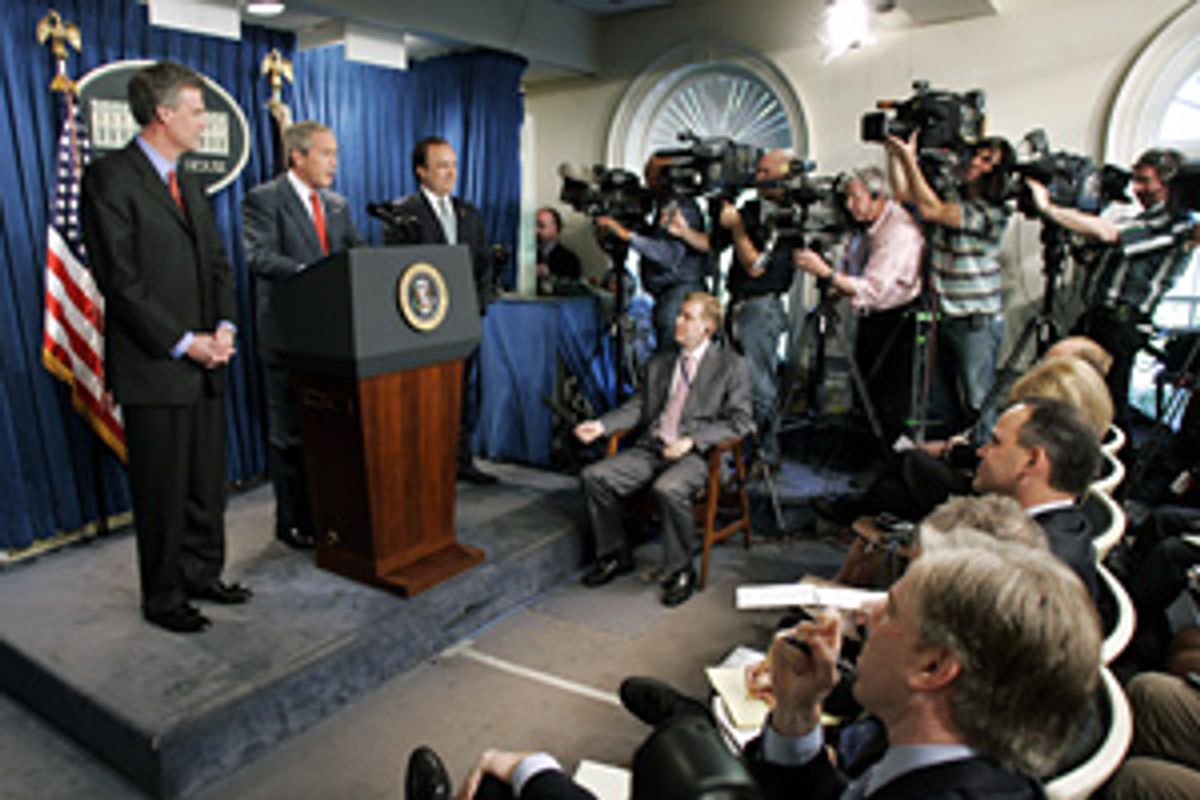
Thirteen days before he announced United States-led coalition forces had begun the war to "disarm Iraq, to free its people and to defend the world from grave danger," President Bush on the evening of March 6, 2003, strolled into the East Room of the White House at 8:02 p.m. for a rare press conference -- just his eighth since taking office. With war looming, the evening was clouded in a strange dynamic. Perhaps trying to shake off allegations of being a cowboy charging towards war, Bush appeared oddly sedate throughout the prime-time appearance, talking slowly and in a pronounced hush. His low-key approach was mirrored by the ninety-four equally somnambulant reporters assembled that night in the East Room who meekly walked through the motions with Bush.
If anxious viewers at home were hoping for some last-minute insight from Bush to help ease their doubts about the imminent war, why it had to be fought now, and why so many of the United States' longtime allies around the world refused to support it, those viewers were likely disappointed as the president stuck to his well-worn talking points ("Saddam Hussein has had twelve years to disarm. He is deceiving people"). And for any viewers who held out hope that members of the assembled mainstream media (hereafter, "MSM") would firmly, yet respectfully, press Bush for answers to tough questions about the pending invasion, they could have turned their TVs off at 8:05 p.m.
The press corps's barely-there performance that night, as reporters quietly melted into the scenery, coming at such a crucial moment in time remains an industry-wide embarrassment. Laying out the reasons for war, Bush that night mentioned al-Qaida and the terrorist attacks of September 11 thirteen times in less than an hour, yet not a single journalist challenged the presumed connection Bush was making between al-Qaida and Iraq, despite the fact that intelligence sources had publicly questioned any such association. And during the Q&A session, nobody bothered to ask Bush about the elusive Osama bin Laden, the terrorist mastermind whom Bush had vowed to capture. Follow-up questions were nonexistent, which only encouraged Bush to give answers to questions he was not asked.
At one point while making his way through the press questioners, Bush awkwardly referred to a list of reporters whom he was instructed to call on. "This is scripted," he joked. The press laughed. But Bush meant it was scripted, literally. White House spokesman Ari Fleischer later admitted he compiled Bush's cheat sheet, which made sure he did not call on reporters from some prominent outlets like Time, Newsweek, USA Today, or the Washington Post. Yet even after Bush announced the event was "scripted," reporters, either embarrassed for Bush or embarrassed for themselves, continued to play the part of eager participants at a spontaneous news conference, shooting their hands up in the air in hopes of getting Bush's attention. For TV viewers it certainly looked like an actual press event.
That was not the night's only oddly scripted moment. Before the cameras went live, White House handlers, in a highly unusual move, marched veteran reporters to their seats in the East Room, two-by-two, like school children being led onto the stage for the annual holiday pageant. The White House was taking no chances with the choreography. Looking back on the night, New York Times White House correspondent Elisabeth Bumiller defended the press corps' timid behavior: "I think we were very deferential because ... it's live, it's very intense, it's frightening to stand up there. Think about it, you' re standing up on prime-time live TV asking the president of the United States a question when the country's about to go to war," she told students at Towson University in Maryland. "There was a very serious, somber tone that evening, and no one wanted to get into an argument with the president at this very serious time."
It's unlikely viewers expected "an argument" that night in the East Room. But what about simply asking pointed questions and firmly requesting a direct response? On March 6, even that was beyond the media's grasp. The entire press conference performance was a farce -- the staging, the seating, the questions, the order, and the answers. Nothing about it was real or truly informative. It was, nonetheless, unintentionally revealing. Not revealing about the war, Bush's rationale, or about the bloody, sustained conflict that was about to be unleashed inside Iraq. Reporters helped shed virtually no light on those key issues. Instead, the calculated kabuki press conference, stage-managed by the White House employing the nation's most elite reporters as high-profile extras, did reveal what viewers needed to know about the mind-set of the MSM on the eve of war.
And for viewers that night who didn't get a strong enough sense of just how obediently in-step the press corps was with the White House, there was the televised post-press conference analysis. On MSNBC, for instance, "Hardball's" Chris Matthews hosted a full hour of discussion. In order to get a wide array of opinion, he invited a pro-war Republican senator (Saxby Chambliss, from Georgia), a pro-war former Secretary of State (Lawrence Eagleburger), a pro-war retired Army general (Montgomery Meigs), pro-war retired Air Force general (Buster Glosson), a pro-war Republican pollster (Frank Luntz), as well as, for the sake of balance, somebody who, twenty-five years earlier, once worked in Jimmy Carter's White House (Pat Caddell).
Battered by accusations of a liberal bias and determined to prove their conservative critics wrong, the press during the run-up to the war -- timid, deferential, unsure, cautious, and often intentionally unthinking -- came as close as possible to abdicating its reason for existing in the first place, which is to accurately inform citizens, particularly during times of great national interest. Indeed, the MSM's failings were all the more important because of the unusually influential role they played in advance of the war-of-choice with Iraq. "When America has been attacked -- at Pearl Harbor, or as on September 11 -- the government needed merely to tell the people that it was our duty to respond, and the people rightly conferred their authority," noted Harold Meyerson in the American Prospect magazine. "But a war of choice is a different matter entirely. In that circumstance, the people will ask why. The people will need to be convinced that their sons and daughters and husbands and wives should go halfway around the world to fight a nemesis that they didn't really know was a nemesis."
It's not fair to suggest the MSM alone convinced Americans to send some sons and daughter to fight. But the press went out of its way to tell a pleasing, administration-friendly tale about the pending war. In truth, Bush never could have ordered the invasion of Iraq -- never could have sold the idea at home -- if it weren't for the help he received from the MSM, and particularly the stamp of approval he received from so-called liberal media institutions such as the Washington Post, which in February of 2003 alone, editorialized in favor of war nine times. (Between September 2002 and February 2003, the paper editorialized twenty-six times in favor of the war.) The Post had plenty of company from the liberal East Coast media cabal, with high-profile columnists and editors -- the newfound liberal hawks -- at the New Yorker, Newsweek, Time, the New York Times, the New Republic and elsewhere all signing on for a war of preemption. By the time the invasion began, the de facto position among the Beltway chattering class was clearly one that backed Bush and favored war. Years later the New York Times Magazine wrote that most "journalists in Washington found it almost inconceivable, even during the period before a fiercely contested midterm election [in 2002], that the intelligence used to justify the war might simply be invented." Hollywood peace activists could conceive it, but serious Beltway journalists could not? That's hard to believe. More likely journalists could conceive it but, understanding the MSM unspoken guidelines -- both social and political -- were too timid to express it at the time of war.
To oppose the invasion vocally was to be outside the media mainstream and to invite scorn. Like some nervous Democratic members of Congress right before the war, MSM journalists and pundits seemed to scramble for political cover so as to not subject themselves to conservative catcalls. One year later, a pro-war writer for Slate conceded he was "embarrassed" by his support for the ill-fated invasion but he insisted, "you've got to take risks." But supporting the war posed no professional risk. The only MSM risks taken at the time of the invasion were by pundits who staked out an unambiguous position in opposing the war. Bush's rationale for war -- Saddam Hussein, sitting on a swelling stockpile of weapons of mass destruction, posing a grave and imminent threat to America -- turned out to be untrue. And for that, the press must shoulder some blame. Because the MSM not only failed to ask pressing questions, or raise serious doubts about the White House's controversial WMD assertion, but in some high-profile instances, such as with Judith Miller's reporting for the New York Times, the MSM were responsible for spreading the White House deceptions about Saddam's alleged stockpile; they were guilty of "incestuous amplification," as former Florida senator Senator Bob Graham called it. Being meek and timid and dictating administration spin amidst a wartime culture is one thing. But to be actively engaged in the spin, to give it a louder and more hysterical voice, is something else all together. In fact, the compliant press repeated almost every administration claim about the threat posed to America by Saddam. The fact that virtually every one of those claims turned out to be false only added to the media's malpractice.
And when not playing up the threat of WMDs in 2002 and 2003, the press was busy playing down the significance of peace activists and war doubters, as the MSM instead handed over the press platform at times exclusively to pro-war drum beaters and government talking heads. The White House could not have asked for more. Of course, by March 2003, the White House had already become accustomed to having a compliant press diligently detail each and every one of the administration's War on Terror warnings, warnings that played to Bush's political strength by casting him as a wartime leader and warnings that almost always fell into the less-than-meets-the-eye category. The often overblown MSM reporting on terror threats, fed directly from the White House, segued right into the overblown reporting on Saddam's deadly arsenal, also fed directly from the White House. The latter would not have been possible without the former. The press's timid War on Terror coverage foreshadowed its timid WMD coverage.
As Washington Post ombudsman Michael Getler later wrote, the MSM's performance in 2002 and 2003 -- its inability and refusal to demand sharp answers to difficult questions about prewar intelligence -- likely represented their most crucial newsroom failing in nearly half a century. "How did a country on the leading edge of the information age get this so wrong and express so little skepticism and challenge?" asked Getler. "How did an entire system of government and a free press set out on a search for something and fail to notice, or even warn us in a timely or prominent way, that it wasn't or might not be there?" The single-word answer is, timidity.
Looking back, bigfoot journalists conceded they failed to do their jobs during the run-up to war. ABC's Ted Koppel admitted, "If anything, what we've been criticized for, and probably more justifiably, is that we were too timid before the war." Dan Rather agreed: "We did not do our job of pressing and asking enough questions often enough." They weren't the only ones disappointed. A majority of Americans thought the news media could have done a better job informing the public about Iraq and the stakes involved in going to war, according to an August 2005 survey conducted by the McCormick Tribune Foundation in Chicago.
While some journalists admitted their mistakes, most refused to admit it was political pressure from the right and a fear of being labeled unpatriotic that fueled the timidity. Instead, journalists offered up head-scratching explanations for their timorous prewar performance. PBS's Jim Lehrer suggested journalists just weren't smart enough to have foreseen all the troubles that would plague Iraq following the invasion. Appearing on MSNBC's "Hardball," Lehrer was asked by host Matthews about the press's wartime performance. Matthews noted, "During [the] course of the war, there was a lot of snap-to-it coverage. We' re at war. We have to root for the country to some extent. You' re not supposed to be too aggressively critical of a country at combat, especially when it's your own." Matthews asked Lehrer if he thought the press had failed to provide "critical analysis" in the months before the war.
Lehrer: I do. The word "occupation," keep in mind, Chris, was never mentioned in the run-up to the war. It was "liberation." So as a consequence, those of us in journalism never even looked at the issue of occupation.
Matthews: Because?
Lehrer: Because it just didn't occur to us. We weren't smart enough to do it. I agree. I think it was a dereliction of our -- in retrospective.
It never occurred to journalists that the United States might have to effectively occupy Iraq in the wake of the invasion? That's just not believable. It's far more likely journalists were too anxious to express their doubts during the drum-beating of early 2003. Lehrer later returned to the topic, suggesting even if journalists had been smart enough to figure out the occupation angle, it still would have been hard to report it out:
Lehrer: It would have been difficult to have had debates about that going in, when the president and the government of the -- it's not talking about "occupation." They're talking about -- it would have been -- it would have taken some -- you'd have had to have gone against the grain.
"Could 'courage' be the word Lehrer sought?" asked the Daily Howler. "Did he want to say: 'It would have taken some courage' " for the nation's press to have gone against the grain.
Equally odd, Washington Post columnist David Ignatius, looking back on the press's failings with regards to Iraq, suggested, "The media were victims of their own professionalism. Because there was little criticism of the war from prominent Democrats and foreign policy analysts, journalistic rules meant we shouldn't create a debate on our own."
Little criticism of the war from prominent Democrats? In a sense, Ignatius was right and for Post readers that statement may have had a ring of truth to it simply because the Post seemed to do such a masterful job of ignoring prewar criticism from prominent Democrats, like party stalwart Senator Ted Kennedy. In September 2002 he made a passionate, provocative, and newsworthy speech raising all sorts of doubts about the war. It garnered exactly one sentence -- thirty-six words total -- of coverage from the Post, which in 2002 printed more than a thousand articles and columns, totaling perhaps 1 million words about Iraq, but only set aside thirty-six words for Kennedy's antiwar cry. As for Ignatius's suggestions that journalists were supposed to wait to be signaled by the political parties before leaping into action -- that reporters and pundits couldn't raise doubts about the war because Democrats, supposedly, were not -- that represented an entirely new standard for news gathering. Or did Bob Woodward and Carl Bernstein wait for Democrats to raise doubts about Watergate before the duo started making calls?
When the Post was not downplaying criticism from Democrats, it was downplaying the warnings from respected foreign policy analysts, and even decorated generals. On October 10, 2002, retired Marine General Anthony Zinni, the former head of Central Command for U.S. forces in the Middle East, delivered a keynote address at a Washington think tank where he outlined his grave concerns about the Bush administration's war with Iraq. Among the key points made by Zinni, who endorsed Bush during the 2000 campaign and whom Bush then handpicked to serve as the United States' envoy to the Middle East, was that war with Iraq should not be the United States's top priority. "I'm not convinced we need to do this now," said Zinni. "I believe that [Saddam] can be deterred and is containable at this moment." How did the Post play the antiwar speech by one of the administration's own senior officials? It set aside 336 words, which were tucked away on page 16. (One year later Zinni spoke before the U.S. Naval Institute and the Marine Corps Association, undressed the administration for its bungled handling of the war, and famously described its misguided preemptive war effort as "a brain fart of an idea." The Washington Post declined to cover those remarks.)
Zinni was hardly alone in getting snubbed. A survey conducted by the liberal media watchdog group Fairness and Accuracy in Reporting focused on the first two weeks of February, 2003, when the debate about the war should have been raging on the public airwaves. The survey found that of 393 people interviewed on-camera for network news reports about the war, just 6 percent were people who expressed skepticism about the looming invasion. Keep in mind, at that time a majority of Americans -- 61 percent according to one national poll -- expressed some skepticism over the war; specifically favoring diplomacy over invasion. But on television, the narrative was quite different. Additionally, according to Media Matters for America, 23 percent of U.S. senators voted to oppose the war in the fall of 2002, but only 11 percent of the senators invited to appear on the Sunday morning talk shows prior to the invasion were antiwar.
Then again it should not have been surprising that most guests invited by MSM producers to discuss the war on television were in favor of it, since so many of the experts were on the government payroll themselves. According to figures from media analyst Andrew Tyndall, of the 414 Iraq stories broadcast on NBC, ABC, and CBS from September 2002 until February 2003, almost all the stories could be traced back to sources from the White House, the Pentagon, or the State Department. Only 34 stories, or just 8 percent, were of independent origin.
Independence did not seem to be a trait held in particularly high regard by the MSM at the time. Prior to the invasion of Iraq, CNN's then-news chief Eason Jordan took the extraordinary step of making sure he received a personal okay from Pentagon officials regarding the retired military officers CNN planned to use as on-air commentators for its war coverage. As Jordan explained it, "I went to the Pentagon myself several times before the war started and met with important people there and said, for instance, at CNN, 'Here are the generals we're thinking of retaining to advise us on the air and off about the war.' And we got a big thumbs-up on all of them. That was important."
MSNBC was so nervous about employing an on-air liberal host opposing Bush's ordered invasion that it fired Phil Donahue preemptively in 2003, after an internal memo pointed out the legendary talk show host presented "a difficult public face for NBC in a time of war." MSNBC executives would not confirm -- nor deny -- the existence of the report, which stressed the corporate discomfort Donahue's show might present if it opposed the war while "at the same time our competitors are waving the flag at every opportunity." By canning Donahue, MSNBC made sure that cable viewers had no place to turn for a nightly opinion program whose host forcefully questioned the invasion. The irony was that at the time of Donahue's firing one month before bombs started falling on Baghdad, MSNBC officials cited the host's weak ratings as the reason for the change. In truth, Donahue was beating out Chris Matthews as MSNBC's highest-rated host.
Newspapers played it safe, too. In 2003 the Columbia Journalism Review called around to letters-page editors to gauge reader response to the looming war in Iraq and was told that at The Tennessean in Nashville letters were running 70 percent against the war, but that the newspaper was trying to run as many pro-war letters as possible in order to avoid accusations of bias.
Indeed, between the time Bush first included Iraq as part of the "axis of evil" in January 2002, and the time the invasion commenced in March 2003, the MSM didn't seem to know how to cover those who opposed the war. The press just wanted the protesters to go away. Maybe because, as influential broadcast news consulting firm Frank N. Magid Associates informed its clients, covering antiwar protesters turned off news consumers, according to its survey. On October 26, 2004, antiwar protesters staged a massive rally in Washington, D.C., drawing more than 100,000 people from across the country. The next day in a small piece on page 8 that was accompanied by a photo larger than the article itself, the New York Times reported falsely that "fewer people attended than organizers had said they hoped for." Two days later, scrambling to fix the article's obvious error, yet at the same time refusing to run an actual correction, the Times published a second, sort of do-over article about the rally. As historian Todd Gitlin noted, "the Times ran a rare nonapology apology story under the peculiarly passive headline, "Rally in Washington Is Said to Invigorate the Antiwar Movement," stating that the demonstration had drawn "100,000 by police estimates and 200,000 by organizers" this time declaring that the numbers "startled even organizers."
Meanwhile, editors at the Washington Post seemed similarly unsure how to handle the October 2004 outpouring of antiwar sentiment in its backyard, as the newspaper dramatically downplayed the story. The Post's ombudsman Michael Getler was not impressed. "Last Saturday, some 100,000 people, and possibly more, gathered in downtown Washington to protest against possible U.S. military action against Iraq," he wrote. "The Post did not put the story on the front page Sunday. It put it halfway down the front page of the Metro section, with a couple of ho-hum photographs that captured the protest's fringe elements." Months later Getler detailed the Post's laundry list of misses when it came to covering the antiwar movement or even noteworthy displays of war doubt. The list is worth reading in full, while keeping in mind the extraordinary resources the Post devoted to covering the war story, albeit only certain parts of the war story:
"The [missed opportunities] started last August with the failure to record promptly the doubts of then-House Majority Leader Richard K. Armey (R-Tex.) and of Brent Scowcroft, the first President Bush's national security adviser. The first public hearings on the implications of war, held by the Senate Foreign Relations Committee, got just a few paragraphs at the end of stories. In September, there was no spot coverage of the testimony of three retired four-star generals before the Senate Armed Services Committee warning against an attack without exhausting diplomatic options and gaining United Nations backing. Soon after, a widely reported speech by Sen. Edward M. Kennedy (D-Mass.) got one line in The Post, and large antiwar rallies in London and Rome went unreported the next day. In October, when more than 100,000 people gathered in Washington to protest war, the paper put the story in the Metro section. Then came complaints that a major speech by Sen. Robert C. Byrd (D-W.Va.), one of the few senators who has taken a strong antiwar position, was missed and that the story about the most recent bin Laden audiotape failed to point out bin Laden's description of Iraqi leaders as "infidels." An overflow town meeting on war policy in Alexandria was missed. A rare story last month estimating the cost of the war, which was front-page news elsewhere, ran on Page A19. The congressional testimony the following day of Deputy Defense Secretary Paul D. Wolfowitz, who discounted those cost estimates and who described as "wildly off the mark" previous testimony by the Army chief of staff that hundreds of thousands of troops might be needed for occupation duty, was not reported."
The MSM's awkward look-the-other-way approach to peace activists extended for years. In August 2005 Cindy Sheehan, a mother from Vacaville, California, whose son Casey was killed while serving in Iraq, set up a bring-the-troops-home vigil in Crawford, Texas, as Bush relaxed during his five-week vacation. On August 8, and one week into her campaign, the New York Times profiled Sheehan, reporting that much to the White House's chagrin, she and her antiwar protest had been "transformed into a news media phenomenon."
But had she really? The story certainly seemed compelling; an angry mom camped out on the side of the road in the 100 degree Texas heat waiting out a reluctant president who refused to meet with her but whose caravan of Secret Service SUVs actually sped past her in a cloud of dust on the way to a GOP fundraiser. Yes, reporters took an early interest. But as had become customary since 2003 when dealing with any antiwar protest story, the press proceeded with extreme caution.
Between August 5 and August 8, the time frame during which the Times called Sheehan a "phenomenon," here's how many times "Cindy Sheehan" was mentioned on CNN: eight. Between August 5 and August 8, here's how many times "Britney Spears" was mentioned on CNN: eighteen.
During the second and third weeks of August the MSM did increase its coverage of Sheehan's protest, as her antiwar camp quickly swelled in size to include hundreds of fellow demonstrators. (USA Today correctly described it as a "headline-grabbing national movement.") But there were still some notable MSM holdouts. For three weeks, as the protest story continued to mushroom, ABC's "Nightline" refused to touch it. ("Nightline" finally addressed the Sheehan story on August 19, giving it just seven minutes of air time.) The omission was telling because, despite the uptick in print coverage, the Sheehan story still had not crossed over into phenomenon territory for most television producers, and certainly not at network news outlets. For instance, between August 8 and August 18, ABC News aired more than fifty hours of morning and evening national news programming, but mentioned "Cindy Sheehan" just twenty-six times.
Compare that to the 2005 springtime news craze when Terri Schiavo's parents, who like Sheehan, staged a very public, and political, vigil for their child. The Schiavo story, cherished by conservatives, dominated the networks night after night. During the peak ten-day period of that saga, from March 20 to March 30, here's how many times ABC News mentioned "Terri Schiavo": 189. During that same stretch "Nightline" devoted four entire programs to the story. The message was clear: Schiavo, a right-to-life martyr (for some) was very big news, but Sheehan, an antiwar martyr (for some), was not.
As Sheehan's star rose through August, so did the right-wing attacks. As nervous Bush supporters watched the president's approval rating slide, they unleashed their wrath on Sheehan, labeling the mourning mom a "crazy," "anti-Semite," "left-wing moonbat," "crackpot" whose behavior bordered on "treasonous" and who was nothing more than a "hysterical noncombatant." They also charged that Sheehan was a creation of the radical left, that she was being exploited, and she did not represent mainstream Americans. That kind of organized attack was to be expected from the conservative operatives. What was not expected was how easily some in the MSM absorbed those talking points for themselves. On MSNBC, Norah O'Donnell referred to the "left-wing supporters" behind Sheehan. Later she asked a guest if Sheehan had become "a tool of the left," while pressing another on whether it was wise for Sheehan to be associated with "antiwar extremists" camped out in Crawford. (At no point during the 2005 Schiavo story did an MSNBC anchor ever suggest the pro-life parents had become "tools of the right.")
The Washington Post's Dana Milbank wondered out loud if Sheehan would be remembered as a modern-day Lyndon LaRouche, the fringe political figure who's been accused of being a cult leader and fascist, and who served a prison sentence for mail fraud and tax code violations. Later that month, Milbank gave prominent display in the Post to a right-wing activist who accused Sheehan of being a communist. Meanwhile, Milbank's Post colleague Mike Allen, appearing on CBS's Face the Nation on August 21, belittled the Crawford protesters by highlighting what he considered to be the camp's fringe elements: "Right now it's PETA, hippies, Naderites." Allen conveniently left out the fact that also in attendance at the Sheehan camp were military parents whose children had also been killed while serving in Iraq.
The Atlanta Journal-Constitution printed an opinion column in which a critic of Sheehan asserted "Cindy Sheehan evidently thinks little of her deceased son." Asked if that was appropriate, even in an opinion column, to suggest a mother "thinks little" of her dead son, the Journal- Constitution's op-ed page editor David Beasley insisted the attack on Sheehan was fair game. Yet it's hard to imagine that if a prominent Georgia politician's son was killed in the line of duty the Journal-Constitution op-ed page would allow a columnist to assert that the politician thought little of his or her dead son.
At the same time several corporate-owned television stations refused to broadcast antiwar ads that Sheehan appeared in. In one ad Sheehan pleaded with Bush for a meeting and accused him of lying to the American people about Iraq's development of weapons of mass destruction and its connection to al-Qaida. An ABC affiliate in Utah owned by Clear Channel Communications informed backers their ad was an "inappropriate commercial advertisement for Salt Lake City." A CBS affiliate in Boise, Idaho, also refused to air the ad, insisting its claim that Bush lied about Iraq's WMDs was not provable. The station's action was highly unusual. As the Associated Press noted in a 2004 article about political advertising, "Stations rarely reject commercials" over a concern about accuracy.
The following month, on September 24, Sheehan helped lead a massive antiwar rally in Washington, D.C., which drew between 100,000 and 200,000 participants, making it the largest United States demonstration since the war began. Nonetheless, the event was effectively boycotted by television news outlets. Instead, CNN, Fox, and MSNBC were obsessed with providing wildly overexcited coverage of Hurricane Rita, which delivered less-than-expected damage as it came ashore in the marshlands along the Texas and Louisiana borders. Unlike Hurricane Katrina, the monster storm that decapitated New Orleans just weeks before, television news outlets struggled to find compelling images of real Rita-related devastation to justify their breathless, around-the-clock coverage, while at the same time they all but refused to even acknowledge the historic antiwar rally.
Question: If between 100,000 and 200,000 pro-war demonstrators had assembled in the nation's capital on that same September 2005 weekend and cheered Bush outside the White House, would the MSM have given them just cursory coverage, Rita or no Rita?
The night of the antiwar protest, NBC Nightly News at least managed to mention the rally on the air. Anchor Brian Williams, though, was careful to give one sentence to the antiwar protesters and one sentence to a small group of pro-war demonstrators who also gathered in Washington, D.C., that day. Antiwar forces absolutely dwarfed their pro-war counterparts but NBC news executives thought both groups deserved the same amount of coverage, with the subtext being dueling war demonstrators facing off against each other. That was a common MSM theme. CNN reported it "was a weekend of protests and counter-protests in Washington."
The MSM's ingrained timidity regarding war protesters, even in 2005, was telling because on the eve of the Sheehan-led rally, a CNN/USA Today poll revealed 67 percent of Americans disapproved of Bush's handling of the war in Iraq and 59 percent said sending troops to invade Iraq was a mistake. Both numbers represented public opinion high-water marks since the war began. Yet the press, still spooked about charges it was not being sufficiently pro-administration during a time of war, treated antiwar demonstrators with an overabundance of caution.
On Monday, September 26, when Sheehan along with 370 war protesters were arrested outside the White House, NBC's Nightly News ignored the arrests. Both the CBS and ABC nightly newscasts gave the arrests one sentence, downplaying the numbers involved. CBS reported Sheehan was arrested along with "dozens" of others. (As in, thirty dozen?) The next morning CNN, ignoring the fact that nearly four hundred people chose to be arrested in order to protest the war, reported "Sheehan and several others were arrested." [Emphasis added.]
The MSM's signature 2002-2003 timidity during the run-up to war, though, was most clearly visible in their reporting on weapons of mass destruction and the overblown prewar estimates about Iraq's firepower. The topic was absolutely essential. If the White House could prove, or at least convince most Americans, that Saddam posed an imminent danger, then the war of choice with Iraq would be easier to sell. Easier for Bush to announce, one month before the invasion, "My job is to protect the American people from further harm. I believe that Saddam Hussein is a threat to the American people." Any lingering, why-a-war-now doubts would hinder that sales pitch. In the fall of 2002 the White House needed to paint a picture of Saddam's Iraq as a country flooded with illegal chemical and biological warfare agents. The MSM was more than willing to help with the task.
A telling and comprehensive media study of the WMD coverage conducted by Center for International and Security Studies at Maryland (CISSM) and the University of Maryland and released in March 2004 concluded too many press stories simply repeated the "official line" on WMD regarding the Iraq war, and that most journalist accepted the Bush administration's linking of the War on Terror with WMDs, while at the same time failing to note that there was no precedent of terror organizations demonstrating the capacity to use WMDs. Simply put, "The American media did not play the role of checking and balancing the exercise of power that the standard theory of democracy requires," according to CISSM, which monitored WMD coverage between October 2002 and May 2003 from seven U.S. news outlets: Christian Science Monitor, Los Angeles Times, New York Times, Washington Post, Newsweek, US News & World Report, as well as NPR's "Morning Edition" and "All Things Considered."
In retrospect, NBC's Brian Williams argued the MSM had no choice but to simply repeat what administration officials were saying about Saddam's alleged WMD arsenal. "We had no independent testing authority," Williams told CNN. "We had to go with [what] the government experts and witnesses [were saying], including our own secretary of state before the United Nations." Williams's predecessor Tom Brokaw agreed, insisting, "A lot of what happened during the lead-up to [war] was unknowable." In truth, there was a long list of distinguished military and political experts who were ready and willing -- before the war began -- to illuminate NBC's viewers about the gaping holes in Bush's justification for war and what the colossal hurdles would be post-invasion. NBC anchors, though, were not overly interested in hearing from them and yet years later insisted there was no way to have known the war had been poorly thought out.
As the MSM watched Fox News post big rating numbers with its openly conservative broadcasts while at the same time journalists were being dogged by accusations of being too liberal, out of touch, and unpatriotic in a time of national crisis, pressure mounted to prove they could play nice with a Republican administration and forcefully back a war. That seemed to be particularly true at the New York Times, which knee-jerk conservatives had singled out as being too pro-peace in its reporting. Executive editor Howell Raines wanted to show his right-wing critics wrong. "According to half a dozen sources within the Times, Raines wanted to prove once and for all that he wasn't editing the paper in a way that betrayed his liberal beliefs," wrote Seth Mnookin in his 2004 Times expose, "Hard News." Mnookin quoted Doug Frantz, the former investigative editor of the Times, who recalled how "Howell Raines was eager to have articles that supported the war-mongering out of Washington. He discouraged pieces that were at odds with the administration's position on Iraq's supposed weapons of mass destruction and alleged links of al-Qaida." The New York Observer later reported, "One senior Washington bureau staffer said that as the Bush administration edged closer to invasion, the editorial climate inside The Times shifted from questioning the rationale for military action to putting the paper on a proper war footing. 'Everyone could see the war coming. The Times wanted to be out front on the biggest story,' the staffer said. 'It became the plan of attack.'"
For the administration, one cornerstone of its plan of attack was built around Iraqi defectors who told reporters wild tales about Saddam's WMDs. Shepherded to the press by Ahmad Chalabi, the unreliable, glad-handing Iraqi defector who, much to the White House's delight, conned reporters with tales of Saddam's fearsome arsenal, the defectors were greeted as truth tellers. And perhaps nowhere were their tales told more excitedly than on the front pages of the New York Times, and most often told by the sympathetic Judith Miller who stood out as the paper's go-to person for anonymous heavy security scoops and who had risen to the top of the Times's newsroom star system. Miller may have won the admiration of the Times leadership, but years prior to the war in Iraq at least one reporter with the paper voiced his distaste for Miller's unique style of pro-government reporting. According to the Washington Post, Craig Pyes, a former contract writer for the Times who teamed up with Miller for a series on al-Qaida, complained about her in a December 2000 memo to Times editors and asked that his byline not appear on one piece:
"I'm not willing to work further on this project with Judy Miller. I do not trust her work, her judgment, or her conduct. She is an advocate, and her actions threaten the integrity of the enterprise, and of everyone who works with her. ... She has turned in a draft of a story of a collective enterprise that is little more than dictation from government sources over several days, filled with unproven assertions and factual inaccuracies."
One of the Times's first high-profile, post-9/11 defector stories came on December 20, 2001, when neoconservatives inside the White House were first pressing their case for an invasion of Iraq. The article was headlined, "An Iraqi Defector Tells of Work on at Least 20 Hidden Weapon Sites." Written by Miller, the story wove the startling tale of Adnan Ihsan Saeed al-Haideri, a forty-three-year-old Iraqi who had fled his homeland in Kurdistan and who, according to Miller, "said he personally worked on renovations of secret facilities for biological, chemical, and nuclear weapons in underground wells, private villas, and under the Saddam Hussein Hospital in Baghdad as recently as a year ago." If verified, she noted, "his allegations would provide ammunition to officials within the Bush administration who have been arguing that Mr. Hussein should be driven from power partly because of his unwillingness to stop making weapons of mass destruction, despite his pledges to do so."
As James Bamford later detailed in Rolling Stone, al-Haideri was lying about his claims about Saddam. CIA officials, who had strapped al-Haideri up to polygraph tests for hours at a time, knew he was lying long before Miller ever wrote her ominous-sounding article. (The CIA did not peddle the fake al-Haideri story to Miller, Chalabi did.) Regardless of its authenticity, al-Haideri's fanciful tale, trumpeted by the Times, proved to be invaluable to the White House. Wrote Bamford:
"For months, hawks inside and outside the administration had been pressing for a preemptive attack on Iraq. Now, thanks to Miller's story, they could point to 'proof' of Saddam's 'nuclear threat.' The story was soon being trumpeted by the White House and repeated by newspapers and television networks around the world. It was the first in a long line of hyped and fraudulent stories that would eventually propel the U.S. into a war with Iraq -- the first war based almost entirely on a covert propaganda campaign targeting the media."
The administration's war architects had set up a simple, yet foolproof way to disseminate pro-war propaganda through the Times; foolproof as long as Times reporters and editors played along. Here's how one former CIA analyst described the scheme to James Moore, writing in Salon:
"The White House had a perfect deal with Miller. Chalabi is providing the Bush people with the [Saddam] information they need to support their political objectives with Iraq, and he is supplying the same material to Judy Miller. Chalabi tips her on something and then she goes to the White House, which has already heard the same thing from Chalabi, and she gets it corroborated by some insider she always describes as a 'senior administration official.'"
Round and round it went. Of course there were scores of senior intelligence officials within the administration, and specifically within the CIA, who refuted Chalabi's intelligence, but they never received the same type of airing in Miller's articles. In retrospect, Miller's Iraq reporting was in desperate need of balance, not to mention professional skepticism. Two Page One stories in particular stand out not only for being extraordinarily helpful to the White House's war efforts -- in fact, the articles appear to have been spoon-fed by government officials -- but also for being untrue.
The first arrived September 8, 2002, and was co-written with Michael Gordon. The duo were investigating the state of Iraq's arsenal and discovered that Saddam had made a bold initiative in hopes of reconstituting his nuclear weapons program. Two weeks earlier Vice President Dick Cheney announced in an August 26 speech, that "Many of us are convinced that Saddam Hussein will acquire nuclear weapons fairly soon ... and subject the United States and any other nation to nuclear blackmail." Few independent arms experts signed off on Cheney's Armageddon warning. But that's where the Times September 8 expose came in. Keep in mind that the Times article surfaced after Bush's chief of staff and former General Motors executive Andy Card had famously explained that the administration held off from trying to publicly make the case for war during the summer months of 2002 because, "From a marketing point of view, you don't introduce new products in August."
So think of the Times September 8 article as the launch commercial in the war marketing effort. And what more could the White House have asked for than the so-called liberal New York Times trumpeting on its front page a Holy Shit-type exclusive that forcefully reported, "More than a decade after Saddam Hussein agreed to give up weapons of mass destruction, Iraq has stepped up its quest for nuclear weapons and has embarked on a worldwide hunt for materials to make an atomic bomb, Bush administration officials said today." Specifically, the article relayed administration claims that Saddam had been trying to import thousands of high-strength aluminum tubes used for rotors in centrifuges to enrich uranium, a key step in producing an atomic bomb. None of the tubes ever reached Iraq. The article came complete with colorful quotes from administration officials who feared a "mushroom cloud" if Saddam's mad arms march was not stopped.
At times it was difficult for readers to discern where White House spin ended and the Times reporting began. Adopting the administration rhetoric with astonishing ease, Miller and Gordon wrote, "Mr. Hussein's dogged insistence on pursuing his nuclear ambitions, along with what defectors described in interviews as Iraq's push to improve and expand Baghdad's chemical and biological arsenals, have brought Iraq and the United States to the brink of war." [Emphasis added.] Of course, arms inspectors later determined that allegations about Saddam's "nuclear ambitions" were erroneous.
The tubes article, which was later discredited, appeared on a Sunday. That morning administration officials, the same ones who likely leaked the story in the first place, hyped the Times exclusive on the morning talk shows. On CNN's "Late Edition," National Security Adviser Condoleezza Rice insisted the tubes "are only really suited for nuclear weapons programs, centrifuge programs." She added: "We don't want the smoking gun to be a mushroom cloud," using the exact same language as one of the off-the-record administration sources featured in the Times exclusive. The synergy between the White House and the Times was stunning, even to other members of the MSM. "You leak a story to the New York Times and the New York Times prints it, and then you go on the Sunday shows quoting the New York Times and corroborating your own information," noted CBS reporter Bob Simon. "You've got to hand it to them. That takes, as we say here in New York, chutzpah."
As Michael Massing wrote in the New York Review of Books, "The September 8 story on the aluminum tubes was especially significant. Not only did it put the Times' imprimatur on one of the administration's chief claims, but it also established a position at the paper that apparently discouraged further investigation into this and related topics." In other words, Miller, a star reporter, had publicly and forcefully staked out her, and the paper's, position regarding Saddam's WMD. Unfortunately for both, it was the wrong position.
The Times tubes article immediately raised doubts among scientists and other independent experts who did not believe the tubes in question would have been used for making nuclear weapons. At least one, David Albright, director of the Institute for Science and International Security, contacted Miller after the article ran and spoke with her at length, relaying the skepticism he and others had. A follow-up to the tubes story was imminent and the Times had two choices. It could step back and emphasize the doubts being raised regarding the story being told by the White House, thereby deflating some of the original article's hyperbole, or the paper could stick close to the president and forge ahead with the Saddam-might-have-nukes narrative. Miller opted for the latter. Said Albright after reading the Times follow-up tubes article, "I thought for sure she' d quote me or some people in the government who didn't agree. It just wasn't there."
Fast forward to Iraq, April 2003, and Miller was embedded with U.S. forces, hunting for WMDs, sporting a military uniform, and boasting top-secret security clearance no other reporter -- let alone Times editor -- could match. (Secretary of Defense Donald Rumsfeld reportedly signed off on Miller's unique arrangement.) It seemed clear Miller, rewarded for her bellicose prewar WMD reporting, had landed a unique role in the search for WMDs, although one that would be hard to describe as a journalist. Instead, she seemed to be more of a quasi government agent who happened to file dispatches on deadline. As the Washington Post's Howard Kurtz reported, "More than a half-dozen military officers said that Miller acted as a middleman between the Army unit with which she was embedded and Iraqi National Congress leader Ahmed Chalabi, on one occasion accompanying Army officers to Chalabi's headquarters, where they took custody of Saddam Hussein's son-in-law. She also sat in on the initial debriefing of the son-in-law, these sources say. Since interrogating Iraqis was not the mission of the unit, these officials said, it became a "Judith Miller team," in the words of one officer close to the situation. Kurtz also quoted an anonymous senior staff officer complaining, "It's impossible to exaggerate the impact she had on the mission of this unit, and not for the better."
Miller was embedded with the high-profile WMD military search team, Mobile Exploitation Team (MET) Alpha, which was combing Iraq looking for the same weapons Miller had spent so much of 2002 hyping. Being embedded with MET Alpha -- the best seat in the house -- and being the first reporter to break the worldwide news when MET Alpha found the WMDs was going to be Miller's victory lap, and likely lock up her second Pulitzer Prize in three years. And on April 21, it all seemed to come together when Miller filed her biggest post-invasion scoop: "Illicit Arms Kept Till Eve of War, an Iraqi Scientist Is Said to Assert." In it, she reported MET Alpha had hit the trifecta in the sands of Iraq when it located a scientist who said he worked in Iraq's chemical weapons program for more than a decade and that: (a) He'd "led Americans to a supply of material that proved to be the building blocks of illegal weapons." (b) He insisted Saddam had destroyed chemical weapons and biological warfare equipment just days before the war began. (c) And Saddam had also ferried lots of WMDs into Syria for safekeeping, which explained why U.S. forces couldn't find them. In case readers missed the implications, Miller reported that the scientist's allegation "supports the Bush administration's charges that Iraq continued to develop those weapons and lied to the United Nations about it." Indeed, the scientist represented the answer to anxious White House prayers.
But when readers delved deeper into the story, Miller's account became more peculiar as she revealed that she had no independent confirmation on any of the information; it was all relayed to her by MET Alpha commanders. That's because Miller was never told the scientist's name, she could not confirm he was a scientist, she was not allowed to interview him, and she was not allowed to visit his home. She was, however, allowed to look at him, from a distance, and watch as he "pointed to several spots in the sand where he said chemical precursors and other weapons material were buried." Additionally, Miller agreed not to write about the scientist and his claims for three days while military officials read over her story and okayed it for publication. In other words, military officials provided Miller with a string of exclusive and extraordinary WMD revelations via the scientist. Miller then typed the information up and military officials double-checked it to make sure she got everything right. The next day, appearing on PBS, Miller hyped the scientist's story even harder, suggesting he was better than a "smoking gun" of Saddam's WMD arsenal. To Miller, the alleged scientist was "a silver bullet in the form of a person." (Reporter James Moore noted that during the same PBS appearance Miller referred to scientists, plural, whom the MET Alpha team had found; her article referred only to a single mysterious scientist.)
Like Bush's infamous March 6 press conference, Miller's MET Alpha article should be studied and dissected in journalism schools for years to come. The fact that it was printed as is, with no independent verification of any kind, on the front page of the New York Times was stunning. But in retrospect, the "wacky-assed piece," as one anonymous Timesman famously dubbed it, served a very useful purpose -- it illustrated just how dramatically the wartime mind-set among top Times editors had shifted, to the point where they thought that kind of trust-me brand of journalism was acceptable. (It's ironic: During the Clinton years, high-profile reporters at the Times cut journalism corners writing dubious Whitewater stories that embarrassed the White House. But during the Bush years, Times reporters cut journalism corners writing dubious WMD stories that aided the White House.)
Needless to say, the scientist's claims championed by Miller were never verified, and the United States' handpicked weapons inspector -- and war supporter -- David Kay, concluded the WMDs were nowhere to be found. Or as Kay put it, "There were no stockpiles of weapons of mass destruction at the time of the war." In 2005 Miller did concede her WMD articles failed to hold up, but Miller insisted everyone else got it wrong, too: "W.M.D. -- I got it totally wrong. The analysts, the experts and the journalists who covered them -- we were all wrong. If your sources are wrong, you are wrong."
But other reporters found the right sources prior to the war. Knight Ridder's Warren Strobel and Jonathan Landay wrote in October 2002 about a "bitter feud over secret intelligence" that was unfolding between the CIA and Bush administration appointees at the Pentagon who were pushing for the war rationale. "The dispute," they wrote, "pits hardliners long distrustful of the U.S. intelligence community, against professional military and intelligence officers who fear the hawks are shaping intelligence analyses to support their case for invading Iraq." Another Knight Ridder piece quoted an anonymous official who said "analysts at the working level in the intelligence community are feeling very strong pressure from the Pentagon to cook the intelligence books." Miller never wrote those kinds of stories during the run-up to war. Instead of sparking debate over intelligence, she, along with the White House, seemed intent on snubbing it out.
Walter Pincus, the veteran national security reporter for the Washington Post, was another notable example. Prior to the war Pincus wrote a string of insightful articles about the type of intelligence the administration was leaning on to justify a preemptive war. Those stories included "Bush Clings To Dubious Allegations About Iraq," "U.S. Lacks Specifics on Banned Arms," "Alleged al-Qaida Ties Questioned; Experts Scrutinize Details of Accusations Against Iraqi Government," and "Making the Case Against Baghdad; Officials: Evidence Strong, Not Conclusive."
The only problem was, prior to the war Pincus's prophetic dispatches were routinely buried by his editors inside the Post's A section, on page 13, 16, 18, or 21. It wasn't until three months after the invasion when the elusive weapons of mass destruction could not be found that Post editors began to regularly feature Pincus's Iraq exposes on the front page. "[They] went through a whole phase in which they didn't put things on the front page that would make a difference," Pincus complained.
The same mind-set was on display at the New York Times; breathless scoops about Saddam's mighty arsenal were paraded on Page One, while insightful examinations about doubts surrounding prewar intelligence got buried. For instance, the Times's James Risen completed "C.I.A. Aides Feel Pressure in Preparing Iraqi Reports" days before the invasion began. Yet editors held the article for a week before finally publishing it on Page B10.
Given that reticence, it was not surprising that MSM outlets were so slow in admitting their prewar shortcomings. As early as July 2003, Slate media critic Jack Shafer, looking back on Miller's overexcited reporting, labeled it "wretched." The Times leadership, though, did nothing. Nine months later, in March 2004, the paper's public editor, badgered by readers asking that the paper hold itself accountable for its fraudulent reporting, asked executive editor Keller about the issue. In a dismissive response, he insisted there was no need to recant Miller's reporting, that she was a "fearless" journalist, that her critics basically didn't know what they were talking about, and that an internal review would simply "consume more of my attention than I was willing to invest." (During the run-up to war in 2002 and 2003 Keller worked as a Times columnist and wrote for the Sunday Times Magazine, where he supported the war and wrote glowingly of Paul Wolfowitz, then-deputy defense secretary and chief architect of the Iraq invasion.)
On May 26, 2004, the Times, without mentioning Miller by name, finally addressed the paper's faulty WMD reporting. In its "From the Editors" note, Times leaders conceded the reporting was "not as rigorous as it should have been." Keller, though, remained in a defensive crouch. "I don't see this as an apology," he told the Boston Globe the day the editors' note was published. "I see this as an explanation. It's not a note that's going to satisfy our most bloodthirsty critics." He stressed that while there may be a "small lynch mob of people who want to see someone strung up," it was time for the Times, "to move on" from the debate; to get past the annoying "distraction" of the paper's faulty WMD reporting. It was telling that the Times's "mini-culpa," as Shafer dubbed it, only appeared after the Times public editor tipped off the paper's leadership that he was going to investigate, and write about, the Times's prewar reporting. (He later called it "very bad journalism.")
Another year later, and now nearly thirty months after the invasion, the Times was still wrestling with the ghost of Miller's war reporting after she got dragged into court as part of the ongoing criminal investigation into which Bush White House insider leaked the identity of CIA operative Valerie Plame, the wife of a prominent Bush administration war critic. Miller stood her ground and served eighty-five days in jail rather than cooperate with prosecutors, a move the Times cheered from its editorial page. But when Miller emerged from prison only to announce she couldn't remember who leaked her the sensitive information (it was not Cheney's top aide, Scooter Libby, she insisted), nor could she recall why she had scribbled the name "Valerie Flame" in a notebook she brought back from a July 2003 meeting with Libby at the time Plame's name was being leaked by the White House, the notion that Miller had swapped her allegiance from the Times to the White House became impossible to ignore. Amid the unfolding scandal, which did deep damage to the newspaper's reputation, Keller addressed the staff in an October 21 memo and was forced, yet again, to circle back to the paper's faulty prewar reporting. "I wish we had dealt with the controversy over our coverage of WMD as soon as I became executive editor [in July 2003]. At the time, we thought we had compelling reasons for kicking the issue down the road," Keller explained. "The paper had just been through a major trauma, the Jayson Blair episode, and needed to regain its equilibrium. It felt somehow unsavory to begin a tenure by attacking our predecessors." (Blair was a young reporter who had duped Times editors into publishing scores of his fictitious news reports.) "I was trying to get my arms around a huge new job, appoint my team, get the paper fully back to normal, and I feared the WMD issue could become a crippling distraction."
That's a plausible explanation. But there was likely another, unspoken, element in play -- Keller in 2003 simply didn't feel like he had to deal with the WMD controversy because the criticism mostly came from the left (i.e., the "small lynch mob"), and from the MSM perspective in 2003, antiwar critics did not have to be engaged, which was part of the larger media mind-set during the Bush years of ignoring their liberal critics.
But try to imagine a parallel universe where the WMD facts had been reversed. Imagine that Miller, playing up tips from Democrats and progressives, had been aggressively skeptical in her prewar reporting about administration claims about Saddam's WMDs, and that time and again her editors gave Miller's pro-peace-flavored dispatches pageone placement. But then months after the invasion, U.S. troops uncovered WMD stockpiles bigger and deadlier than even the administration officials had claimed. At that point right-wing press critics like Rush Limbaugh, Michelle Malkin, and the team at the Weekly Standard would have declared war on the Times, accusing the paper of undermining the president, putting the nation at risk, and being driven by a blind liberal bias. The notion that, beset with those kinds of outside political attacks, editor Keller would have kicked the Miller controversy down the road for a year or more because it would have been too messy to deal with is just not believable. Instead, following an immediate internal review, Miller likely would have been quietly relieved from the paper within six months of the invasion. In reality though, Times leadership, for nearly two years, did not treat criticism of Miller's reporting seriously. In fact, if it hadn't been for the subpoena power of Fitzgerald, whose investigation cast the spotlight on the Times's regrettable prewar performance, it's doubtful the paper, based on its halfhearted effort at self-examination in 2004, would have ever come clean.
The Times WMD embarrassment was not an isolated incident. In fact, it fit into a larger pattern that the paper's leaders refused to address, let alone fix. Just as with its dishonest Whitewater coverage in the 1990s and its misleading coverage of Wen Ho Lee, the scientist inside the Los Alamos National Laboratory who was wrongly charged with espionage, a charge the Times hyped relentlessly, the paper continued to let itself be used by partisan Republicans who were planting and pushing phony stories for political advantage. During the Clinton years the fantastic tales -- Whitewater and Wen Ho Lee -- were designed to embarrass a Democratic president. During the Bush years the fantastic tale about WMDs was designed to help start a war. In each case the Times, anxious to shed its "liberal media" tag, fell for the ploy, promoted the false stories, and did severe damage to the newspaper's reputation in the process.
Both the press and the White House were guilty of hyping the WMDs' existence, and both often avoided taking a serious look back. Unless, of course, it was to look back and have a good laugh together about the administration's fruitless hunt. The backslapping occurred on March 24, 2004, at the annual black-tie dinner of the Radio and Television Correspondents Association, held at the Washington Hilton. The eagerly anticipated social event attracted a media-saturated crowd of approximately 1,500 people who were treated to a tongue-in-cheek address from Bush. Tradition held that sitting presidents took the opportunity at the Correspondents dinner to poke fun at the press as well as themselves. Bush did just that during his ten-minute, professionally written monologue, delivering some topical zingers: "'Queer Eye for the Straight Guy.' My Cabinet could take some pointers from watching that show. In fact, I'm going to have the Fab Five do a makeover on [Attorney General John] Ashcroft."
Then Bush turned to the "White House Election-Year Album," as photos flashed on the screen behind his podium. One showed Bush gazing out an oval office window as he provided the narration: "Those weapons of mass destruction must be somewhere!" The audience laughed. Then came a picture of Bush on his hands and knees peering under White House furniture. "Nope, no weapons over there!" The MSM audience laughed harder. And then came a snapshot of Bush searching behind the drapes. "Maybe under here?" The audience roared in approval -- Bush couldn't find the WMDs!
The next morning, newspaper reporters who laughed out loud themselves at the Correspondents dinner dutifully typed up the jokes. It wasn't until some Democratic members of Congress, along with parents whose children had been killed in Iraq, expressed their disgust that it dawned on some members of the MSM that Bush's jokes might be considered offensive. Even after objections were raised the MSM rallied around Bush arguing the jokes were no big deal. In fact, it was telling how the MSM were reading off the exact same talking points as the Bush supporters in the right-wing press. Their mutual message was simple -- lighten up! On National Review Online, conservative talk show host Michael Graham, who attended the Correspondents dinner, mocked the critics: "Somehow, over the past 30 years, liberalism has mutated into something akin to an anti-comedy vaccine. The more you're Left, the less you laugh."
The supposedly liberal Los Angeles Times completely agreed. In an unsigned editorial, the paper belittled Democrats and anyone else who had the nerve to question Bush's sense of wartime humor, or daring to question Beltway tradition: "The truly serious thing about what's known as Washington's 'Silly Season' is whether presidents rise to the challenge." On Fox News, there was heated agreement between Sunday News anchor Chris Wallace and the network's Washington bureau managing editor, Brit Hume, that Bush's WMD jokes were perfectly acceptable.
Wallace: "I still think it's funny."
Hume: "I thought it was a good-natured performance."
But what about Fox liberal Juan Williams? He also had no patience for the Bush critics upset about the jokes: "I think people are petty in the situation."
Washington Post news reporter and Fox panelist Ceci Connelly concurred: "The pictures were funny. I laughed at the photos."
To his credit, MSNBC's Chris Matthews was among the few Beltway celebrity pundits who separated from the pack and expressed real resentment over the poor taste displayed by Bush and his press apologists: "I wonder if they're spending a day at Walter Reed Hospital with all the guys who had limbs amputated and brain injuries and things like that, how funny they think it is that the reason they were given for fighting this war is now the butt of humor by their commander in chief."
The MSM's meek performance prior to the war did not spring out of a vacuum -- the WMD charade, the mad rush to quote government sources, and the knee-jerk attempt to undermine and ignore administration critics. It was all telegraphed in the wake of 9/11 and through the early stages of the press's deferential War on Terror coverage, which worked full-time to portray Bush as a savvy wartime president. Those efforts didn't come any more devoted than Washington Post's 2002 eight-piece series, "10 Days in September: Inside the War Cabinet," in which reporters Bob Woodward and Dan Balz were given extraordinary access to the White House and in exchange explained away lingering questions about Bush's response to 9/11, like why he spent that day flying around the country instead of returning to the capitol, and why it was his flack Karen Hughes who first addressed the nation and took questions that traumatic day, not Bush or Cheney. The duo also covered up for the White House regarding its phony cover story that a coded message had come in on 9/11 indicating Air Force One was a terrorist target.
Conservative pundits cheered the series, suggesting it was a Pulitzer Prize must-win. Raves from the right were understandable. To say the series presented the administration, and Bush in particular, in a favorable light would be an understatement. Readers saw Bush utterly sure of himself, operating on gut instincts, leading roundtable discussions, formulating complex strategies, asking pointed questions, building international coalitions, demanding results, poring over speeches, and seeking last-minute phrase changes.
The portrait was so contrary to the public's previous perception of the president that it was reminiscent of the classic "Saturday Night Live" sketch that ran at the height of the Iran-Contra scandal and featured an outwardly jolly and oblivious Ronald Reagan, who in private Oval Office meetings revealed himself as a mastermind of the complicated arms-for-hostage operation, barking out orders to befuddled cabinet members. In the same way, but without satire, the Post series suggested that a president often depicted prior to 9/11 as a genial delegator of duties, who ducked the Vietnam War with a stateside post in the Texas Air National Guard, was in fact a natural, hands-on commander in chief of the War on Terror.
From the ubiquitous flag pin lapels for anchor men and women and the stirring news team theme music to the permanent terror alert logos sketched into the corner of television screens, the MSM broadcast their allegiance. It was CBS anchor Dan Rather, on September 17, 2001, declaring, "George Bush is the president, he makes the decisions. Wherever he wants me to line up, just tell me where. And he'll make the call."
Twenty months after announcing he'd take orders from Bush, Rather, as the war in Iraq unfolded, made another public proclamation: "Look, I'm an American. And when my country is at war, I want my country to win, whatever the definition of 'win' may be. Now, I can't and don't argue that that is coverage without a prejudice. About that I am prejudiced." NBC's Brian Williams called it "the 9/11 syndrome," or "guilty of settling in to too comfortable a journalistic pattern." Some outside the MSM likely preferred the phrase "dictation." It was the kind of pronounced and prolonged presidential press reverence likely not seen in this country in half a century.
ABC News's White House correspondent Terry Moran claimed he was offended when he overheard two print reporters talking inside the briefing room in January 2002, as they awaited spokesman Ari Fleischer's arrival to face mounting questions about the administration's role in the burgeoning Enron business scandal. "I heard people saying, 'All right, we're back, to hell with the war [in Afghanistan],' as if chasing the shadows and ghosts of potential appearances or possible conflicts of interest [regarding Enron] was more important than the war the country had been thrust into," Moran told American Journalism Review. "I was shocked ... I'm not sure that lower Manhattan had actually stopped smoldering." Four months after the attacks of 9/11, Moran thought it was still inappropriate for reporters to pose tough questions to the White House.
That was the prevailing MSM attitude as 2002 unfolded. Then halfway through the year the administration doubled down and secured another round of free passes when it signaled its interest in invading Iraq. Between the War on Terror and the war with Iraq, the Bush White House all but guaranteed itself a timid press corps that emphasized its megaphone function. The MSM coverage of the War on Terror and their reporting during the run-up to the invasion of Iraq were inexorably linked. By the time the invasion was launched in March of 2003, the press was so comfortable having spent the previous year lying down for the White House and its foreboding War on Terror, that it could not muster enough energy to get up off the floor.
What was telling, and often ignored by the MSM, was how the White House's choreographed terror alerts so often coincided with crass political maneuvering; jockeying the MSM refused to acknowledge. For instance, the first noticeable wave of terror scares came in early 2002, in the weeks surrounding Bush's hawkish "Axis of Evil" State of the Union Address, in which the first seeds for an invasion of Iraq were publicly planted. In his speech Bush warned about "thousands of dangerous killers" who had spread throughout the world "like ticking time bombs set to go off without warning." Later, White House communications director Karen Hughes told reporters 100,000 men had been trained in al-Qaida camps and were now scattered in sixty countries.
The same week, FBI Director Robert Mueller warned Americans that undetected al-Qaida sleeper cells might still be operating on American soil. Secretary of Defense Donald Rumsfeld warned Americans to prepare for other attacks that "could grow vastly more deadly than those we suffered" September 11. And CIA Director George Tenet sent a report to Congress indicating agents found crude diagrams of nuclear weapons in a suspected al-Qaida safe house in Afghanistan. Maybe the scariest scenario of all was an alleged terrorist plot to fly a commercial airliner into an American nuclear power plant.
The bad news came so fast and furious that it was hard to get a handle on what was more upsetting; that the Bush administration, which had previously maintained absolute secrecy about its domestic anti-terror operations, was suddenly so talkative, or that the media reported the thinly documented terror threats so breathlessly and uncritically. This was the same administration, after all, that refused to identify hundreds of mostly Middle Eastern immigrants jailed in the United States in the wake of September 11, that ordered many routine immigration hearings closed to the public and mandated records of the proceedings not be released to anyone. It also refused to release the identities of al-Qaida fighters held at Guantanamo Bay, Cuba, and proposed that accused terrorists be tried in secret military tribunals. Yet when it came to suggestive and potentially deadly terrorist scenarios, the White House opened the spigots for the press.
Of course, for careful news consumers who read deep into news stories and searched out lots of different perspectives, they soon realized the dire warnings coming from the White House were not all that they appeared to be. Those 100,000 al-Qaida -trained terrorists roaming the world? One week after the allegation was made by the White House, Newsweek reported that intelligence officials thought the number was inflated ... by 90,000.
The White House alone controlled virtually all the information about the war on terrorism and it alone decided how that information was disseminated. The press, anxious for access, eagerly played along. That snug relationship was on stark display on January 17, 2002, just weeks before Bush's State of the Union Address. That's when Attorney General John Ashcroft and FBI Director Mueller held a hurried press conference, carried live on CNN, to unveil five videotapes found in the rubble of a home near Kabul, Afghanistan, owned by Muhammad Atef, a top aide of bin Laden's. Five men seen on the tapes were identified as deadly terrorists, who, in the words of Ashcroft, "may be trained and prepared to commit future suicide terrorist attacks."
What made the discovery so unsettling, Ashcroft said, was the fact that "the videotapes depict young men delivering what appear to be martyrdom messages from suicide terrorists." The nation's top crime fighter added that the seriousness of the threat demanded the information be released immediately. The names and pictures of the five al-Qaida members were distributed to the press as a sort of worldwide version of the TV show "America's Most Wanted," as Ashcroft asked for tips from concerned world citizens in helping track the men down.
The press eagerly complied. The New York Times played the story on page 1, where it also ran color head shots of the men. The Washington Post also printed the story on its front page, reporting excitedly that "five al-Qaida members ... may be on the loose and planning suicide attacks against Western targets." (Then again, they "may" not.) Meanwhile, CNN reported extensively about the "extraordinary videotape." In fact, there wasn't a television news operation in the country that didn't display the government's most-wanted poster of the five al-Qaida members. It was the best War on Terror prop producers had had in weeks.
Naturally it's newsworthy when government officials lay out those sorts of terror warnings, and nobody's suggesting they should be ignored. But it's also the press's job to seek context and perspective, and pry additional information from officials to determine just how dire the threats might be. Because there was something odd about Ashcroft's breathless news bulletin. For instance, pressed further at the press conference, Ashcroft seemed to back away from his original, already tentative description of the taped utterances, suggesting, "We believe that these could be, and likely appear to be, sort of, martyrdom messages from suicide terrorists." Sort of? Either the statements were martyrdom messages or they were not. Even the overworked Arabic translators inside the government should have been able to make that simple distinction.
Meanwhile, what exactly did the men say on the tapes? Journalists were never told, because before being shown snippets of the tapes, the government stripped all the sound off and refused to provide a printed transcript. Reporters instead were reduced to describing the men's silent gesticulations in an effort to wring out any meaning. There was even less to the story than that. Ashcroft and Mueller did not know, or would not say, if the men planned any imminent attacks, when the tapes were made, when the tapes were found, who found the tapes, what the nationalities of the five men were, if they were in America, or even if they were dead or alive.
No matter. The tapes were universally treated as very big news. Two weeks later, though, in a brief, 235-word aside, the Washington Post revealed intelligence officials had determined the martyrdom tapes had actually been made more than two years earlier, raising doubts about the fear of "imminent" suicide attacks. Would the Post or the New York Times have originally played that story on Page One if Ashcroft had forthrightly announced the so-called suicide tapes had been made in 1999? Probably not. But that's how the War on Terror press game was played; Ashcroft garnered huge headlines with frightening allegations about terrorist threats, and then when the stories petered out the MSM obediently looked away.
On February 20, 2003, when Ashcroft personally announced the terrorist indictment of Sami Al-Arian, a former University of South Florida professor, the news conference was carried live on CNN (Ashcroft tagged Al-Arian the North American leader of the Palestinian Islamic Jihad) and the story generated a wave of excited media attention. Al-Arian's case never had anything to do with bin Laden or Saddam, but Bush's Justice Department, which indicted Al-Arian just one month before the invasion of Iraq, made sure to leave the impression that the crucial terror case would keep America safe. That night, ABC's World News Tonight led its newscast with the Al-Arian indictment. Both NBC and CBS also gave the story prominent play that evening. But fast forward to December 2005 when, in an embarrassing blow to prosecutors, Al-Arian was acquitted by a conservative Tampa, Florida, jury. Big news, right? Nope. That night, neither ABC, CBS, nor NBC led with the terror case on their evening newscasts. None of them slotted it second or third either. In fact, none of the networks reported the acquittal at all. The odds that the networks would have ignored the conclusion of the Al-Arian trial if the jury had returned a guilty verdict in a case that the government had called a centerpiece to its War on Terror? Zero.
By early 2003, with the war in Iraq only weeks away, the MSM, and particularly the cable news outlets, had taken their unique brand of "Fear Factor" programming to new extremes (remember the duct tape scare?), never pausing to ask whether the red-hot terror rhetoric streaming out of the administration was intended to accomplish anything besides whip up hysteria about Arab terrorists and placing the country on a firm war setting for the Iraq invasion.
"With terrorists out there somewhere, how scared should you be?" asked CNN one month before the invasion. Terror experts displayed the hottest models of gas masks on television, the way toy gurus usually run down the must-have gifts during the Christmas buying season; endless what-if chatter about possible terrorist attacks replaced the kind of hype that usually comes with the arrival of a category-four hurricane. ABC News, trotting out its "Good Morning America" home improvement editor, showed viewers how to turn a laundry room into a fallout shelter with duct tape and drop cloths.
Solid reporting could have helped relieve some of the anxiety surrounding terror threats, instead of heightening it. For instance, the Pentagon's decision to deploy Avenger surface-to-air missile launchers around Washington, D.C., at the time clearly ratcheted up the panic level. The New York Daily News simply reported they were there to "protect prime targets -- the White House, Congress and the Pentagon -- from an aerial attack."
But an aerial attack from whom? The newspaper never asked. Neither Saddam nor bin Laden had planes or missiles that could reach America. Of course, al-Qaida successfully turned commercial jets into missiles. But if seventeen months after 9/11 the government was placing surface-to-air missile launchers to shoot down hijacked planes as a last defense before crashing into U.S. targets, what did that say about the country's national defense? The press was entirely uninterested in that debate.
There's no question that the White House, teaming up with the MSM in early 2003, succeeded in scaring the hell out of Americans, with an amazing 82 percent of those interviewed by CBS/New York Times pollsters saying they expected America to be hit by a terrorist attack in the next few months. For the White House, the scare offense made for great politics. First, the anxiety level helped boost support for the war in Iraq since Bush -- falsely -- assured Americans an invasion would help eliminate Islamic terrorists. And second, Americans routinely gave the Bush presidency its highest marks for his handling of terrorist threats. (By early 2006, polls indicated that battling terror was virtually the only issue Bush scored well in.)
The media's obedient brand of terror scare reporting extended all the way into 2005, as the MSM dutifully played up the White House's selected theme for Bush's second inauguration: terror. The MSM's signature timidity was on full display as it detailed the massive, unprecedented, and largely unexplained security blanket that turned the nation's capital into something akin to an armed fortress. Snipers were positioned on rooftops, bombers flew overhead, Humvee-mounted antiaircraft missiles dotted the city, manholes were cemented shut, and news racks swept off the streets. Specialists in chemical, biological, and radiological terrorism prevention mingled with the spooked inauguration crowds. Armed Coast Guard boats patrolled the Potomac River. And there was even an emergency engineering unit on standby to deal with any collapsed buildings.
The MSM, though, were too afraid to ask the simple question, why? Why were tens of millions of taxpayer dollars being spent -- nearly 9,000 police officers and military personnel were deployed -- to transform a public celebration of democracy into a show of foreboding military force? And was it all simply a political ploy for a White House that thrived on the issue of national security? Keep in mind, the military clampdown came despite the fact an assessment compiled at the time by the departments of Defense, Homeland Security, and Justice declared, "There is no credible information indicating that domestic or international terrorist groups are targeting the inauguration." Indeed, Homeland secretary Tom Ridge refused to raise the terror alert level, announcing on the eve of Bush's second swearing-in, "There is nothing that we've seen that gives us any reason to even consider [it]."
Another way cable news outlets boosted Bush's War on Terror was by simply handing over huge chunks of airtime to the president for him to use however he wanted. By the spring of 2002, Bush's afternoon stump speeches from cereal factories, elementary schools, and chambers of commerce had become a staple on the cable news networks. CNN officials insisted the coverage reflected the unique war on terrorism being waged. "CNN, like all news organizations, makes decisions about its coverage based on the stories of the day. In covering a war at home and military action overseas, it is necessary to cover the administration making the decisions, regardless of political party," said a network spokesperson.
The high-minded protestations of the news channels notwithstanding, the fact was that the majority of the Bush events the cable outlets rushed to cover had nothing whatsoever to do with the war on terrorism. Viewers who regularly watched CNN in 2002 saw it break away from programming to show Bush delivering prepared, extended remarks in front of friendly, partisan crowds about faith-based charities, defense modernization, education reform and tax cuts, education, simplifying tax codes for small business, strengthening Social Security, protecting the rights of investors, welfare reform, and on and on and on.
The irony was that in May of 1999, CNN's high-profile anchor Lou Dobbs got into an on-air tiff with then CNN chief Rick Kaplan. A noted friend of the Clintons, Kaplan demanded that producers cut away from Dobbs' program in order to show Clinton addressing a ceremony honoring the victims of the shooting at Columbine High School. Dobbs, a firm Republican, was incensed. As the New York Post reported, "Dobbs, who didn't consider the staged event breaking news, was absolutely livid." But no one at CNN seemed mildly concerned -- let alone absolutely livid -- about the countless staged events CNN aired for Bush. Once again, the MSM came up with new, more convenient rules for the wartime president.
Excerpted with permission from "Lapdogs: How the Press Rolled Over for Bush," by Eric Boehlert (Free Press, 2006).
Shares