

Back in March, Marine Maj. William McCollough, the commanding officer of a small team of U.S. military advisors training an Iraqi army battalion in the volatile Anbar province, found out that his team had failed to receive a supply of 40 mm grenades. They were crucial munitions: Since the 15-man team of Marines had arrived in late January in the al-Jazirah region, an insurgent hotbed between Fallujah and Ramadi, the small compound they shared with their Iraqi counterparts had been attacked almost every night. In one of their first major engagements, the Marines simply lined up on the roof of their barracks and poured grenades into a nearby tree line until the enemy fire stopped. For an isolated advisor team living among foreign troops of questionable dependability, a supply of grenades could mean the difference in whether it could stop insurgents from overrunning the perimeter.
The missing supply of grenades was another in a string of shortfalls McCollough's team had experienced since arriving, and the major had had it. He sent a letter to the Marine high command in Iraq, stating that the Iraqi 1st Battalion they were training would have to cease operations due to the lack of logistical support. According to McCollough, a general on the receiving end of the letter "scorched some earth," and his team started to get more of what they needed.
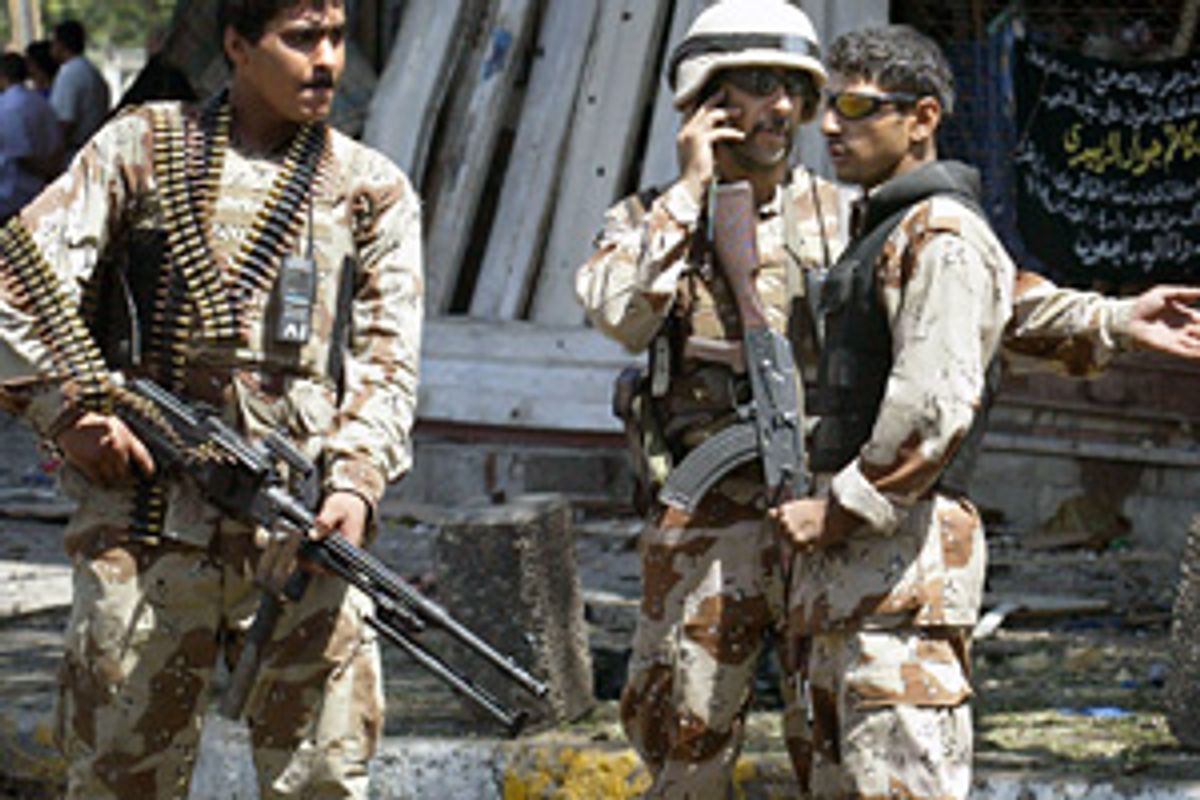
I spent five days in July living and patrolling with this group of Marines and the Iraqis they were training. Initially, the prospect of embedding with what appeared to be a team of military baby sitters was uninspiring. But I soon realized it would provide an extraordinary look inside what strategists consider to be perhaps the last, best hope to salvage stability from the U.S. occupation of Iraq as it spirals toward full-blown civil war.
In a nationally televised speech in June 2005 at Ft. Bragg, N.C., President Bush made an announcement that has been repeated many times since: "As the Iraqis stand up, we will stand down." McCollough's team of advisors, known as a Military Transition Team, or MiTT, is at the center of that strategy. Comprising 10 to 15 U.S. servicemen drawn from across the armed forces, each MiTT lives with Iraqi forces for months at a time, providing them with training, oversight and operational support. More than 200 MiTTs are operating in Iraq, according to the Pentagon. The training and deployment of autonomous Iraqi forces is seen as critical to securing the country, handing it over to the fledgling Iraqi government, and bringing U.S. troops home.
But according to more than a dozen Marine and Army officers I spoke with, since its launch approximately a year ago, the MiTT program has been dogged by bureaucratic mismanagement, inadequate training, and an astonishing shortage of equipment and supplies -- the latter a predicament I witnessed firsthand with McCollough's team. Many servicemen assigned to the MiTTs are distraught by this state of affairs. One disillusioned lieutenant I spoke with said that despite his intense love of the Marine Corps, he would be leaving the service because of what he has observed during his advisory tour. A frustrated team leader told me, "Thirty years from now, when historians are trying to figure out how we lost this war, they'll look to the MiTT program."
- - - - - - - - - - - -
Across the Euphrates River from Fallujah, al-Jazirah is a lush patchwork of palm groves and grass fields, bisected by dikes and dotted by the occasional farmhouse. Thickly vegetated and shockingly green, it is marvelous guerrilla country -- much more like Vietnam in appearance than anyone wants to admit.
When McCollough and his team arrived, the area was largely in the hands of hard-core Iraqi insurgents and foreign jihadis. The main road that connected the web of villages in al-Jazirah, dubbed "Route Duster" by the Marines, was virtually undrivable due to the constant threat of ambush. Mortar and small-arms attacks on the Marines compound became so commonplace through the spring that unless it was a sustained barrage, the Marines simply noted the time and went about their business. One afternoon I watched in amazement during an intense 120 mm mortar attack as one of McCollough's lieutenants stomped out of the team's barracks in nothing but shorts and flip-flops to get a closer look at the barrage. Marching back in, he declared, "It ain't that close" and went back to tinkering with the team's laptop computer.
McCollough's team is known as MiTT 3/5, because its members hail primarily from the 3rd Battalion of the 5th Marine Regiment. Embedding with them meant incurring a startling degree of danger. At one point McCollough showed me a calendar he kept inside his journal, on which a circled date indicated enemy contact. Beginning in early February, almost every date was circled. During one stretch, McCollough's team had either been shot at, mortared, RPG'd or hit by a roadside bomb on 37 out of 40 days. Nearly half of his team had been wounded, one member three times.
They were some of the most skilled soldiers I've seen, from my own service in the Marines to trips into Iraq since the fall of Saddam Hussein. Yet, as I would learn during this trip, optimism about the U.S. efforts to train Iraqi forces largely begins and ends with the top brass and Bush administration officials back in Washington.
By most accounts, McCollough's team is a model one. A Marine officer I spoke with in Ramadi described it as "exceptional." But that is telling in its own right: Even MiTT 3/5 is undermanned and grievously undersupplied, and it was given only skeletal preparation for its pivotal mission.
A survey of the MiTT compound revealed that much of the equipment had been acquired by scrounging or borrowing from other American units. The team's two generators -- without which the team would have no electricity, air conditioning or access to the U.S. military's tactical intranet -- were obtained by the team's logistics officer, who twisted the arm of a friend stationed at a nearby Marine supply depot.
Much of the Marines' gear was substandard. The doors of their dilapidated Humvees didn't close properly and had inch-wide gaps at the top of them -- potentially deadly in a sector rife with roadside bombs. At the beginning of my embedded tour I had noticed that all of the Marines at the public affairs office at Camp Fallujah had been outfitted with the latest fire-retardant combat uniforms -- but McCollough's Marines were all wearing less-protective cotton uniforms, despite an order from on high that all Marines in Iraq have the new ones.
In a document distributed to commanders after the MiTT program was launched, Lt. Gen. John Sattler, the head Marine general in Iraq, identified the advisor teams as "the main effort" -- an official designation that should have given them head-of-the-line privileges for supplies, ammunition, communication equipment and all the sundry items that a combat unit needs to function in the field. However, when the logistics officer assigned to MiTT 3/5 first submitted support requests, he told me, the response from Marine supply officers was, "Who are you? What unit are you with? What's a MiTT?" The disconnect between them and the larger American military apparatus drove the Marine advisors crazy -- "the main effort" was the punch line to many jokes told by McCollough's team while I was with them.
The MiTT program is strained by other fundamental issues. Historically, the mission of training indigenous troops has been handled by U.S. Army Special Forces, made up of experienced soldiers who have undergone years of specialized linguistic and culture-specific training. But with the military stretched thin by the Bush administration's far-reaching war on terror, there simply aren't enough Special Forces troops to go around, so the military has been forced to draw upon less seasoned troops from across the armed forces.
Despite an admirable track record in combating the insurgency in al-Jazirah, McCollough's team had a less-than-auspicious beginning. Formed around a few handpicked officers and sergeants, a number of the men who joined the team had been assigned against their wishes and on short notice from other noncombat units within the Marine Corps. The team's second in command came from the traffic-management office at Camp Pendleton and had never served in an infantry unit before. Only a third of the team had training in the foreign weapons the Iraqis use.
A senior enlisted Marine on the team described their mission preparation as "a joke." The entirety of it consisted of a week's lectures at Camp Taji, a forward operating base north of Baghdad. Most of the classes were hastily assembled slide presentations. One covered Iraqi radio equipment and was given by an instructor who had never seen the gear before. The sector-specific training consisted of a one-hour briefing given by an officer who had visited al-Jazirah only once.
One recent after-action report I saw, written by a MiTT team leader from elsewhere in Iraq, concluded that the Pentagon has "given lip-service to the importance of advisors but has not allocated resources (time, funding and command attention) to the training and equipping of the advisors."
In Washington, the message about the MiTT program remains upbeat. "The [Iraqi] army has been improving by leaps and bounds in the eight months we've been here," Army Col. Brian Jones, a commander in the Diyala province bordering Iran, said during a Pentagon press briefing on Aug. 4. "And truly I think we're starting to see the evolution of a professional force."
But McCollough's team expressed concern about the long-term prospects for the Iraqi forces they've been training. Soldiers continue to desert, and the battalion is never at full strength because Iraqis expect to have at least one week of leave per month in order to ensure that their families are safe and provided for.
Several of the Marines said they've seen some progress with the Iraqis. Yet, despite the Marines' continual hectoring, the Iraqis' field discipline leaves much to be desired. A gunnery sergeant told me that, with few exceptions, the Iraqis were poor shots. The Marines were happy to have at least curtailed the infamous "death blossom" -- the Iraqis' indiscriminate spraying of bullets into the air. But many moments were frustrating for Marines accustomed to working with well-disciplined troops. A prime example occurred in June: In the middle of an extended gun battle, the Marines were flabbergasted to discover some of the Iraqi soldiers relaxing and eating watermelon instead of manning their weapons.
A number of veteran U.S. military advisors I spoke with believe that the training under way essentially will last only as long as American officers are physically present and directly supporting the Iraqi army units.
In addition to the challenges posed by the Iraqi trainees, the Marine advisors have run into some galling problems with the U.S. military itself. In February, when the Iraqi 1st Battalion began taking casualties, the Marines took them to a U.S. medical facility at Taqqadum, a sprawling logistics base a few miles to the south -- and were initially turned away. "Iraqi soldiers aren't allowed on this base," they were told. After wrangling with the gate guards, they were eventually able to get the wounded Iraqis treatment, but it was an incident that none of the Marines forgot. The American attitude, according to McCollough, is frequently one of "Well, they're only Iraqi casualties" -- not something to get too worked up over.
There is an almost mind-boggling gap between the Marine advisors' daily reality and life on the large, relatively plush forward operating bases that support many U.S. troops in Iraq. This is a point of irritation for the Marine advisors, who refer to the other troops as "Fobbits," a derogatory term denoting those who never leave the safe environment of the large bases. At Taqqadum, American personnel dine on prime rib and enjoy Baskin-Robbins ice cream. In one of the chow halls there, I spotted a 4-foot-tall Statue of Liberty sculpted out of butter. In contrast, McCollough's men subsisted mostly on Iraqi army chow, Top Ramen noodles, Spam and junk food sent to them by family members back home. Combined with the relentless pace of operations in al-Jazirah, the poor rations resulted in major weight loss among some members of the team. One gunnery sergeant told me he'd shed almost 40 pounds over the course of the deployment.
While at Taqqadum, which increasingly resembles the "Little America" bases that became emblematic of the bloated U.S. war effort in Vietnam, I also noticed fliers for aerobics and salsa-dancing classes. There were weekly jazz concerts. When McCollough's team first arrived in Iraq, he told me, they went hunting at the Taqqadum post exchange for felt-tipped markers and protractors for their field maps. They were disgusted to discover that while there was thong underwear, hair care products and other luxury items available, they could not find some of the combat-essential items they needed.
As the U.S. military increasingly has dug in with large bases like Taqqadum, the trail of logistics and supplies supporting them has grown longer. As one particularly frustrated Army captain at Camp Ramadi put it, "We're chasing our own tail over here."
Yet, out on the bleeding edge of the war, the MiTT Marines took an unmistakable pride in their situation. They saw themselves as the magnificent bastards of the Corps, far away from the flagpole, and while they felt the burn of neglect from higher headquarters, the war seemed to retain an adventure-like feel for them. They had an unbelievable nonchalance toward danger. It seemed miraculous that none of them had been killed, which McCollough attributed in part to dumb luck.
In spite of the doubts hanging over the MiTT program, over time many of the Marines had developed a sentimental attachment to their Iraqi counterparts. And despite the Iraqis' mixed feelings about the American occupation, good will developed in the other direction as well. On my last day with McCollough's team, he told that he had recently taken the Iraqi 1st Battalion's executive officer, Lt. Col. Jafra, to the U.S. hospital at Taqqadum to have his leg looked at. Jafra, a Shiite from the Sadr City neighborhood of Baghdad, had taken some shrapnel in his ankle from an American artillery shell during the Gulf War. At one point Jafra said to McCollough, "I prefer to think that you shot me, Major McCollough, because that way, if it was a fellow soldier I respect who shot me, then there is no anger."
During my time with McCollough's team, I was heartened by the camaraderie between the Marines and the Iraqis. But that couldn't obscure the feeling that the MiTT program appears headed the way of many aspects of this war -- another casualty of poor planning, attention and execution by U.S. leaders.
Shares