Editor: Mark Schone
Updated: Today
Topic:

Healthcare Reform

I'm a doctor. So sue me. No, really

The doctors' lobby says capping malpractice suits will make healthcare cheaper. I'm an M.D. and I don't believe it

Flu season has come early and I'm writing far too many prescriptions for Tamiflu. I'm trying my best to adhere to the guidelines set by the Centers for Disease Control for who should get the drug (kids under 5 years of age, or kids who have a chronic illness like asthma or diabetes). But in more than a few instances, I've ignored the guidelines and given Tamiflu to perfectly healthy kids with no risk factors for influenza-related complications.

Part of the reason I'm writing so many extra prescriptions stems from stories about healthy people getting sick with H1N1 and ending up critically ill or dead. One of those stories aired recently on "60 Minutes" -- a healthy high school football player in Arkansas developed a fever after a game. He went to his doctor, who thought he had a garden variety flu and sent him home. Two days later, the boy collapsed and was airlifted to the nearest pediatric intensive care unit. He developed a bacterial pneumonia on top of his H1N1 flu, which led to severe damage to his lungs. He couldn't breathe on his own, so he remains in the ICU on a ventilator.

The H1N1 strain of influenza is no more lethal than any other strain of flu. Mortality is less than 1 percent. Nevertheless, by over-prescribing an expensive drug that has only marginal benefits, I'm unequivocally practicing what is known as defensive medicine. As in, the kind of medicine that protects doctors as much as patients.

Mine isn't an extreme example of defensive medicine. I'm a pediatrician. Obstetricians and emergency room doctors are sued at far higher rates, and would have more dramatic stories to share. But my motivations are the same as theirs: I'm afraid that if I don't do something, one of my patients may get sick or die, and I'll end up in court being asked why I didn't do everything I could have.

Defensive medicine is just one of the supposed systemic ills that doctors, doctors' lobbies and doctors' insurers invoke when they shill for what they call malpractice reform. Proponents of reform say that defensive medicine, frivolous lawsuits and high premiums are behind the surge in healthcare expenses. They insist that malpractice costs are forcing doctors to close their doors and depriving patients of care. Recently, three past presidents of the American Medical Association coauthored an opinion piece for the Wall Street Journal that bundled all of these arguments into an attack on the public option. Their piece attempted to shift the blame for America's healthcare crisis away from private insurers and onto a supposed scourge of ambulance chasers. "The nation needs comprehensive medical malpractice reform," they wrote. "It is the surest and quickest way to slow down the rising cost of healthcare."

Their refrain is familiar to anybody following the healthcare reform debate. The only problem is that it's not true. There's nothing "sure or quick" about changing medical liability laws that will improve healthcare or its costs. Defensive medicine adds very little to healthcare's price tag, and rising malpractice premiums have had very little impact on access to care.

Let's look at the numbers. First, based on the current rhetoric, it's easy to assume we have an epidemic of malpractice suits in America. We don't.

There are many statistics out there, and it's not always possible to make an apples to apples comparison between one study and another. Some surveys cover the nation, some cover one group of states, some cover another cluster, and results vary. But according to the Congressional Budget Office, nationally, between the mid-1990s to the mid-2000s, the frequency of malpractice suits per capita remained stable at about 15 claims per 100 physicians per year. Another report, from the National Center for State Courts, actually shows that the number of cases between 1996 and 2006 dropped 8 percent. 

Although the payout per claim has increased, the Justice Department, in a 2007 report about medical malpractice -- in fact, the same report cited by the authors of the Wall Street Journal piece mentioned above -- provided an explanation quite different from an epidemic of lawsuits. "Growing healthcare costs and an increasing effort by many attorneys to litigate only those medical malpractice claims involving severe injuries or wrongful death claims may explain some of these increases," they wrote. Still, even with the rise in payouts, the Congressional Budget Office, using statistics from the government's Centers for Medicare and Medicaid Services, estimates that malpractice costs account for less than 2 percent of healthcare spending. Saving 2 percent of the over $2 trillion we spend on healthcare isn’t going to bend the cost curve.

Next is the question of frivolous lawsuits. Tort reformers push the notion that junk lawsuits dominate the legal system. The Wall Street Journal article cited above refers to studies that show that 80 percent of claims are settled without payment to the patient and that when a case does make it to trial, doctors win 89 percent of the cases.

But the private studies cited often involve small numbers of claims, or focus on a single hospital, insurer, specialty or type of injury, or were commissioned by interested parties, aka the malpractice insurers themselves. The 2007 Department of Justice study cited by the Journal trio covers only seven states, and nowhere does it mention the numbers 80 percent and 89 percent. Repeated attempts to contact and ask one of the authors of the WSJ story about the specific source of their data were unsuccessful. The DOJ report shows that in one state, Illinois, 88 percent of claims were closed without a payout. But for the other states it examined, the number was between 62 percent and 69 percent. Regarding the percentages of cases doctors win, a 2001 analysis by the Bureau of Justice Statistics, examining malpractice trends in the 75 most populous counties in the U.S., put that number closer to 70 percent.

In 2006, researchers from Harvard published a study in the New England Journal of Medicine  that was designed to avoid the limits, and the biases, of prior research. What they found kills the notion of frivolous lawsuits. It suggests that most people who sue are suing for good reason.

The researchers reviewed nearly 1,500 claims from five different malpractice insurers. First, they reviewed the merits of each case by determining whether a patient was injured and, if so, whether it was due to physician error. Most of the suits were not frivolous: Almost two-thirds of cases involved errors by doctors. Second, they followed each claim to see if the legal system acted appropriately. The majority of the time, it did. Seventy-three percent of injuries in which a doctor committed an error resulted in payments. Seventy-two percent of cases in which there was an injury not due to physician error did not result in payment. Those conclusions do not paint the picture of a medical-legal system burdened by ambulance-chasing lawyers and their litigious clients.

Instead of a swamp of frivolous lawsuits, what the data shows is a system that functions. Insubstantial claims tend to collapse, while the medical industry usually opts to pay off injured patients instead of going to trial. The doctors and the insurers choose to fight to win when they think they can, and when there is enough money at stake, and usually do win.

There are two more arguments tort reformers use to make their case for change: The first is that defensive medicine drives up the cost of care. The second is that skyrocketing malpractice premiums are driving doctors out of business, cutting patients' access to care. In both cases, however, the facts don't substantiate those claims.

Tort reformers like to cite a 1996 study by Daniel Kessler and Mark McClellan as evidence that defensive medicine increases healthcare costs. That study analyzed Medicare hospital spending for patients who had been hospitalized for heart disease, and concluded that states that had enacted tort reforms had lower healthcare costs than those that did not, the assumption being that in those states without reforms, doctors were more likely to practice defensive medicine.

Yet more recent analyses show that the effect of defensive medicine on overall costs is, at best, marginal. The most visible of them came from the nonpartisan Congressional Budget Office. In a 2004 report, it reviewed studies suggesting tort reform did reduce healthcare costs, including the Kessler and McClellan study. However, when the CBO applied the methods used in that study to a broader set of ailments, it found no evidence that restrictions on tort liability reduced medical spending. It also found no difference in per capita healthcare spending between states with and without limits on malpractice awards. More recently, the Kessler-McClellan study received another blow when two new authors reassessed their original work. Unlike the original study, this one looked at the effects of tort reforms over a longer time period. Just like the CBO review, it concluded that "Direct reforms (caps on damages, abolition of punitive damages, eliminating mandatory prejudgment interest, and collateral source offset) did not significantly reduce payments for Medicare-covered services."

In that same 2004 report, the CBO also took a hard look at the claim that rising malpractice premiums were driving doctors out of business and thus cutting access to care. While the report did find instances of reduced access to emergency surgery and newborn delivery, albeit in scattered, often rural, areas, it also found that many reported shortages of healthcare providers could not be substantiated or did not widely affect access to healthcare. Traditionally, rural areas are where healthcare is scarce anyway. According to the Council of Graduate Medical Education, "the relative shortage of health professionals in rural areas of the United States is one of the few constants in any description of the United States medical care system." So with or without tort reform, access to care is likely to stay tight outside of big cities.

It would seem that after all of this, what we’re left with is a crisis not of the medical-legal system, but of the economics of malpractice insurance, as doctors have seen their premiums skyrocket in recent years. But even that can’t be pinned strictly on the risk of insuring physicians. Public Citizen, a consumer advocacy group, notes "that a historical pattern has been established that insurance rates rise also based on the investment market ... Earlier 'crises' (in 1975–6 and 1985–6) similar to today’s 'crisis' were due to declining investment fortunes and failed pricing practices of the insurance industry rather than an increase in medical malpractice filings and awards. Then, as now, the insurance industry covered its losses by raising rates dramatically, then blamed the lawyers of innocent patients rightfully seeking compensation for negligence-related injuries."

The real tragedy in all of the rhetoric around tort reform is best illustrated by a personal story. While I was in college, my friend's mother died on the operating table due to an error by her doctor. I remember asking my friend if they were going to sue the doctor. "It won't bring my mom back," he said.

Tort reformers neglect the fact that malpractice reform won't save one extra life. To make that difference, insurers, doctors and their lobbyists like the AMA need to find ways to improve patient safety. So for those who push tort reform as a panacea for a sick healthcare system, working to prevent injuries is a much more noble pursuit than writing up baseless arguments for the back pages of a newspaper. 

Surprise guest at White House briefing: Obama

In a surprise press appearance, the president pushes back against GOP demands for "bipartisanship" Video
AP/Pablo Martinez Monsivais
President Obama takes questions during the daily press briefing at the White House Tuesday.

WASHINGTON -- President Obama made a surprise visit to the White House briefing room Tuesday -- and he kept up the pressure the administration has been applying to Republicans on everything from healthcare reform to jobs.

Just after a bipartisan meeting with leaders of Congress wrapped up, Obama strolled into the regularly scheduled (if, due to snow, poorly attended) daily press briefing -- his first extended solo time with the press since last July.  He didn't mince words.  "Bipartisanship depends on a willingness among both Democrats and Republicans to put aside matters of party for the good of the country," he said. "I won't hesitate to embrace a good idea from my friends in the minority party, but I also won't hesitate to condemn what I consider to be obstinacy that's rooted not in substantive disagreements but in political expedience."

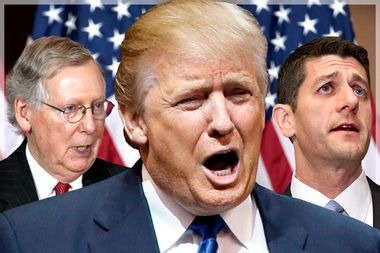
Republicans had just left the meeting and scoffed at the idea that the White House was actually interested in working with them. Take healthcare reform (cue the administration saying, "please"). "It's going to be very difficult to have bipartisan conversations with regard to a 2,700-page healthcare bill that the Democrat majority in the House and the Democrat majority in the Senate can't pass," House Minority Leader John Boehner told reporters. "Why are we going to talk about a bill that can't pass? It really is time to scrap the bill and start over." Senate Republican leader Mitch McConnell said more or less the same thing. "Why would they want to keep pushing something that the public is overwhelmingly against?" he asked. "The obvious answer is to put that measure on the shelf, start over."

A bipartisan summit on the issue is scheduled for two weeks from now, when Congress returns from its Presidents' Day break. And the GOP doesn't have high hopes for anything productive coming from itt. "It is becoming increasingly clear that the administration does not intend to reopen the legislative process -- they seem to just want to listen to what we have to say and move on," one senior GOP aide told Salon. "Fine. But you wasted an entire year doing exactly that. By taking that approach on healthcare, they drown out any efforts, post-stimulus, on jobs or any other of their priorities. And in the process, took a president with near-70 percent approval and drove him below 50. Nice work."

But the White House has been faster to fight back on attacks like that since the Massachusetts Senate special election, and Obama picked up that same message. "'Bipartisanship' can't be that I agree to all of the things that they believe in or want and they agree to none of the things I believe in or want, and that's the price of bipartisanship, right?" he said. The healthcare summit can't just be "political theater," the president said. And he made clear he still wants to push ahead. "The public has soured on the process that they saw over the past year," he said. "I think that actually contaminates how they view the substance of the bills."

In his last session with the press back in July,  a prime-time news conference that also focused on healthcare reform, Obama waded into the Henry Louis Gates Jr./ Cambridge police controversy, which led to the much-mocked beer summit -- perhaps explaining the lack of similar sessions these past seven months. But reporters have started grumbling lately, so Obama dropped in on an otherwise slow news day.

Obama also pushed for Congress to act fast on a jobs bill -- but the House has already gone on recess, thanks to the winter storms pummeling D.C. lately, and won't be able to vote on anything until the week of Feb. 22 at the earliest. In the end, the meeting Tuesday, and Obama's impromptu presser, aren't likely to do much to actually move legislation along. But the White House tone could help change voters' minds about who's to blame if it stalls.

UPDATE: Watch Obama's appearance here:

Visit msnbc.com for breaking news, world news, and news about the economy

White House proposes talking it out on TV

Both parties to reach the high ground by trying to extract a public "no" from the other side

Since President Obama’s agenda ground to a halt in Congress, everyone’s been popping with theories of how he could get it moving again, particularly on healthcare. He should scrap the basic bill already passed by both houses and restart bipartisan talks, say Republicans, surely in full good faith. Mainstream liberals seem to hold out some hope that the White House can broker the House and the Senate to a tractable middle ground. Politico thinks the president should stop telling people what to do already. And his progressive allies want him to force the GOP to filibuster, and to call them out for their obstruction.

As usual with this administration, the working strategy seems to be to give a little bit to everybody. Obama announced yesterday that he would call for a televised half-day bipartisan meeting at the White House to try to reach a breakthrough on healthcare. Echoing his State of the Union address and his "question time" with the House Republican caucus, the president said, "I want to come back and have a large meeting, Republicans and Democrats, to go through systematically all the best ideas that are out there and move it forward."

It’s not, of course, actually likely that the White House and congressional Democratic majorities are going to hear some revelatory and brilliant new proposal from the GOP -- especially when the Republicans, as a relatively tiny legislative minority, are insisting the president and majority meet their demands. Says Senate Minority Leader Mitch McConnell, R-Ky., "We know there are a number of issues with bipartisan support that we can start with when the 2,700-page bill is put on the shelf."

If the last eight months have shown anything systematically, it’s that there isn’t really any ground on which the parties can meet for compromise. Republicans are uninterested in letting Democrats pass a bill and claim success. McConnell’s point is clearly Republican orthodoxy; House Minority Leader John Boehner, R-Ohio, tells the New York Times almost exactly the same thing as his Senate counterpart. "The best way to start on real, bipartisan reform would be to scrap those bills and focus on the kind of step-by-step improvements that will lower health care costs and expand access."

For its part, the White House clearly has no intention of scrapping the bill and rebooting negotiations, not after watching Max Baucus and his "Gang of Six" fritter away a half a year in fruitless talks.

Clearly, this televised session idea would be some kind of kabuki theater. What’s happening here is a part of the administration’s ongoing effort to claim the center. The idea is that another on-air, face-to-face encounter will help the president to hold Republicans accountable with the public for abdicating shared responsibility for governing. They’ll be revealed for the do-nothing obstructionists they are.

But you have to think the GOP probably isn’t going to get caught off guard as it did with Obama’s "question time." Republican negotiators won’t just show up unprepared. They’ll do their homework, and they’ll have lots of proposals. You can bet that they will have ideas that sound perfectly good to the layperson but are actually completely infeasible in any compromise, for fairly complicated and wonky reasons. They won't suggest these ideas because they want the president to actually enact them; they'll just try to make him the one saying "no."

Obama and the Democrats want to go on TV to reveal the opposition as uninterested in genuine compromise. But really, it’s not hard to imagine how Republicans maneuver the Democrats into spending this half-day televised session rejecting all of the minority’s ideas. It sounds something like a replay, in miniature and on-air, of the whole painful process so far.


Dem tensions on healthcare flare up behind closed doors

In closed door session, Sen. Al Franken jumps on prominent advisor to President Obama over lack of leadership
AP/J. Scott Applewhite
Sen. Al Franken, D-Minn.

President Obama’s public question-and-answer session with the Senate Democrats earlier this week was a pretty tame event – especially compared to the spectacular hijinks that went down when Obama addressed Republican members of the House. The President briefly admonished his own party, telling them to “finish the job on healthcare,” but that was the extent of the conversation. None of the senators actually asked Obama a question about healthcare reform.

But there are some tensions between the White House and Senate Democrats, and behind closed doors, they're coming out. In a follow-up meeting, Sen. Al Franken, D-Minn., tore into David Axelrod, a senior advisor to Obama, about the president’s lack of leadership on healthcare. According to one Democratic aide quoted in the Huffington Post, the Minnesota senator said that "he really needed to know if the White House was going to lead." Apparently, Franken was not alone in his grievances. As one Democratic senator told Politico, "There was a lot of frustration in there."

Obama has long been criticized for his lack of leadership on healthcare -- first by liberal commentators and more recently by leading progressive members of the House, including Rep. Anthony Weiner, D-N.Y. The argument stems from frustration that the President hasn't done enough to garner public enthusiasm for reform. Franken and his fellow Democrats in the Senate, however, have been reluctant to blame the White House for their healthcare woes.

Obama’s latest comments on healthcare reform don’t seem to indicate that he'll be getting more personally involved anytime soon. At a fundraiser Thursday night, the President voiced concern about whether a bill would pass at all, and suggested that the onus lay on Congress to get something done:

So there’s a lot of information out there that people understandably are concerned about. And that’s why I think it’s very important for us to have a methodical, open process over the next several weeks, and then let’s go ahead and make a decision.

And it may be that — you know, if Congress decides — if Congress decides we’re not going to do it, even after all the facts are laid out, all the options are clear, then the American people can make a judgment as to whether this Congress has done the right thing for them or not. And that’s how democracy works. There will be elections coming up and they’ll be able to make a determination and register their concerns one way or the other during election time.

"Checklist Manifesto": Healthcare reform rock star

Talking medicine, checklists and alternative music with New Yorker staff writer and surgeon Atul Gawande
Atul Gawande

Dr. Atul Gawande has only been a practicing surgeon for six years, and he is still just an assistant professor at Harvard, but his game-changing New Yorker essay about the gobsmacking cost of healthcare in McAllen, Texas, became required reading in the White House. As a New Yorker staff writer, Gawande has long been known for his meditative, honest and lyrical essays about medicine, but his work became that much more important as healthcare exploded into a national conversation (and crisis).

Gawande's third book, "The Checklist Manifesto: How to Get Things Right," explores how doctors and other professionals, overwhelmed with the complexity of their work, have become more likely to fail. Gawande's proposed solution is simple and inexpensive, if not terribly sexy: a checklist. Sound too mundane? Keep in mind that Gawande proved, in conjunction with the World Health Organization, that doctors and surgical teams who use checklists save lives.

I arranged to meet Gawande on a crisp, clear Wednesday afternoon in downtown San Francisco while he was on book tour. The doctor arrived a few minutes early, so instead of looking out for him, I had my head buried in Paul Starr's "The Social Transformation of American Medicine," and my iPod headphones on. It was Gawande who got in the first question.

"What are you listening to?" he asked.

LCD Soundsystem, I told him, as we shook hands. Like me, Gawande is an alternative music fiend. Later he pulled out his own iPod, suggesting Bon Iver and a Scottish Band called Frightened Rabbit, whom he recently saw in a bar in Boston with 30 other people. "Maybe it's the surgeon in me, but many of their songs involve someone who has been either maimed or dismembered," he said. And later, we both agreed that Radiohead still ruled the day, and that as amazing as the Flaming Lips are, "Embryonic" wouldn't fly in the operating room, where Gawande famously plays music while he operates. But before that, we talked about how he influenced "Grey's Anatomy," his simple suggestion for fixing a sprawling problem and, of course, the ongoing debate about healthcare reform. (Note to readers: This interview took place a week before the election in Massachusetts.)

If you had to make a checklist of, say, three killer items that reform must address, what would they be?

First, it has to offer coverage for the population. We have to eliminate families going bankrupt because of healthcare bills. The second thing is not killing the deficit. The third has to do with delivering reform -- being able to begin providing opportunities for change that would begin phasing away from fee-for-service medicine.

Will this bill change what you saw in McAllen?

One of the things I saw was how fragmented and disorganized care was. Doctors are paid for doing things piecemeal rather than knitting care together in some meaningful way. And further, they were pursuing that as a business objective. The doctors were caught between maximizing the needs of their business and the needs of their patients.

I think the incentives in this bill will begin to provide opportunities for people who want to change that culture. The key moment that matters most is when the doctor -- who has control of 90 percent of spending -- sits down with the patient and has to make a decision about the right thing to do, and whether [doctors] are equipped to make the decisions that avoid wasted and unnecessary care.

But the entire success or failure of this reform package will depend on what we do in communities. If there's one community that manages not just to bend the curve but actually lowers costs and raises quality, then it will become the metric for reform. Then we need to determine how to implant them.

Let's talk more about that moment when a doctor is sitting down with his or her patient trying to decide what to do. When doctors are paid to do more, and patients often expect more, how are we going to make it so that doctors are doing the right thing? As we both know, that isn't always ordering more tests, drugs or procedures. Consider the recent outrage over the breast cancer screening guidelines, which recommended fewer mammograms. 

If we think of having to do it through Washington rules, we'll fail. Instead, it’s important that a doctor and patient [relationship] is part of a system of care that makes doing the right thing easier. For example, we’ve had tremendous growth in the number of CT scans we order, and it’s partly out of the belief that more can’t be a bad thing, even though they cost a lot and expose people to a lot of radiation. But also, the radiologists get paid for doing more scans, and there’s no incentive to moderate it. At my hospital, we decided to tackle this, because we got incentive from insurers to give it a try. Our solution, instead of having a committee or an insurance administrator decide, was to have an electronic system that required you to talk to the radiologist about your decision [to do a CT scan] when your reason fell outside of the established guidelines. The result is that we are below our 2005 ordering numbers while others have been rising.

That result didn’t happen by rationing. The radiologists were instructed not to deny a scan. Rather, it happened by one doctor talking to another doctor, comparing notes and deciding what the right thing to do was. 

You're talking about what happens between doctors, but what about the American health consumer? If I come to you and say I have a headache, and I tell you my friend down the street went to another hospital and had a head CT the same day, I'm going to expect and may even demand the same from you. How do you fix that?

I think that has to do with how we talk to patients, and to learn to have those conversations. Most of medical care is totally invisible to us, and just being able to see what a community does can have an effect by itself. The gray zone is usually not a patient pushing -- it’s how we deal with our discomfort about what we know and don’t know. It’s about reaching the point where the better investment is to consult with a colleague, or about asking the patient to come back in four weeks to recheck him or her.

But there are other tools. I was fascinated by one that pediatricians now are using to deal with antibiotic resistance and ear infections. Before, a parent might come all that way to see the doctor and expect something. Now [since studies show that most ear infections resolve without antibiotics], they write a safety net prescription for ear pain -- go ahead and fill this in 48 hours if it’s not getting better. As much as it sounds like these dumb little tools, how they help manage that social interaction is a chance for some real innovation.

In your New Yorker article, there is a moment that struck me, as a doctor. You were having dinner with a group of doctors from McAllen, and you told them just how costly the care there was. They didn't seem to have a clue about that. So how is it that we know how good a doctor we actually are -- and how do patients also figure that out? 

I think this is something that has been totally overlooked in reform. The National Center for Health Statistics is going to have to be equipped to produce that data, like we do for agriculture, and for economic needs like unemployment. The Medicare data we have now is only there because an academic center -- Dartmouth -- put it together, but that data is three years old. I haven't seen the real goods, which is pulling data from all insurers regardless of where a person is receiving care and putting it together with clinical information. How many operations are done in my country, and how many ended up with a disability or death because of it? How many people had a heart attack, and how did they fare in the hospital? We have that data on maternal and infant mortality, but that’s about it. The fact that we have no idea about how our health systems are doing now versus, say, two years ago -- that flabbergasts me. 

By the end of the book, I talk about how we’re obsessed with components in medicine: Do I have the best medicine, do I have the best doctor? The reality is that a doctor embedded in one system may get different results than if he or she were embedded in a different one. Some studies have started to show doctors getting different results when they work in more than one hospital. I think it’s much more critical for patients to see how good a system can be. Because care requires a whole chain of events.

So why in the world would you write a book about checklists, of all things?

What we're grappling with in reform or public health is immense complexity. We do 50 million operations a year in the U.S., with 150,000 deaths within 30 days. Five hundred thousand people are disabled, and half of those are avoidable. When we think about how we grapple with complexity, we've been using two solutions: super-specialization and technology. These haven't been good enough. When I looked at how other worlds like aviation and construction grapple with complexity, I found checklists.

But checklists are also an admission of fallibility. It's an admission that individuals aren't the only thing that matter, that chains of people and processes matter. Further, it's an admission that we can't handle the complexity that's coming at us. And I think that's the case across lots of walks of life.

For millennia, we didn't know why we got ill. Now, there are more than 13,000 diagnoses, 6,000 drugs and 4,000 procedures. Back when the main problem was ignorance, people gave doctors leeway. If you succeeded, you were a miracle worker. And if you failed, well, what could you do? But if you fail nowadays, it's because you didn't deliver on existing knowledge. That's infuriating. What do you mean my mom is in the ICU with an infection because someone didn't wash their hands? What do you mean that the bomber got on the plane to Detroit when there were three pieces of information someone couldn't put together? Checklists can help get at that kind of failure.

Why are people resistant to the idea, and why is it so hard to bring change to the culture of medicine?

A checklist feels like a judgment on who we are in a way that a drug doesn't, and I think there's a deep resistance to that. Also there's a reality -- because a drug costs money, prescribing it means revenue for somebody, while a checklist is free.

Also, we think what it means to be effective is to have it all in your head, to make the right move in the right moment and do it with our gut instinct. It took a long time to change aviation from a culture in which you were just great because you knew what you were doing to one in which, no matter how good you were, you weren't great until you used the checklist. And then you see a kind of joy in the discipline of it.

Besides a checklist, what is it going to take for future doctors to be successful?

Culturally, the shift from individuals to teams, and equipping physicians to lead teams that execute very complex things. Also, how to be a member of a team where you may not be the leader. There’s a couple of lessons given to pilots before they get on a plane. One is that their brain is fallible, and if you don't recognize that, you’re going to die and take some people with you. The second is that pilots get drilled and taken through simulations for complex planes in which you're part of a group. The first time you probably dealt with a major high-stress, chaotic situation was during a code as an intern your first week on call. That’s crazy. I think we ought to import the pilot training into what we do. I’m also fascinated by one experiment at the University of Nevada Reno, where they’ve combined parts of the medical and nursing school -- and co-teaching parts of classes so that both groups have the same language and know each other from the very beginning.

Your fellow New Yorker writer Malcolm Gladwell wrote a book called "Blink," which is essentially about how we make split decisions and judgments. Checklists seem the very opposite of that. Is your book the anti-"Blink"?

[laughs] In the second half of "Blink," Gladwell talks about the Diallo shooting, where the police put 44 bullets in a guy who was just sitting on his porch in New York. So I think he understands the cautionary nature of gut instinct. What he was interested in was how experts achieve the great gut instinct -- to look at a CT scan and see the tumor, or look at an EKG and see the heart attack without having to take the pieces apart. You need that intuitive capability, but you also need preparation upfront, which involves a check on what you're doing. You need to think about, as a group, what could go wrong, and are we prepared for it? Is everything available so when that moment happens and you need that intuitive capability, you're primed as much as you can be.

I understand your first book, "Complications," became the inspiration for "Grey's Anatomy."

It's a sore point. "Grey's Anatomy" was actually called "Complications" when they made the pilot. Every chapter in the book gets used as an episode. They have the blushing patient, the 23-year-old with the flesh-eating bacteria. But they didn't acknowledge it, and I didn't want to battle it. Mostly, I was flattered that they took an interest.

Now, the really flattering thing was a guy named Teddy Blanks, who made an EP called "Complications" based on stories from the book. He also wrote and recorded a song called "The Itch" based on my New Yorker article. That was one of the most gratifying things to me, to feel like people made a connection at that level. I sent him my book and he actually made a whole series of songs -- he's morbidly fascinated by medical things -- and included a cover of the Frank Black song "Headache."

And the checklist made it onto "ER" as well?

I worked with them on that episode, as a vehicle to help people understand what it's about. There's a four-minute scene with Benton fighting with another surgeon who wouldn't use the checklist and wanted to throw him out. And the checklist saves Carter's life. That was much more about the cultural differences in medicine. It was a huge part of our work. It was shown in hospitals here and abroad which were adopting the checklist.

You've been practicing for such a short time, yet you've done so much. When, someday, they put your picture up at Harvard, what do you want them to say about you?

I don't know. My teams once asked me what our mission statement is. All I could come up with is to do cool stuff that lasts. That's all I got. 

Landrieu criticizes Obama over healthcare, speech

Louisiana Democrat says reform "on life support," president "should have been more clear"

President Obama obviously needed to reach, and convince, the American people with his State of the Union address Wednesday night. But there may have been an audience more important for him in the short-term: All the nervous Congressional Democrats who need to feel comfortable backing his agenda, especially on issues like healthcare reform. On that score, it seems like Obama may have fallen a bit short.

After saying that reform is "on life support, unfortunately," Sen. Mary Landrieu, D-La., told reporters Thursday that Obama hadn't done enough with his speech to change that. "He should have been more clear, and I am hoping that in the next week or two he will because that is what it is going to take if it is at all possible to get it done. Mailing in general suggestions, sending them over the transom, is not necessarily going to work.”

Landrieu also criticized the president for having called out the Senate for being slow to pass legislation already approved by the House, saying it was "a little strange, a little odd." It's hard not to hear her talking about herself when she went on to say, "Moderate Senate Democrats, who give the Senate the 60 votes, come from states that have to appreciate a broad range of ideas." She's got a tough political situation in Louisiana, and has been slow to join her Democratic colleagues in supporting the president's agenda for just that reason.

Let the uninsured die

Republicans have decided that defeating Obama is more important than passing healthcare

There they all were on the Sunday-morning chatfests, droning on about the anger of the American people as shown by the election in Massachusetts of a pickup truck to the U.S. Senate -- ever ready, as pundits are, to take one good story and extrude it into a national trend portentous with meaning. One could draw other conclusions from that election -- the importance of actually campaigning, for one, and not vacationing in the Caribbean -- but OK, maybe anger was a factor. Nobody looks on the marathon healthcare debate as a noble chapter in political science. No legislator is going to have a hospital named for him in honor of his heroic work. (Maybe a parking ramp.)

Meanwhile, one-sixth of our population is without health insurance, and Republicans have decided that defeating Mr. Obama is more important than the welfare of 50 million Americans: Let them die and decrease the surplus population and be quick about it. That's the long and the short of it. And now they have won a Senate seat in a Democratic stronghold and feel revived and are smelling the bacon and looking forward to November.

This is good. The midterms will require Republicans to decide who they are. Are they interested in unemployment, healthcare, banking regulation and the long-term health of the planet? Or are they just angry that a non-citizen and practicing Muslim got elected president so he could send death panels around to enslave us in the chains of Marxism?

Running on anger is not such a great idea. For one thing, it's hard to sustain if, God forbid, the economy springs back. And as Republicans well know, government does not change when you yell at it. The world doesn't run on slogans, it runs on paperwork. Federal agencies are full of old Reaganauts and Bushites in civil service positions who went to Washington with high ideals of making government smaller, but government can't get smaller, there being so many of them, and these conservative ideologues gradually turn into weary old bureaucrats with dandruff on their shoulders, same as the liberal ones.

Populism is a stiff liquor (Power to the People, Down With the Meritocracy, Into the Tumbrils with the Elitist Media), but in the end it fails to give you useful directions. In North Dakota, in the '30s, the populist Non-Partisan League took power and put their folks into state jobs, including running the insane asylum in Jamestown, and the poor inmates suffered at the hands of the People. So did universities suffer at the hands of students who took over campuses back in the day. It was fulfilling to sit in the president's big armchair and smoke his cigars, but then what? They had no idea what.

Be as anti-elitist as you like, but when the surgeon comes in to open up your skull to see what that big dark spot on the CT scan was, you don't want him to be wearing a humorous T-shirt ("Hey It IS Brain Surgery") and eating Jujubes. You board the DC-10 to London and you'd like to see a lean guy with a military-style crew cut, an overachiever, not a guy with hair in his eyes who is really, really into his own music. Your life may depend on an arrogant elitist who happens to know what he's doing.

I'm in Peoria as I write this, having just left Sheboygan, two factory towns (Caterpillar and Kohler) hit hard by the recession and by the southward migration of manufacturing, with plenty of "For Lease" signs on industrial buildings. And yet I haven't met anyone here who imagines that Obama is the cause of it all. There was a previous administration, during which regulation of banks and the securities trade was negligible, that had a hand in it, too.

Meanwhile, the lights are still on, beer is still coming out of the taps, and the genial gentlemen at the bar are talking about a big bump in corporate profits in 2010, maybe 25 percent. My heart was gladdened by an official-looking sign in the Milwaukee airport, just beyond the TSA checkpoint, hanging over where you put your shoes and coat back on and stuff your laptop back in the case: The sign said, "Recombobulation Area." The English language gains a new word. Recombobulate, America. Pull yourself together, tie your shoelaces, and if your pilot is wearing a button that says "To hell with the FAA," wait for the next flight.

(Garrison Keillor is the author of "77 Love Sonnets," published by Common Good Books.)

© 2010 by Garrison Keillor. All rights reserved. Distributed by Tribune Media Services, Inc.

Page 1 of 117 in Healthcare Reform Earliest ⇒

Healthcare Reform in the news

Loading...

Recommended Reads

Currently in Salon

Other News