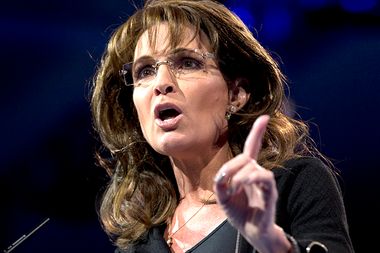
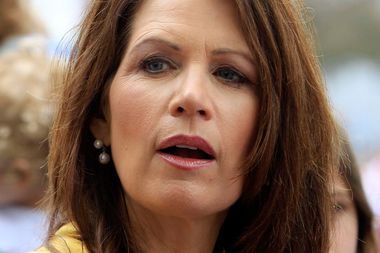
WASHINGTON -- Think Stephen Colbert was impressed by Sarah Palin's speech to Tea Party Nation and her, ahem, handy way of remembering her talking points? Think again:
| The Colbert Report | Mon - Thurs 11:30pm / 10:30c | |||
| Sarah Palin Uses a Hand-O-Prompter | ||||
|
||||
Who said the Republican Party lacks a bold vision for governing America in the 21st century? Sarah Palin and Republican congressman Paul Ryan prove that Republican conservatives are bold to a fault.
On "Fox News Sunday," where the former Republican vice-presidential candidate is now a paid commentator, Palin suggested that Obama might be likely to win reelection if he "played the war card."
The AP reports:
Palin says that declaring war on Iran or showing stronger support for Israel might convince voters that Obama is tougher than they think on national security and doing all he can to protect the U.S. Otherwise, according to Palin, Obama won't be re-elected if he continues on his current path.
As if.
As if the Obama administration were not escalating the war in Afghanistan against the Taliban, who aided and abetted the al-Qaida attacks on the U.S., while continuing the war in Iraq, which had nothing whatsoever to do with 9/11.
As if invading two countries that did not attack the U.S., Iran and Iraq, would be more statesmanlike than merely invading and occupying one.
As if the public, sickened by the cost of the Iraq war in American dead and maimed and trillions of dollars in the long run, had not turned against wingnut militarism and tossed Palin's party out of Congress back in 2006.
As if singing "Bomb, bomb, bomb Iran" to the tune of the Beach Boys' "Barbara Ann" helped Palin's running mate John McCain win the White House in 2008.
As if swing voters were concerned, not about the highest levels of unemployment since the Great Depression, but about what they considered to be too few American military deaths abroad.
But the contemporary right's claim to intellectual dynamism is not limited to Sarah Palin's suggestion that another unnecessary, unprovoked war in the Middle East might be good policy as well as a a good idea. In domestic policy, Paul Ryan, R-Wis., the ranking Republican on the House Budget Committee, recently unveiled an alternative budget that would deal with the long-term deficit problem (about half of which was caused by Bush's and the Republican Congress's wars and tax cuts) by privatizing Social Security and turning Medicare into a voucher system.
As Michael Myers' Doctor Evil might say: .......R....r......r.....right.
That's what Americans are demanding, Rep. Ryan. Millions of Americans are not content to have lost much or all of their 401K and other private retirement savings in the stock market in the last decade, with nothing but Social Security remaining to rescue them in their retirement years. No, Americans are angry because they weren't allowed to lose all of their Social Security money, as well, in the stock market. Clearly they are angry because Wall Street brokers aren't able to rake in commissions from middle-class and working-class retirees by flipping stocks bought with diverted Social Security funds. The bailouts to Wall Street were not enough. We need to give the rent-seeking bankers the vast funds of Social Security as well and let them charge us fees for "managing" it with the legendary expertise we all know and admire.
Bomb Iran and privatize Social Security now! There's a chant for the tea partiers.
These ideas are not going to bring the Republican Party back to power in Congress in 2011 or into the White House in 2013. Which is not to say that the Republicans can't come back to power. In a two-party system, frustrated voters could vote the out party back in, while ignoring the out party's message, even if the message is as crazy as "Bomb Iran and privatize Social Security."
If they came back in, would the Republicans bomb Iran and privatize Social Security? Almost certainly not. Bush talked tough about Iran but didn't do anything. (Correction: He accidentally promoted a major goal of Iranian foreign policy, by deposing the minority Iraqi Sunnis detested by Iran and bringing the Iran-supported Shia to power in Iraq. Oops).
Nor are the Republicans likely to privatize Social Security. A few years back, the Republicans controlled both houses of Congress and the White House and a freshly reelected Republican president made partial Social Security privatization a major part of his second-term agenda. Result? The very idea of channeling Social Security savings into the stock market was so unpopular with Republican voters -- forget Democrats -- that the central domestic policy initiative of the conservative movement for the last 30 years was not even brought to a vote in either house.
So there is little or no chance that even under a Republican president the U.S. will declare war on Iran or privatize Social Security. These are not serious policy proposals. They are just lollipops for the Limbaugh listeners. Boob bait for Bubba.
The Republicans have specialized for a generation now in running as radical right-wing revolutionaries and then, once in power, governing on behalf of their K Street lobbyist friends, until the next election, when, for a few weeks, they are leading the American Revolution or World War II all over again until Election Day.
Eric Hoffer observed that movements tend to turn first into businesses and then into rackets. The racket side of the Republican machine is illustrated by a New York Times story about Sen. John Cornyn, R-Texas, chairman of the National Republican Senatorial Committee. Cornyn visits New York twice a month to take advantage of Wall Street's "buyers' remorse."
Buyer's remorse is what the voters should feel when they vote for a party that promises a bold reform agenda and then acts between elections as though it were a lobby for the financial industry. But wait -- which party are we talking about here?
Michael Lind is policy director of the Economic Growth Program at the New America Foundation.
Although former Alaska Gov. Sarah Palin was the headlining act at this weekend’s National Tea Party Convention, the guy with the costumes sometimes threatened to steal the show.
William Temple, 59, came to the inaugural event in Nashville armed with a wardrobe of period dress. On each of the three days of the confab, the ex-Secret Service agent strutted the halls of the Gaylord Opryland Resort & Convention Center tricked out in a different 17th or 18th century getup, including kilts, leggings and tricorn hats.
Due to his Founding Fathers flair, the Georgia native was a favorite with the 120 or so members of the international press in town to cover the event; all weekend reporters flocked to Temple’s side while he delivered his bombastic big government jeremiads. By Saturday evening, he’d become the conference’s de facto mascot.
"I am not for the Republican Party. When they send me their documents, I tear them up and throw them in the trash," Temple thundered to reporters on the conference’s first day. "I pick individual candidates now based on whether or not they’ll support the Constitution."
Even though a majority of the 600 conventioneers on hand for Tea Party Nation’s high-priced event seemed to echo Temple’s independent ideology, the costumed crusader was still a bit out of sync with his fellows. This theatrical brand of tea partying was what originally put the movement on the map. But ironically the bombast was mostly absent from this weekend’s conference. Instead of rowdy grass-roots upstarts, the event was attended by a mild pack of mostly white, middle-aged and polite men and women.
But the sedate nature of the conference shouldn’t be taken as a sign the tea party phenomenon is fading. The calm tone reflected an effort by event organizers Judson Phillips and Mark Skoda to reposition the movement as a legitimate political force.
“Let’s not be naive here, the notion of holding up signs and simply responding with emotion does not get people elected,” Skoda told reporters.
Throughout the weekend, Tea Party Nation tried to present the image of an older and wiser movement, one of a tea party that’s moved beyond demonstration alone and is ready for constructive activism. As part of this message, organizers continuously urged unity, telling attendees that fragmentation stands in the way of electing candidates who support a truly conservative agenda.
It's undeniable that the Nashville event itself created a schism within the wider tea party world. Purists say AstroTurf has edged out the grass-roots spirit, and accuse Phillips and other organizers of buddying up to the GOP establishment for personal gain. Some of the event’s planner’s harshest critics are former Tea Party Nation volunteers.
“I think the tea party movement has largely descended into ego and quest for purpose for individuals at the expense of what the tea party movement started out to be,” conservative blogger Erick Erickson recently wrote on RedState.com after appraising the fallout within Phillips’ group.
And Phillips' effort to present a kinder, gentler face to the movement was set back a bit by opening speaker Tom Tancredo, best known for strident opposition to illegal immigration. According to Tancredo, "people who could not even spell the word 'vote', or say it in English, put a committed socialist ideologue in the White House. His name is Barack Hussein Obama."
After Tancredo's speech, Phillips and Skoda split over whether it was helpful to the cause. Phillips praised it to CNN. "Tom Tancredo gave a fantastic speech last night. I think he is an amazing politician ... The word 'socialist' is a word you don't want to be labeled with in the American political system. It's got a lot of negative connotations, but it also has a very specific political meaning. It refers to a specific political ideology. I think it is very clear that that is the political ideology of Barack Obama." But Skoda told the cable news network Tancredo's message "doesn't further the dialogue."
By contrast, Sarah Palin's often-jeering tone at Saturday's dinner almost seemed moderate.
After two days of lead-up, the conventioneers were primed for Palin’s speech, lining up outside the banquet hall on Saturday evening hours before the event. When the dinner began, the 600 original attendees were joined by an additional 500 guests who shelled out $349 for a seat and a dinner of lobster and filet mignon.
First Phillips took the stage, and again took the opportunity to distance the movement from its most strident adherents. “People say the tea party movement started with frustration and anger, and a lot of it is true. A year ago, at our tea party rallies, there was frustration and anger,” he said. “But at this convention, it’s not frustration, it’s not anger, it’s optimism. We know we can change America.”
Then right-wing agitator Andrew Breitbart introduced Palin, noting he had long yearned to meet her. He paused and added, "A man can have his fantasy."
Meeting Palin appeared to have been a lot of tea partiers' fantasy. Her comments were often interrupted by standing ovations from ecstatic conventioneers more than willing to break into a “Run, Sarah, run” chant at any moment.
But Palin’s speech wasn’t as much a direct tea party call-to-arms as a 50-minute test run of campaign material; with her characteristic homespun sarcasm, the former governor used her podium time to deride the “Obama-Pelosi-Reid agenda,” a policy she claimed will leave the country “less secure, more in debt, and more under the thumb of big government.”
She targeted the Obama administration on all fronts. Beginning with national security, she lambasted the president’s response to the failed Christmas Day bombing and said it illustrated the same weak approach to terrorism that led to the 9/11 attacks.
“To win that war, we need a commander in chief, not a professor of law,” Palin said above a roar of applause from the crowd.
On the home front, Palin criticized the $775 billion stimulus package for its lack of fiscal responsibility and told the crowd the president’s recent budget was “immoral” because it was “sticking our kids with the bill,” a line that garnered one of the evening’s loudest reactions from the banquet hall.
But Palin’s strongest encouragement for the movement specifically came in a rare question and answer session with a fawning Phillips following the speech. (Despite the softball questions, some bloggers charged after the event that Palin appeared to have to check her hand for answers.) When asked about the future of the tea party, the former governor was adamant the group represented “the future of politics.”
“The Republican Party would be really smart to try and absorb as much of the tea party movement as possible,” Palin said. “This is a beautiful movement because it is shaping the way politics are conducted. You’ve really got both party machines running scared.”
Palin’s answer was in keeping with the message event organizers had spread at the conference. Phillips and Skoda pressed home to attendees that Tea Party Nation was not for establishing a third party, but would rather use grass-roots momentum to drive the Republican Party to the right. Over the weekend the pair announced plans to form the nonprofit Ensuring Liberty Corp., and a related political action committee. The group will take corporate donations and give money to candidates that match the tea party’s principles.
It’s a move that not only represents the further organization of the tea party movement, but is another example of Phillips’ habit of steering grass-roots efforts into more mainstream directions while allegedly leaving other activists behind. Nothing illustrates that more than the rocky history of Tea Party Nation. According to former volunteers, Phillips was responsible for eschewing the group’s original grass-roots ethics in order to reposition the group as a national player.
By day a DUI lawyer in the nearby affluent enclave of Franklin, Tenn., Phillips was an organizer of two tea party rallies in early 2009 that drew considerable crowds to the Legislative Plaza in downtown Nashville. As the group -- then known as the Tennessee Tea Party -- gained traction, Phillips took aim at establishing a new brand, according to former supporters.
In April 2009, Phillips rechristened his group Tea Party Nation and went live with a social networking site envisioned as a conservative activist’s form of Facebook; the attorney also organized the outfit as a for-profit entity -- a move that raised concerns among the group’s faithful.
One of those individuals was Kevin Smith, the group’s webmaster. According to a lengthy blog post in January, Smith became disillusioned with the group not only after learning of the for-profit status, but also because of a lack of transparency regarding donated funds. When these qualms finally forced him to resign on April 24, Smith says Phillips turned ugly, accusing the former webmaster of trying to crash the group’s site and eventually threatening legal action. Since his exit, Smith says he’s realized Phillips has abandoned his activist roots for the Republican establishment.
“It’s become clear to me that Judson and his for-profit Tea Party Nation Corporation are at the forefront of the GOP’s process of hijacking the tea party movement,” Smith wrote in his blog post. “What began as cries for true liberty and a public showing of frustration with the big government policies of both Democrats and Republicans has now been co-opted by mainstream Republican demagogues determined to use this as their 2010 election platform.”
According to Smith, all of the original members of the local tea party group have since jumped ship. At least one other former volunteer, East Tennessee tea party organizer Anthony Shreeve, has also publicly denounced Tea Party Nation’s leadership. In an interview with Politico, Shreeve said, “the tea party movement is a grass-roots movement; it’s not a business,” and added that Phillips’ convention could be detrimental to the movement because “it’s a premature national initiative that doesn’t have the support of the majority of we the people.”
Although Phillips publicly denounced the whistle-blowers as apostates with an ax to grind, there was a considerable fallout from the schism. Tea Party Nation’s for-profit status and the outcry over ticket prices led to the pull-out of sponsors Tea Party Express, American Liberty Alliance and National Precinct Alliance. Reps. Michele Bachmann and Marsha Blackburn canceled their convention appearances as well.
If the National Tea Party Convention was the second stage in the evolution of the movement for Tea Party Nation, Ensuring Liberty Corp. appears to be the next step. However, as the group rebrands and gets further way from the public hysteria of the original tea party events, it's likely to shed more of the support the movement has relied on for momentum up to this point.
The Gaylord Opryland was an odd locale as a training ground for future grass-roots revolutionaries. The resort is located about 10 miles from downtown Nashville, stranded out amid miles of parking lots, fast food outlets and discount motels.
On the inside, the complex is a conventioneer’s playground, well-stocked with elegant meeting space, restaurants, high-end boutiques and a trendy nightclub. The sprawling building is arranged around four massive atriums crowned with towering glass roofs; on the main floor indoor rivers snake past transplanted palm trees and terraced walkways.
Despite the event’s notoriety, the National Tea Party Convention took up only a small amount of the resort’s meeting space, sharing the area with a conference of woman bloggers.
(updated below)
Hundreds of protesters gripped Mexican flags as they marched for immigration reform in the past few weeks, but they say a display of cultural unity is being mistaken as a lack of loyalty to the United States.
The displays turned off many Americans. Conservative talk show hosts admonished the protesters, while everyday people wrote angry letters to the editors of their local newspapers.
Some called for those carrying the Mexican flag to return to Mexico. Others questioned why immigrants demanding rights in the United States would wave symbols of Mexico. . . .
Critics of waving the red, white and green have questioned marchers' loyalty to the United States, but Latino activists deny the implications.
The Washington Post, yesterday, on Sarah Palin's Tea Party speech:
[Palin] had on three opera-length strands of pearls, two white and one multi-colored. [O]n her lapel, a small pin with two flags -- for Israel and the United States.
In its adulating report on Palin's speech, National Review -- whose Rich Lowry and Jonah Goldberg both bitterly complained about the waving of Mexican flags on U.S. soil -- also proudly noted: "On her lapel, Palin wore a small pin with two flags -- for Israel and the United States." Along with the fact that she remains deeply unpopular with most Jewish-American voters, Palin's flamboyant display of her so-called love for Israel -- she previously boasted that the Israeli flag was the "only" one she kept in her Gubernatorial office -- is almost certainly grounded in her creepy desire to mold America's foreign policy to fit her evangelical belief that God demands that "Israeli land" be unified under Israeli control in order for Jesus to return and sweep all the good Christians up to heaven in Rapture (while banishing everyone else -- including the Jews she loves so much -- straight to hell forever). That's one major reason why neocons such as Bill Kristol love her. Led by Joe Lieberman, neocons have repeatedly shown their willingness to cynically exploit extremist Christian Rapture dogma for greater American fealty towards Israeli actions, and Palin reliably spouts neoconservative dogma on virtually every issue. Almost every one of her national security pronouncements sounds exactly like Dick Cheney and The Weekly Standard (though her call for expanded Israeli settlements go beyond what even most neocons are willing to advocate openly).
Is there any other nation in the world where a leading politician can appear in public -- without controversy -- wearing the flag of a foreign country? It was a huge scandal on the Right when immigration reform marchers waved Mexican (along with American) flags in order to display cultural solidarity with Mexican immigrants who were being demonized and living in wretched conditions, as non-persons, in the U.S.; isn't it obviously more significant when someone who recently wanted to be Vice President and is now the leader of this Fox-News-sponsored political movement appears at events in the U.S. wearing an Israeli flag melded to an American flag, as though the two nations are joined as one entity? Why should an American political leader be wearing an Israeli flag?
All of this underscores both (a) the total incoherence of the "tea party movement" and (b) how it is, at bottom, nothing more than a cynical marketing attempt to re-brand the right wing of the Republican Party under the exact same policies and principles which defined it for the last couple of decades. As I've noted before, there are many individual participants in this "tea party movement" with valid populist grievances against the sleaze and corruption of both parties in Washington, but it's all being directed towards a pedestrian goal that has nothing to do with any of those sentiments: namely, the re-empowerment of the Republican Party in completely unchanged form. Palin last night righteously condemned the Wall Street bailout even though she (like Glenn Beck) supported that bailout. She wears the banner of "freedom" and "individual liberty" even as she mocks the notion that our laws and Constitution -- the instruments by which we restrain government power -- ought to limit what the President can do in the name of national security; cheers for the omnipotent Surveillance State; and demands that her religious beliefs form the basis of government intervention in people's lives. She rails against government debt while supporting the policies largely responsible for its explosion: namely, limitless increases in military spending and endlessly expanded wars and imperial policies (primarily in the Middle East and oh-so-coincidentally aimed at Muslims).
In sum, Sarah Palin loyally supports virtually every policy that defined the uniquely disastrous Bush/Cheney first term. The "tea party movement" depicts itself as some sort of novel and independent force in American politics, and the establishment media -- which patronizingly equates far right extremists with "real Americans" and is petrified of accusations of "liberal bias" -- plays along. But exactly the opposite is true. It's just an appendage of the Republican Party: more dogmatic and boisterous than party leaders would like, but nonetheless devoted to the purest of partisan goals of restoring the same GOP to power that ran the country into the ground over the last decade. All of the GOP leaders whom this movement seeks to empower are the same ones who subserviently supported almost every Bush/Cheney policy for eight straight years. As is true for Palin, Fox News is this movement's primary sponsor because Fox, which craves a return of the Bush years, knows that the "tea party movement" will promote that goal by re-imaging the destroyed GOP brand into something fresh, pretty and new. Hardened GOP loyalists like Rush Limbaugh, Bill Kristol, National Review and Sean Hannity are perfectly at home in the "tea party movement" because its principal effect is to empower the standard right-wing GOP politicians and policies they've long craved.
George Bush and Dick Cheney are too widely discredited for anyone trying to appeal to the unconverted to praise their rule directly. The GOP needed new packaging, a new face. The "tea party" movement is just a respectable way for love of GOP dogma to once again be safely expressed:
In a bid to advance the tea party movement from holding rallies to holding office, the leaders of the anti-establishment groups announced a new political organization Friday that they say will "endorse, support and elect" conservatives across the country.
Mark Skoda, chairman of The Memphis TEA Party, made the announcement at a news conference in the middle of the National Tea Party Convention in Nashville. . . .The announcement came with an official platform that could help define what the multi-faceted tea party movement stands for and expects from the candidates it supports. The group's leaders plan to support candidates who stand for a set of "First Principles."
Those principles are: fiscal responsibility, lower taxes, less government, states' rights and national security. Prospective political candidates will be expected to support the Republican National Committee platform. If a particular candidate meets the proposed criteria he or she would be eligible for fund-raising and grassroots support.
Though it's not true for all of its supporters, the "tea party movement" itself is just a Republican movement -- the standard-issue type that blindly cheered Bush and Cheney. It's all the same nationalistic militarism and warmongering, Wall Street-subservient economics, and religion-based policy-making that has defined the GOP forever. There's nothing new here. If anything, it represents a demand for even greater allegiance to the Bush/Cheney mindset, for a more purist and even less restrained version of the national security insanity, civil liberties assaults, massive increases in the rich-poor gap, control of Americans' lives through "social issues," and endless wars which the Republican Party has long rhetorically claimed to embody. Other than a Medicare prescription plan here and an immigration reform plan there, from what Bush/Cheney orthodoxies do they dissent? None.
This movement is nothing more than the Republican Party masquerading as a grass-roots phenomenon. In 2000, the GOP found a cowboy-hat-wearing, swaggering, "likable" Regular Guy spouting "compassion" in domestic policy and "humility" in foreign policy to re-brand itself in the wake of the Gingrich-led branding disaster. Sarah Palin and the "tea party movement" are just the updated versions of that, the re-branding in the wake of the Bush/Cheney-led image disaster. They're every bit as extremist, radical and dangerous as the last decade revealed standard right-wing Republicans to be, but the one thing they're not is new or innovative.
UPDATE: The Nashville Post's A.C. Kleinheider, who covered the Tea Party convention for that paper, says Sarah Palin killed the tea party movement ("The tea party movement is dead. The one I was familiar with anyway. Judson Phillips held it down and Sarah Palin drove a stake right through its heart live last night on C-Span in front of an unsuspecting audience"). He also observes that "Sarah Palin didn’t give a tea party speech last night. She gave a partisan Republican address"; he asks: "what was [Palin] doing justifying and perpetuating the foreign policy of George Bush at a tea party convention?"; and says that what began as "an authentic protest movement" -- "of ragtag and unorganized libertarians, independents and conservatives [that] was something new and unique" -- has now been completely annexed by Palin and her GOP operative-controllers who want a restoration of the standard Bush/Cheney agenda.
I think it was clear from the start that the populist and anti-Beltway rage fueling these gatherings was being diverted (absurdly) into standard Republican dogma, by the same party that ran the country with virtually no restraints for the last decade. And a large faction of this movement from the beginning was driven by the same ugly nationalism, Christian fanaticism, and Limbaughian hatreds that have long shaped the American GOP Right. There's a reason why the Bush-revering Fox News embraced it from the beginning. But whatever else is true -- whatever authentic elements once existed here -- it is now nothing more than a vehicle for rejuvenating the standard GOP, draped with even more neoconservative extremism and religious fervor than drove it for the last ten years. That's why Sarah Palin is their most beloved leader.
Eric Hoffer didn't live to see Tea Party Nation, but I always think of his most famous quote when I'm forced to deal with it: ""Every great cause begins as a movement, becomes a business, and eventually degenerates into a racket."
I'm not sure the Tea Party cause is a great one, but it's an influential one, and it degenerated into a racket lickety split, in less than a year. This weekend's gathering in Nashville splintered both the Tennessee and the national Tea Party movement, as local go-getter Judson Phillips set up the once-anticipated "convention" as his own for-profit business. We'll have a first-hand report from the racket that paid Sarah Palin more than $100,000 to speak Saturday night. But I can't help weighing in.
Wow. This was the Palin we saw at the 2008 Republican convention, the snarling pitbull in shimmery lipstick. I know journalists aren't supposed to use words like mean and dumb, but I can't help it. Palin is one of the meanest people on the public stage today. She wallows in it. She loves it! Also? Possibly one of the dumbest. But mean works, and so does dumb. And so do lies, and there were many mean, dumb lies in her speech.
How rich that she read her talk in a sing-song voice as she ripped Barack Obama for using a Teleprompter. Once she left the speech for the Q&A, she really went off-message, as well as nearly off-English. (Even though it looked like, at one point, she was reading answers off of her hand.) "They're not knowin what are we gonna do if we don't have Tea Party support" was one of my favorite head-scratchers, a great echo of "when Putin rears his head."
But it was also in her brief Q&A that she made one comment she might regret, if anyone in the Republican Party ever held her accountable. She told the crowd her husband Todd -- according to recently released emails, the non-elected former governor of Alaska -- is "much too independent" to be a Republican, because he's even "more conservative" than she is. What a great way to revisit the controversy over Todd's membership in the secessionist Alaska Independent Party! Remember how Palin dogged poor McCain campaign manager Steve Schmidt, trying to get him to denounce Salon's reporting on the Palins and AIP? She tried to get Schmidt to lie and say her husband checked the AIP box on voter forms mistakenly, and he refused. Now she's bragging her husband isn't a Republican because he's so "independent."
She lied about rejecting stimulus money for Alaska (apparently she rejected a small home-weatherization project, which as it is sounds kind of mean for the governor of Alaska.) She lied about Obama's position on terrorism and the Christmas Day would-be bomber. She mixed up Alaska and America at least once. It was hilarious to hear her denounce political "talk, talk, talk" and also brag about the job she did as governor, when in fact she quit that job to talk, talk, talk, for money, at wine shows and for-profit tea parties and of course for Fox News.
I have to say, I've been assuming Palin probably won't run for president, and that she quit her job as Alaska governor to cash in on her fame. I now feel pretty certain she's trying to do both. She's certainly looking like a grifter, and cashing in at the for-profit Tea Party Nation event, and taking questions from the increasingly despised Phillips, may hurt her politically. But it's now pretty clear to me that in all her narcissism, she thinks she can get rich and run for president at the same time. And who am I to say she can't, given the delusions of her right-wing supporters?
Judging by Tim Tebow’s much-hyped Super Bowl ad, "choose life" remains conservatives' favorite abortion shibboleth. But really, the phrase better captures the stakes in the Great Budget Wars of 2010.
Plagued by deficits, communities everywhere must now decide between tax reform and public spending cuts -- between economic life and death. And thanks to two Western bellwether states, we know what each choice means.
Choosing death means mimicking Colorado Springs -- a Republican red tattoo on Colorado's purple heart.
As a venue for political experiments, the sprawly GOP enclave is as pristine a conservative laboratory as you'll find in America. If the city has garnered contemporary notoriety at all, it has achieved infamy for domiciling right-wing groups like Focus on the Family and infecting the world with viruses like Douglas Bruce -- the father of draconian initiatives that seek to prohibit governments from raising levies.
When the tea party movement’s anti-tax activists refer to the abstract concept of conservative purity, we can turn to a microcosm like the Springs (as we Coloradoans call it) for a good example of what such purity looks like in practice -- and the view isn't pretty.
Thanks to the city's rejection of tax increases -- and, thus, depleted municipal revenues -- the Denver Post reports that "more than a third of the streetlights in Colorado Springs will go dark; the city is dumping firefighting jobs, a vice team, burglary investigators, beat cops; water cutbacks mean most parks will be dead ... recreation centers, indoor and outdoor pools (and) museums will close for good; Buses no longer run on evenings and weekends; (and) the city won't pay for any street paving."
Meanwhile, even with the Colorado Springs Gazette uncovering tent ghettos of newly homeless residents, the city's social services are being reduced -- all as fat cats aim to punish what remains of a middle class. As just one example, rather than initiating a tax discussion, the CEO of the Springs' most lavish luxury hotel is pushing city leaders to cut public employee salaries to the $24,000-a-year level he pays his own workforce -- a level approaching Colorado's official poverty line for a family of four.
This is what Reaganites have always meant when they've talked of a "shining city on a hill." They envision a dystopia whose anti-tax fires incinerate social fabric faster than James Dobson can say "family values" -- a place like Colorado Springs that is starting to reek of economic death.
Choosing life, by contrast, means doing what Colorado's governor and state Legislature are doing by temporarily suspending corporate tax exemptions and raising revenue for job-sustaining schools and infrastructure. Even more dramatically, it means doing what voters in Oregon did last week.
As deficits threatened their education and public health systems, Oregonians confronted two ballot initiatives -- one modestly raising taxes on annual income above $250,000, another hiking the state's $10 minimum corporate income tax.
Despite these measures' exempting 97 percent of taxpayers, conservatives waged a vicious opposition campaign, trotting out billionaire Nike CEO Phil Knight as their celebrity spokesperson. But this time, the right's greed-is-good mantra failed. In a swing state that had killed every similar initiative since the 1930s, voters backed the tax increases -- and chose economic life.
No matter where we live, this same choice will soon face us all in some form. It is a choice embodied in President Obama's pragmatic initiative to end his predecessor's high-income tax breaks, a choice for which future local and federal elections will serve as proxies.
Inevitably, anti-tax zealots will attempt to obscure what this choice is about -- but the choice is now crystal clear.
Tax reform or draconian cuts, life or death -- the decision is ours.
David Sirota is the author of the best-selling books "Hostile Takeover" and "The Uprising." He hosts the morning show on AM760 in Colorado and blogs at OpenLeft.com. E-mail him at ds@davidsirota.com or follow him on Twitter @davidsirota.