(updated below - Update II)
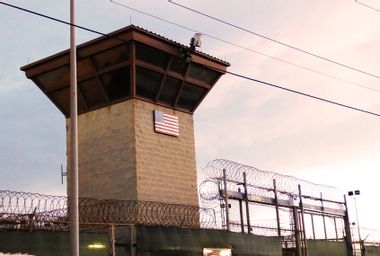
Lithuania is currently embroiled in a bizarre and deeply confusing political controversy which reveals what happens when a country becomes gripped by extremist ideologies. Evidence has emerged that Lithuanian intelligence agencies allowed secret CIA prisons to be maintained in their country during the Bush era. Just because such prisons would be "illegal" under the so-called "law" of Lithuania and various international conventions to which that nation is a signatory, irresponsible leaders of that country are demanding "investigations" and even possibly legal consequences if it turns out crimes were committed. What kind of a backwards, primitive country would do something like this?
[I]ncreasingly, after years of issuing denials, Lithuania's leaders are no longer ruling out the possibility that the CIA operated a secret prison in this northern European country of 3.5 million people, and that its government will have to deal with the fallout.
Last month, newly elected President Dalia Grybauskaite said she had "indirect suspicions" that the CIA reports might be true, and urged Parliament to investigate more thoroughly.
What sort of a newly elected President would get into office and then start demanding that actions From the Past -- rather than the Future -- be investigated, just because they might be "criminal"? This deeply irresponsible Lithuanian leader apparently doesn't care about inflaming partisan divisions, and worse, appears blind to the dangers of criminalizing policy disputes. Even more outrageously, Lithuania faces one of the steepest recessions in all of Europe; obviously, this is a time, more than ever, that Lithuanians should be Looking to the Future, Not the Past. Instead, they're wallowing in deeply inflammatory, partisan and extremist rhetoric like this:
Valdas Adamkus, who was president when the CIA prison was reportedly in operation, from 2004 until 2005, said he had no personal knowledge of the covert program. But he raised the possibility that Lithuanian security officials could face prosecution if the reports are confirmed.
"If this actually did occur, and it is grounded with proof, we have to apologize to the international community that something like this went down in Lithuania," he told the Baltic News Service. "And those who did it," he added, "in my eyes are criminals" . . . .
Dainius Zalimas, a legal adviser to the Lithuanian Defense Ministry, said the existence of a covert prison would violate both Lithuanian statutes and international human rights conventions that the government signed. If firm evidence is gathered by the Parliament, he said, prosecutors would be obliged to open a case and could target both Lithuanian and U.S. officials.
"From a legal point of view, it would mean that Lithuania, along with the United States, was contributing to quite serious violations of human rights," said Zalimas. . . .
"Criminals"? "Prosecutions"? "Obliged to open a case"? "Violations of human rights"? Just because they maintained a few secret prisons in violation of domestic and international law? What kind of crazy, purist, Far Leftist utopians are running that place? They need a heavy dose of pragmatism so they can understand all the reasons why so-called "crimes" like this can be overlooked -- just blissfully forgotten like a bad dream. Even worse, with intemperate and shrill language of the type they're throwing around, it's seems clear that the Lithuanian press is sorely in need of some David Broders, Fred Hiatts, and David Ignatiuses to explain to them that subjecting law-breaking political officials to "investigations" and "prosecutions" is quite disruptive and unpleasant when those crimes involve matters other than consensual sex between adults.
Even more alarming, this "rule of law" and "human rights" fetish seems to be spreading: "In neighboring Poland, prosecutors in the capital of Warsaw have opened a criminal probe into reports that the CIA operated a prison for al-Qaeda suspects near a former military air base." Last month, an Italian court convicted 22 CIA agents of the so-called "crime" of kidnapping someone off their street and sending him to Egypt to be tortured. And the British High Court this week released its written Opinion -- over the objections of British and American officials -- ordering the release of details of Binyam Mohamed's torture at the hands of U.S. agents.
Thankfully, the U.S. remains a bastion of pragmatic sanity in this rising sea of accountability extremism. Unlike those strange Eastern Europeans and absolutist Western European purist judges, we know there are far more important priorities than "investigating" war crimes, compelling transparency, and holding political criminals accountable. As the rest of the world gets distracted by all this chatter about The Past, our President gallantly protects us from such divisive unpleasantries by aggressively blocking any war crimes investigations and concealing evidence -- even modifying decades-old transparency laws to do so if necessary. Even more inspiring, our patriotic media enthusiastically plays a crucial helping role; The Washington Post has known since 2005 in exactly which countries the CIA maintained its illegal, secret prisons but still refuses to say, even though they've now been banned by Executive Order and even though Lithuania and Poland are launching investigations which the Post could easily answer, but chooses not to.
When President Obama was in China last week, he proudly boasted of the American commitment to transparency and lamented that China lacked such values. Fortunately, he doesn't get carried away with "principles" the way that these short-sighted Lithuanians and Polish and others do. Unlike those unhinged primitive nations with no democratic traditions, we understand that government crimes should be disclosed, investigated and punished only when they occur during a time other than the Past. It's vital that we maintain our leadership role in teaching this critical value to the world, lest the type of crazed accountability/rule-of-law fetish currently engulfing Lithuania spreads even further like some uncontrollable virus.
UPDATE: Jonathan Schwarz notes that in 2005, Donald Rumsfeld traveled to Lithuania and visited a museum in Vilnius which once housed a KGB prison, where the Soviets tortured prisoners. That museum exhibits "solitary confinement rooms which were used to break down the prisoners and make them confess." Shockingly, "the walls are padded and soundproofed, made to absorb the cries and shouts for help," as it was the site of barbaric acts like this:
Prisoners either had to stand in ice-cold water or to balance on a small platform. Every time they got tired they fell down into the water.
After his visit, Rumsfeld released an "Open Letter to the People of Vilnius," in which he solemnly observed that "the museum was a stark reminder of the importance of preserving our liberty at all costs." Schwarz asks: "Did Rumsfeld Tour KGB Torture Museum to Pick Up Useful Tips?"
UPDATE II: Here's a Getty photograph of what Rumsfeld called his "enjoyable and educational" trip to the KGB prison, accompanied by this apparently un-ironic caption: "Rumsfeld tours Lithuania’s KGB Museum, a torture site during the Stalin era, in October 2005" (h/t sysprog).
Former Vice President Dick Cheney got an award Wednesday night, the Center for Security Policy's "Keeper of the Flame Award." As you might expect of Cheney, he didn't use the occasion to bask -- instead, he went on the warpath, attacking his liberal critics generally and the Obama administration specifically.
It was, to say the least, an interesting venue for that kind of speech. Admittedly, the award has been given to plenty of other prominent figures, from former President Ronald Reagan to James Jones, who's now President Obama's national security advisor, Sen. Joe Lieberman, I-Conn. and Donald Rumsfeld. (Of that last man, Cheney said Wednesday, "truth be told, any award once conferred on Donald Rumsfeld carries extra luster, and I am very proud to see my name added to such a distinguished list.")
But the Center for Security Policy was founded by Frank Gaffney, who remains the organization's president. And in recent months, Gaffney has been an even harsher critic of Obama's than Cheney himself -- and a much more extreme one.
Just this past June, Gaffney wrote an op-ed for the Washington Times that was headlined, "America's First Muslim president?" He didn't really seem to mean it as a question, either, saying:
During his White House years, William Jefferson Clinton -- someone Judge Sonia Sotomayor might call a "white male" -- was dubbed "America's first black president" by a black admirer. Applying the standard of identity politics and pandering to a special interest that earned Mr. Clinton that distinction, Barack Hussein Obama would have to be considered America's first Muslim president ...
After his five months in office, and most especially after his just-concluded visit to Saudi Arabia and Egypt, however, a stunning conclusion seems increasingly plausible: The man now happy to have his Islamic-rooted middle name featured prominently has engaged in the most consequential bait-and-switch since Adolf Hitler duped Neville Chamberlain over Czechoslovakia at Munich ...
[T]here is mounting evidence that the president not only identifies with Muslims, but actually may still be one himself .... In the final analysis, it may be beside the point whether Mr. Obama actually is a Muslim. In the speech and elsewhere, he has aligned himself with adherents to what authoritative Islam calls Shariah -- notably, the dangerous global movement known as the Muslim Brotherhood -- to a degree that makes Mr. Clinton's fabled affinity for blacks pale by comparison.
Before that, back in April, Gaffney was saying, during an appearance on MSNBC, that Obama had been signaling to the world's Muslims that the U.S. would submit to Sharia law. And in an October 2008 column for the Times, Gaffney aligned himself with the Birthers, writing, "Another question yet to be resolved is whether Mr. Obama is a natural born citizen of the United States, a prerequisite pursuant to the U.S. Constitution. There is evidence Mr. Obama was born in Kenya rather than, as he claims, Hawaii .... Curiously, Mr. Obama has, to date, failed to provide an authentic birth certificate which could clear up the matter."
As for Cheney's speech, it struck predictable chords. According to the prepared text as provided to the Weekly Standard, the former vice president called the Obama administration's decision to scrap missile defense in Eastern Europe "a strategic blunder and a breach of good faith," slammed the administration's positions on Iran and Iraq, said of Afghanistan that the White House is "dithering while America's armed forces are in danger" and defended the Bush administration's anti-terror policies.
An excerpt from that last section of Cheney's remarks is below.
Our administration always faced its share of criticism, and from some quarters it was always intense. That was especially so in the later years of our term, when the dangers were as serious as ever, but the sense of general alarm after 9/11 was a fading memory .... Eight years into the effort, one thing we know is that the enemy has spent most of this time on the defensive -- and every attempt to strike inside the United States has failed. So you would think that our successors would be going to the intelligence community saying, “How did you did you do it? What were the keys to preventing another attack over that period of time?”
Instead, they’ve chosen a different path entirely -- giving in to the angry left, slandering people who did a hard job well, and demagoguing an issue more serious than any other they’ll face in these four years. No one knows just where that path will lead, but I can promise you this: There will always be plenty of us willing to stand up for the policies and the people that have kept this country safe.
On the political left, it will still be asserted that tough interrogations did no good, because this is an article of faith for them, and actual evidence is unwelcome and disregarded. President Obama himself has ruled these methods out, and when he last addressed the subject he filled the air with vague and useless platitudes. His preferred device is to suggest that we could have gotten the same information by other means. We’re invited to think so. But this ignores the hard, inconvenient truth that we did try other means and techniques to elicit information from Khalid Sheikh Muhammed and other al-Qaeda operatives, only turning to enhanced techniques when we failed to produce the actionable intelligence we knew they were withholding. In fact, our intelligence professionals, in urgent circumstances with the highest of stakes, obtained specific information, prevented specific attacks, and saved American lives.
In short, to call enhanced interrogation a program of torture is not only to disregard the program’s legal underpinnings and safeguards. Such accusations are a libel against dedicated professionals who acted honorably and well, in our country’s name and in our country’s cause. What’s more, to completely rule out enhanced interrogation in the future, in favor of half-measures, is unwise in the extreme. In the fight against terrorism, there is no middle ground, and half-measures keep you half exposed.
For all that we’ve lost in this conflict, the United States has never lost its moral bearings – and least of all can that be said of our armed forces and intelligence personnel. They have done right, they have made our country safer, and a lot of Americans are alive today because of them.
After an administration ends and the other party takes over, key members often find an institutional home from which to continue their arguments. In 2003, for example, veterans of the Clinton administration founded the Center for American Progress, to provide research and talking-points for center-left policies.
Following this basic model, Liz Cheney -- daughter of the former vice president and a former State Department official herself -- has gathered a group of conservatives of a particular ilk into a group she’s calling “Keep America Safe.” However, it’s not exactly a Bush administration in exile. Considering some of the people involved -- Weekly Standard editor Bill Kristol, blogger Michael Goldfarb and Cheney herself -- it might be more appropriate to call it a Cheney administration in exile.
Given the group’s principals, there should be little surprise about the main issues with which Keep America Safe is concerning itself. It’s basically your big neoconservative three: detention, torture and bombing. Nor is the argumentative style of the group and its members exactly a breath of fresh air. Bill Kristol explained the group’s purpose to Politico this way: “The Left has dozens of organizations and tens of millions of dollars dedicated to undercutting the war on terror. The good guys need some help too.” On Twitter, Michael Goldfarb wrote, “Why doesn't the left want to Keep America Safe...sort of surprised by all the hostility.”
The Politico article on the group also highlights a two-minute promotional video that it produced. You won’t exactly be enlightened by the content, which is a series of intensely misleading half-truths. The basic gist is, to paraphrase Goldfarb, that President Obama doesn’t want to Keep America Safe.
So here's a quick breakdown of the video’s claims. Thanks goes out to “Keep America Safe” for the “rhetoric vs. reality” format, which I will shamelessly appropriate:
Here it might be instructive to go back to Center for American Progress for a moment. As it happens, Politico recently ran an article on Think Progress, a CAP-based blog. Among the people asked for a quote was none other than Keep America Safe’s Michael Goldfarb. Said Goldfarb, “They’re a shameless bunch of lying, distorting, propagandists, which I respect, and I don’t know what MSNBC would do without them. But I think the high watermark for Think Progress is long past.”
And with that, Goldfarb went back to his office in the Cheney administration in exile.
The day that Raymond Azar was taken by force to Bagram was a quiet day in Kabul. There were no attacks and the sun was shining.
Azar, who is originally from Lebanon, is the manager of a construction company. He was on his way to Camp Eggers, the American military base near the presidential palace, when 10 armed FBI agents suddenly surrounded him.
The men, all wearing bulletproof vests, put him in handcuffs, tied him up and pushed him into an SUV. Two hours later, they unloaded Azar at the Bagram military prison 31 miles northeast of Kabul.
As Azar later testified, he was forced to sit for seven hours, his hands and feet tied to a chair. He spent the night in a cold metal container, and he received no food for 30 hours. He claimed that U.S. military officers showed him photos of his wife and four children, telling him that unless he cooperated he would never see his family again. He also said that he was photographed while naked and then given a jumpsuit to wear.
A need for this sort of place
On that day, April 7, 2009, President Barack Obama had been in office for exactly 77 days. Shortly after his inauguration, Obama had ordered the closing of the Guantánamo Bay detention center and ordered the CIA to give up its secret "black site" prisons. He wanted to shed the dark legacy of the Bush years -- there should be no torture anymore, no more secret kidnapping operations of terrorism suspects, no renditions. At least, that was what Obama had promised. He did not mention Bagram in his speeches.
Azar was in Kabul on business. His company had signed contracts with the Pentagon worth $50 million for reconstruction work in Afghanistan. On April 8, Azar was placed onto a Gulfstream and flown to Virginia to face charges. He was accused of having bribed his U.S. Army contact to secure military contracts for his company, and he was later found guilty of bribery.
It was a classic case of corruption, which is not the sort of crime for which a suspect is normally sent to a military prison. No one can explain to Azar why he was taken to Bagram, where the U.S. military treated him like a terrorism suspect and, in doing so, inadvertently provided him with an insight into a world it normally prefers to keep under wraps.
Bagram is "the forgotten second Guantánamo," says American military law expert Eugene Fidell, a professor at Yale Law School. "But apparently there is a continuing need for this sort of place even under the Obama administration."
From the beginning, "Bagram was worse than Guantánamo," says New York-based attorney Tina Foster, who has argued several cases on behalf of detainee rights in U.S. courts. "Bagram has always been a torture chamber."
And what does Obama say? Nothing. He never so much as mentions Bagram in any of his speeches. When discussing America's mistreatment of detainees, he only refers to Guantánamo.
Classified location
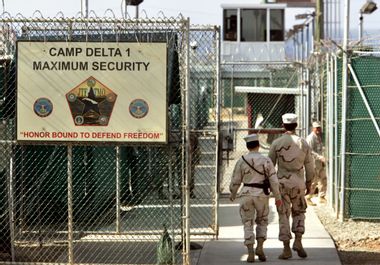
The Bagram detention facility, by now the largest American military prison outside the United States, is not marked on any maps. In fact, its precise location, somewhere on the periphery of the giant air base northeast of the Afghan capital, is classified. It comprises two sand-colored buildings that resemble airplane hangars, surrounded by tall concrete walls and green camouflage tarps. The facility was set up in 2002 as a temporary prison on the grounds of a former Soviet air base.
Today, the two buildings contain large cages, each with the capacity to hold 25 to 30 prisoners. Up to 1,000 detainees can be held at Bagram at any one time. The detainees sleep on mats, and there is one toilet behind a white curtain for each cage. A $60 million extension is expected to be completed by the end of the year.
Unlike Guantánamo, Bagram is located in the middle of the Afghan war zone. But not all the inmates were captured in combat areas. Many terrorism suspects are from other countries and were transported to Bagram for interrogation after being captured. Since the military prison first came into operation, all the detainees there have been classified as "enemy combatants" rather than prisoners of war, which would make them subject to the provisions of the Geneva Convention.
Bagram's most prominent temporary detainee to date was Khalid Sheikh Mohammed, the self-proclaimed chief architect of the Sept. 11, 2001, terrorist attacks. After his arrest in Pakistan, Mohammed was initially taken to Bagram for three days and was then held at a secret prison in Poland before being flown to Guantánamo. He told representatives of the Red Cross that he was beaten in Afghanistan, suspended from shackles attached to his hands and sexually humiliated. "I was made to lie on the floor," he said. "A tube was inserted into my anus and water poured inside."
"In my view, having visited Guantánamo several times, the Bagram facility made Guantánamo look like a nice hotel," says military prosecutor Stuart Couch, who was given access to the interior of both facilities. "The men did not appear to be allowed to move around at will, they mostly sat in rows on the floor. It smelled like the monkey house at the zoo."
Sleep deprivation and sexual humiliation
From the beginning, Bagram was notorious for the brutal forms of torture employed there. Former inmates report incidents of sleep deprivation, beatings and various forms of sexual humiliation. In some cases, an interrogator would place his penis along the face of the detainee while he was being questioned. Other inmates were raped with sticks or threatened with anal sex.
Omar Khadr, a Canadian inmate who was 15 at the time, says military personal used him as a living mop. "Military police poured pine oil on the floor and on me. And then, with me lying on my stomach with my hands and feet cuffed together behind me, the military police dragged me back and forth through the mixture of urine and pine oil on the floor."
At least two men died during imprisonment. One of them, a 22-year-old taxi driver named Dilawar, was suspended by his hands from the ceiling for four days, during which U.S. military personnel repeatedly beat his legs. Dilawar died on Dec. 10, 2002. In the autopsy report, a military doctor wrote that the tissue on his legs had basically been "pulpified." As it happens, his interrogators had already known -- and later testified -- that there was no evidence against Dilawar.
According to an internal military investigation of the prisoner abuse cases at Abu Ghraib prison in Iraq, which triggered worldwide outrage when it became public in 2004, the practices there were inspired by the treatment of inmates at Bagram.
Hundreds of innocent inmates
To this day, there are hardly any photos from inside Bagram, and journalists have never been given access to the detention center. Although exact numbers are unknown, there are believed to be about 600 detainees at Bagram, or close to three times as many as there currently are at Guantánamo. According to an as-yet-unpublished 2009 Pentagon report, 400 of the Bagram inmates are innocent and could be released immediately.
The detainees at Bagram still have no right to an attorney, which means that they have no legal recourse against their imprisonment and no opportunity to testify in their cases. Some have been there for years, without knowing why.
Obama has announced new guidelines for the treatment of the Bagram detainees, which would require that a U.S. military official provide assistance to each detainee -- not as an attorney but as a personal adviser of sorts. This representative could then review evidence and witness testimony for the first time, and could request that a review board examine the case.
Worst abuse
However, attorney Tina Foster feels that the new initiative is just a cosmetic measure. "There is absolutely no difference between the Bush administration and the Obama administration's position with respect to Bagram detainees' rights," she said during an interview.
Foster, a petite 34-year-old with dark brown eyes and black hair, took on the cases of Guantánamo detainees as an attorney with the New York-based Center for Constitutional Rights. That was before she discovered that the worst prisoner abuse happened long before the detainees arrived in Guantánamo -- at Bagram.
Since 2005, Foster has worked exclusively with Bagram cases. She has appeared in court to file habeas corpus petitions for three Bagram inmates. Normally, every prisoner is entitled to habeas corpus rights, which would give him the opportunity to petition a U.S. court to investigate the reasons for his arrest.
"This ugly chapter of American history"
In early April of this year, a judge ruled in favor of Foster's petition, arguing that because her three clients, two Yemenis and a Tunisian, had not been "captured in a battlefield situation" in Afghanistan but instead had been taken to Bagram from a third country, they too had rights guaranteed by the U.S. Constitution. "That was a huge success," says Foster.
Last Monday, the U.S. Justice Department submitted a 64-page brief to the appeals court, challenging the decision. The Justice Department lawyers argued that, as a military prison in a combat zone, Bagram constitutes a special case.
Foster, who supported Obama during the campaign and then voted for him, is disappointed by her former idol. "When I heard his announcement to close Guantánamo, I breathed a sigh of relief that perhaps this extremely ugly chapter of American history was finally being put to an end," she says. "Unfortunately, since then, the Obama administration has completely failed in delivering the change that was promised."
Left in the snow
Foster plans to continue fighting for that cause, even though one of her clients, whose witness testimony figured prominently in her case, is now dead. Jawed Ahmad, who was also known as Jojo Yazemi, was a journalist working in Afghanistan for a Canadian television station. He was 22 when he was arrested in October 2007.
The Americans accused him of being in contact with the Taliban. They incarcerated Yazemi at Bagram, where he became just another "enemy combatant" -- detainee No. 3,370. They left him standing in the snow for six hours, beat him, threatened him and submitted him to sleep deprivation for weeks. It was only after fellow journalists in New York launched a major media campaign in support of Yazemi that he was released -- after 11 months and without any explanation as to why he had been detained in the first place.
Just six months after his release, gunmen driving a white Toyota pickup truck, the kind favored by many Taliban, shot and killed Yazemi in Kandahar. "It was one of the most terrible moments of my life," says Tina Foster. "He was a great person and a friend." And he was also Foster's star witness in her case against Bagram.
Translated from the German by Christopher Sultan.
This article has been provided by Der Spiegel through a special arrangement with Salon. For more from Europe's most-read newsmagazine, visit Spiegel Online or subscribe to the daily newsletter.
A group made up of former directors of Central Intelligence and the CIA has written to President Obama, asking him to overrule Attorney General Eric Holder and stop an investigation into cases in which CIA employees and contractors went beyond the interrogation limits set by the Bush administration.
The letter is signed by everyone who's headed the CIA since 1973 and is still living, with just two exceptions -- former President George H.W. Bush and Secretary of Defense Robert Gates. Included among the signatories are three men appointed to their post by former President Clinton -- R. James Woolsey, John Deutch and George Tenet -- and two appointed by President George W. Bush, Porter Goss and Michael Hayden.
"Attorney General Holder’s decision to re‐open the criminal investigation creates an atmosphere of continuous jeopardy for those whose cases the Department of Justice had previously declined to prosecute. Moreover, there is no reason to expect that the re‐opened criminal investigation will remain narrowly focused," the letter says.
"If criminal investigations closed by career prosecutors during one administration can so easily be reopened at the direction of political appointees in the next, declinations of prosecution will be rendered meaningless. Those men and women who undertake difficult intelligence assignments in the aftermath of an attack such as September 11 must believe there is permanence in the legal rules that govern their actions .... [T]his approach will seriously damage the willingness of many other intelligence officers to take risks to protect the country. In our judgment such risk-taking is vital to success in the long and difficult fight against the terrorists who continue to threaten us."
The Justice Department has put out this statement in response:
The Attorney General works closely with the men and the women of intelligence community to keep the American people safe and he does not believe their commitment to conduct that important work will waver in any way.
Given the recommendation from the Office of Professional Responsibility as well as other available information, he believed the appropriate course of action was to ask John Durham to conduct a preliminary review. That review will be narrowly-focused and will be conducted by a career prosecutor who has shown an ability to handle cases involving classified information. Durham has not been appointed as a special prosecutor; he will be supervised by senior managers at the Department.
The Attorney General’s decision to order a preliminary review into this matter was made in line with his duty to examine the facts and to follow the law. As he has made clear, the Department of Justice will not prosecute anyone who acted in good faith and within the scope of the legal guidance given by the Office of Legal Counsel regarding the interrogation of detainees.
The full letter is available in PDF form here.
Earlier this week, former Attorney General Alberto Gonzales said he supported current Attorney General Eric Holder's decision to open an investigation into certain CIA abuses of detainees. Now, he's taking it back.
In an interview with a Washington Times radio program Tuesday, Gonzales said, "We worked very hard to establish ground rules and parameters about how to deal with terrorists. And if people go beyond that, I think it is legitimate to question and examine that conduct to ensure people are held accountable for their actions, even if it's action in prosecuting the war on terror."
On Thursday, in a new interview with the Times, the former attorney general was singing a different tune.
"Contrary to press reporting and based on the information that's available to me, I don't support the investigation by the department because this is a matter that has already been reviewed thoroughly and because I believe that another investigation is going to harm our intelligence gathering capabilities and that's a concern that's shared by career intelligence officials and so for those reasons I respectfully disagree with the decision," Gonzales said. "I respect the right of the attorney general to make this decision based upon his judgement of the facts, but again based upon what I know I disagree with the decision."
When a reporter for the Times read his original quote back to him, Gonzales replied, "[I]t's an endorsement of [Holder's] right to exercise his discretion. I'm just saying I would have exercised my discretion in a different manner, given the information I have .... So when I talk about how we expect people to abide by a certain set of rules, and if they don't they ought to be looked into, it's been looked into."
Suppressed images don't show rape, official says
The Pentagon says no sexual abuse, no Abu Ghraib photos among those held back in ACLU suit.
By Mark Benjamin, Salon
Taguba denies he's seen abuse photos suppressed by Obama
The general told a U.K. paper about images he saw investigating Abu Ghraib -- not photos Obama wants kept secret.
By Mark Benjamin, Salon
A guide to Salon's investigation of torture, American-style
From Abu Ghraib to Abu Zubaydah, everything you need to know about torture during the Bush administration's war on terror.
By Mark Benjamin, Salon
Gitmo general told Iraq WMD search team to torture
Recent news reports have suggested the possibility that the Bush administration might have endorsed torture to prove an Iraq-al Qaida link.
By Alex Koppelman, Salon
Soufan: CIA torture actually hindered our intelligence gathering
An FBI agent testifies that an al-Qaida prisoner provided useful intelligence until the CIA got rough -- and casts doubt on Bush's statements about the effectiveness of harsh interrogations.
By Mark Benjamin, Salon
The Dark Side: The Inside Story of How The War on Terror Turned into a War on American Ideals
In this fascinating book, a staff writer for The New Yorker examines both the controversial excesses of the war on terror and the home-front struggle to circumvent legal obstacles to its prosecution.
By Jane Mayer