

In 1930, Mahatma Gandhi and 78 followers marched 241 miles across the state of Gujarat to the sea. When he reached the coastal saltpans, Gandhi scooped up and held aloft a handful of salt -- proclaiming resistance not just to Britain's ban on the private production of salt, but to its colonial reign. In a famous photograph taken during what became immortalized as the Salt March he is shown being led by a child -- symbol of an independent India that would soon be born.
Salt is a powerful symbol of purity, tradition and freedom for Indians. But today, it has come to symbolize something darker: the catastrophic consequences of adhering to tradition in the face of scientific knowledge. In a bitter irony, the traditional harvesting and marketing of salt -- a tradition whose defenders claim honors the independent spirit of Gandhi -- is threatening to blight the lives of tens of millions of Indian children.
The villain is iodine deficiency, one of the world's oldest and most devastating nutrition-related health problems. Iodine deficiency disorders (IDDs) are the leading cause of mental retardation in the world. In India, 70 million people suffer from IDDs, with 200 million more at risk. A 1995 UNICEF report estimated that 900 million people around the world suffer from iodine deficiency; 5 million of them are cretins, with millions more suffering lesser mental and neurological problems. 1.6 billion people, almost a third of the global population, are at risk.
Iodine deficiency causes severe hormone-induced physiological damage to fetuses and newborns, resulting in a terrible list of problems: cretinism, stunting, deaf-mutism, malformed limbs, spastic motor disorders, stillbirths, reproductive failure, poor vision and goiter (a grotesque swelling of the thyroid gland on the neck), as well as milder forms of mental and physical impairment.
Iodine is a micronutrient, a trace element that occurs naturally in the soil. Although replenished somewhat by the cycle of evaporation and rain, the earth's soil is gradually being stripped of iodine. Because the human body cannot retain iodine (unlike most other micronutrients), the vegetables and pulses that are iodine-rich must be consumed daily. Hence the worst cases of iodine deficiency are found in the highland regions of the world, areas of greatest soil degradation, where vegetables and pulses have the lowest content of iodine (seaweed, which was used in ancient times as a cure for goiter, has the highest iodine content). However, there is no region in India free of IDD: It is found in the major cities as well as in distant villages.
The tragedy is that iodine deficiency disorders are easily preventable. Studies in highland Guatemala, and in the Himalayan regions of India and Sikkim in the 1950s, proved unequivocally that iodized salt -- salt treated with potassium iodine or iodide -- dramatically reduces the incidence of IDDs. Mandatory iodization of salt, which was introduced by Switzerland in 1922, virtually eliminated the "village idiot" from the gallery of European archetypes, although IDD lingers on in pockets there and is quite severe in poorer countries such as Bulgaria and Romania. The United States and a few other developed nations, including Australia and the Scandinavian countries, have completely conquered the problem.
In the developing world, the roadblocks to wiping out such a widespread public health scourge are much higher. Sub-Saharan Africa, China, Indonesia and the vast region bordering the Himalayas are particularly affected. But there, too, the disease is on the run: UNICEF, which has led the international battle against IDDs, estimates that iodized salt programs have protected 12 million children a year from brain damage.
In 1997, after decades of activism by health experts and international development agencies, India enacted its own Universal Salt Iodization code. At a cost of about a penny per person per year, the program promised to free the world's second most populous country of a scourge that has blighted millions of young lives. In May 2000, in an address at The Hague which referred to India's two-year-old mandatory salt iodization legislation, the noted Indian nutritionist Professor V. Ramalingaswami said that "India is on the brink of the elimination of Iodine Deficiency Disorders as a public health problem."
But in July 2000, only two years after passing the code, the Indian government repealed it -- surrendering to pressure from the highly vocal small salt producer's lobby, as well as to widespread arguments that mandatory iodization was coercive, unfair and an act of multinational exploitation.
Curiously, the statement issued by the Ministry of Health and Family Welfare repealing the legislation said nothing about the overwhelming body of scientific evidence that supports iodization, making only vague references to the "point of principle [that] such a public health measure should not be enforced through statutory provisions."
The decision to repeal the iodization laws appalled the nation's doctors and scientists. Some pointed out that the repeal would not affect the rich, who would continue to buy iodized salt, but the poor, who would be unaware of the risk of using the slightly cheaper salt. The Indian Medical Association, saying the repeal "re-imposes a serious public health burden," lamented that the laws should have stood "for the next century."
Darshdi, a desert village in Gujarat which lies just 20 miles from the Pakistan border in the dry lands of the Indus valley, is typical of many communities bedeviled by malnutrition in general, and iodine deficiency in particular. Visiting this tiny village of perhaps 20 families is like travelling to the middle ages. Years of malnutrition have weakened both the people and animals, and a short walk around the dusty and ill-kempt huts littered between the salt thorn bushes provides a shocking sight: The majority of the children of Darshdi who play under the fierce desert heat are cretinous and malformed, suffering the ravages of the most common forms of iodine deficiency afflictions.
A group of boys plays marbles beneath a stunted tree, two hunchbacked, others with bodies cruelly twisted by malformation. One young child of perhaps three sits listlessly to one side, eyes fixed with a permanent expression of surprise, her head lolling to her shoulder, arms fallen by her side with not a trace of the usual sprightly alertness and cheer of Gujarati children. A young mother in a hut gently feeds another child who seems almost incapable of ingesting the thin white paste that is encouraged into her mouth. Others recoil in unnatural terror from the visitors who are passing through, and scream and wail with tortured cries for a relief that they can never have. A dog licks an apparently sleeping boy until struck by a rock pitched by a hunchbacked boy with twisted legs who flings himself across the dirt with his arms.
An estimated 15 percent of Gujarati children suffer from malnutrition -- 2 percent from the most severe manifestations seen in Darshdi. Malnutrition -- and, specifically and horrifically, IDD -- reinforces itself: The parents of Darshdi must spend a disproportionate amount of time caring for their children instead of tending to crops and animals. That means less food, less quality nutrition, and less money to spend on extra dietary staples. The parents themselves are weakened by the effort. Darshdi is a dying village, and its children are doomed.
Darshdi has no school, and no health post, but its basic health needs are attended to by Dr. Ram Savla, a general practitioner and nutritionist who has maintained an impoverished private clinic in the region for five years. Dr. Savla, who has studied the problem of nutrition intensively, says that while he believes that health problems must ultimately be addressed at a local level, the repeal of India's salt legislation is a step back into the dark days when India could not support its basic food needs. "I don't understand the argument for not having enforced iodization of salt, and reinforced flour if it comes to that," he says.
He holds the upturned face of a young girl who clutches at his trousers, her mouth agape in an odd tiny smile. "This is Rajee, five years old, with no hope of a future," he says. "Hers is the face of the salt debate."
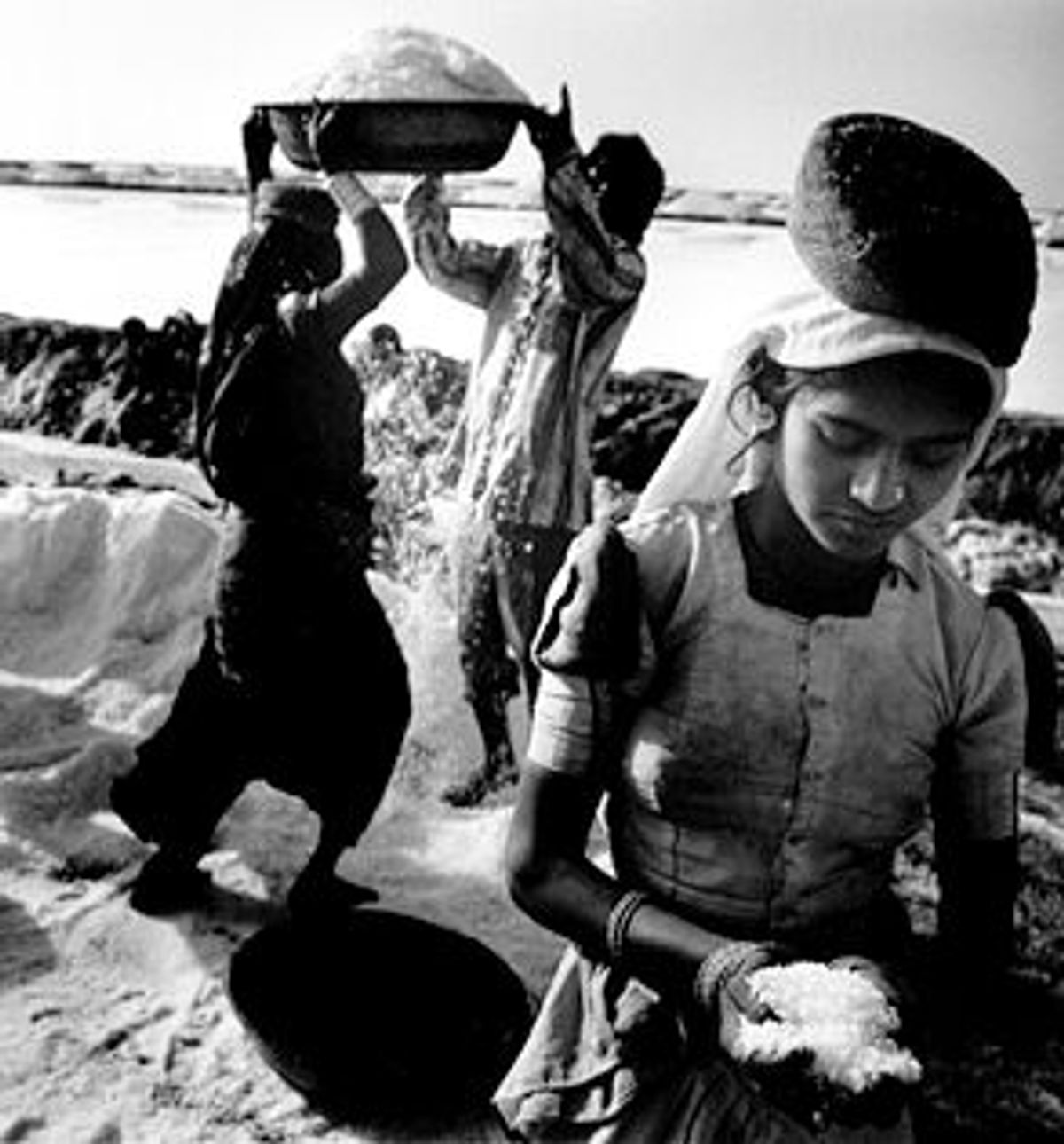
In Gujarat, which produces approximately 70 per cent of India's annual salt requirements -- enough for 700 million people -- salt is still mined using methods that are many centuries old.
From the air, the coastal saltpans where Gandhi ended his march and made his legendary gesture are a checkerboard seam of silver and sludge squares, glittering along the shore, a fringe of patterned pearl teeth in a pool of brown land that spills into an even browner sea. Threads of roads, tiny paths and intersecting banks that separate the fields spindle across the squares like a torn net, and small figures dot the white.
On the ground, a jagged mural of primitive industrial activity fills the landscape, an unforgiving forge of desert and muddy ocean. A searing white sun burns down from above while the thin sheet of steadily evaporating salt water that covers each of the neat fields reflects a blaze of light that scalds the eyes, darkens the flesh and parches the throats of the workers. Cantankerous, crazily patched diesel pumps slowly regurgitate streams of salty water from bore holes into the channels that fill the fields. Boys as young as 10 rake the surfaces of briny water with wooden tools to even out the salt that is slowly captured, slowly stranded, slowly dried by the asphyxiating heat, until what is left are hard fields of coarse salt combed into ranks.
Teams of men and women hoe those long ranks of white crystals into tin dishes. Mothers and daughters heave the dishes onto their heads, taking a curiously graceful step forward as they receive the weight, then trudge with their loads to dump carts.
Two thousand tons per 10-acre plot per year. Eight to 10 workers per holding. Thousands of holdings strung along the Gujarat coastline, providing livelihoods to tens of thousands of workers and their families. Most of the salt workers are low-caste itinerants from other states, who work for both large and small holders. They are badly paid and live in seasonal shanty towns along the coast. Their already difficult life has been made even tougher for the past three years by a deadly triumvirate of natural disasters: Cyclone, drought and, in January this year, an earthquake that left 20,000 Gujaratis dead.
Ironically, these salt workers, who tend to use the salt at their feet -- un-iodized, and "pure" -- record some of the highest incidences of IDD. Children with goiter, cretinism and malformations populate their communities. Poor nutrition, inadequate education and poverty itself combine to imprison these people in a cycle of disabling choices. As one worker says, unconsciously stating the problem as he looks across the bountiful hot fields of salt, "There is no difference between this salt and the manufactured stuff in plastic bags. But our salt is purer."
Medium to large companies account for more than two-thirds of the total salt production and use much the same methods as the small plots to "harvest" their produce. The raw crystals are then machine-processed into consumer-friendly fine salt, and iodized. However, another 30 per cent of that total production is extracted and sold by small farms at slightly lower prices in the form of unprocessed, roughly bagged, iodine-sprayed crystallized salt. This is a crude product that tends to harden into a single lump if touched by damp, and is also adulterated by impurities during the harvesting. It is the continuing iodization of this product, still used by a staggering 200 million people, which is at issue.
The controversy over iodized salt cannot be understood without grasping the plight of the small salt farmers. Even as a considerable portion of Indian society has grown prosperous in a decade-old free market economy, it has become harder and harder for small salt producers to eke out a living. Many small producers are farmers driven from their land throughout the 1990s by drought, who obtained 10-acre coastal leases from the government to produce salt.
This influx of producers strained an already-overcrowded market to the breaking point -- and the 1997 iodization enforcement legislation, which compelled even small salt producers to iodize their product, was the last straw. The expense of obtaining the cheap spray machinery used in the iodization process was widely resented, despite the best efforts of the government and development agencies to support the industry through loans and cooperative groupings. Small producers saw the salt law as one imposed by faraway legislators to cure an intangible health problem, using an expensive foreign substance (iodine is imported), at the cost of food on a salt farmer's table. By a perverse irony, the salt lobby -- whose opposition to the law is condemning hosts of defenseless children to imbecility -- sees itself as the underdog, David to a Big Government Goliath.
The marginalization of the small producer has become a symbol of the conflicts faced by an India in transition -- big business and multinational companies versus homespun tradition and the common man. India's version of the globalization battle has been conveniently, and tragically, reduced to one issue -- salt. In conservative Gujarat, this stark metaphor has stirred political passions that have been heard throughout India, where memories of the exploitation of domestic industries by the British (such as homespun cloth and salt) still rankle, decades after their departure.
Those who are opposed to the compulsory manufacture of iodized salt put forward many arguments. They maintain that IDDs affect a negligible percentage of the population. They say that a surfeit of iodine is harmful. They say that iodized salt is expensive because iodine must be imported; that the plastic bagging process necessary to the preservation of the iodine content is polluting on a massive scale; that the mandatory policy is ruining small workers; that the policy is driven by the greed of multinational corporations and organizations; that industrial iodization is inefficient; that the lack of iodine is due to fertilizers in the soil; that the way Indians cook means that iodine evaporates during the cooking process, rendering iodization pointless. They even argue that banning un-iodized salt when tobacco and alcohol are freely available is undemocratic.
None of these arguments are convincing. The safety of iodized salt has been firmly established by seven decades of testing; studies of the Japanese provide no evidence that an iodine-rich diet (seaweed is a major ingredient of Japanese cooking and is the natural repository of much of the iodine that is flushed from the earth's soil) is detrimental to health. Nor do Indian cooking techniques destroy iodine: Tests show that only 30 per cent of iodine is lost during cooking, leaving sufficient quantities to prevent IDDs.
As for cost, even in impoverished nations, iodized salt is affordable. According to one nutritionist, "The additional cost of iodization per person in India is about the cost of a cup of tea per year. It's negligible, even in a poor man's budget."
As for the emotional arguments that greedy, monolithic multinational organizations are driving local industries out of business, they're beside the point. The real problem faced by small producers is not mandatory iodization but tension created by a changing economic system. India has been open to free trade for only 10 years, and competition among once-protected industries has become savage. As the once-negligible Indian middle class has swelled to 350 million within a decade, its demand for premium products -- including iodized salt, which is seen by increasing numbers of Indians as more "user-friendly" -- has grown.
Finally, the argument that IDDs affect relatively few people is simply false. It is true that IDDs are not the major health threat they were in some countries, but that is a direct result of the policy of universal salt iodization driven by international agencies such as UNICEF.
The salt and iodine marriage, like that of fluoride and water, is one of the few cases where a universally-used product can be cheaply treated to solve a public health threat. Accordingly, organizations such as UNICEF that have been involved in the decades-long struggle to wipe out IDDs have little time for the argument that legislative imposition is "undemocratic." Community consent is desirable, but iodized salt saves children from a terrible affliction.
"As in all things, there is a balance of concerns," says Maria Calivis, the UNICEF representative in India. "But this is a country of immeasurable distance between those who have the luxury to debate and those who simply work, sicken and die. When we speak of the right to choose, we should ask one question: Is the freedom to choose on the IDD issue realistic for those most at risk in India? The answer, for now, is no. Someone has to make that choice for the marginalized and for children."
Shares