
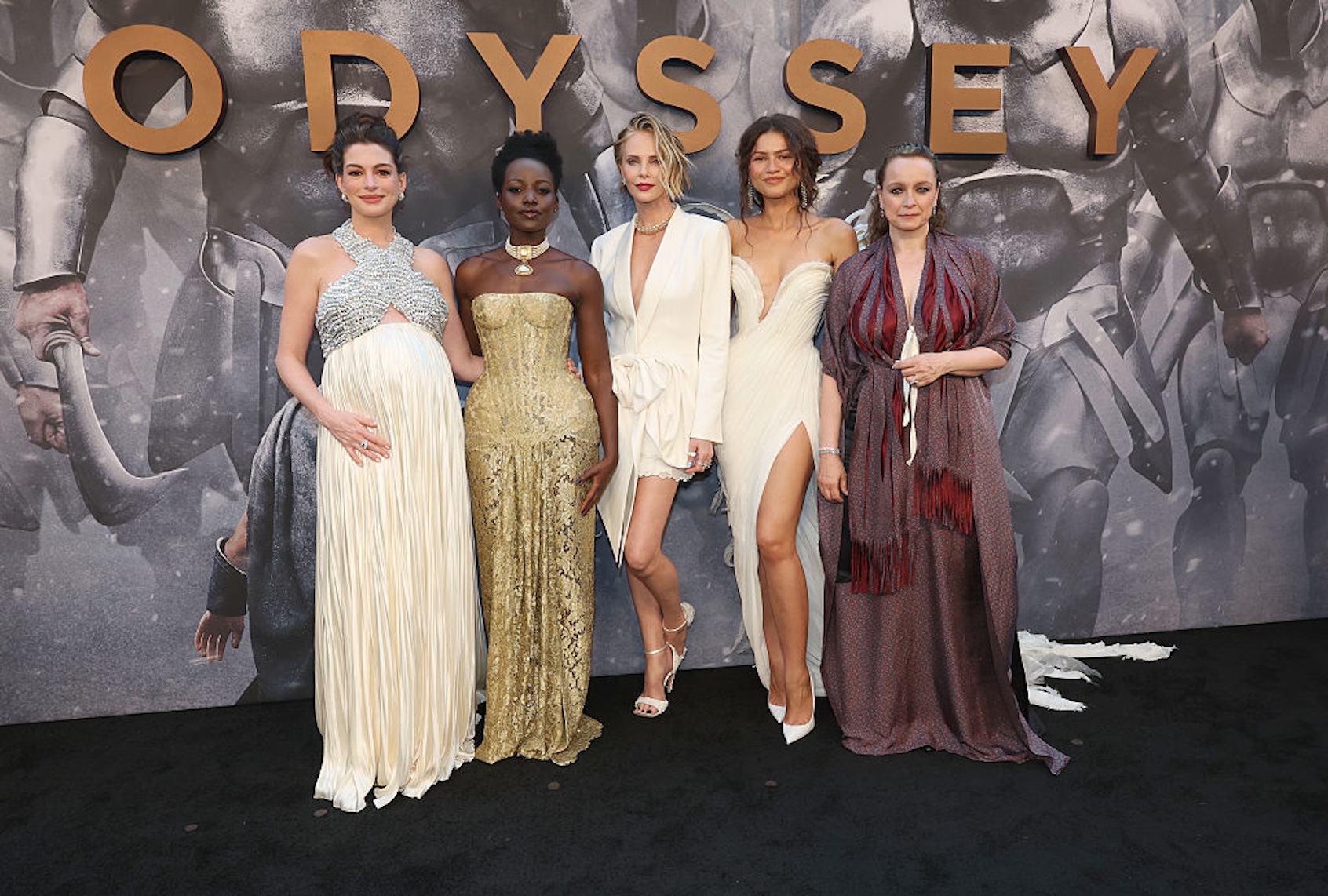

Christopher Nolan’s highly anticipated summer blockbuster “The Odyssey” hit theaters over the weekend. A cinematic retelling of Homer’s epic is not a particularly original idea. The Internet Movie Database (IMDB) lists no fewer than 53 adaptations and, inevitably, the website omitted smaller or older productions. The first feature-length film of “The Odyssey,” the 1911 Italian “L’Odissea,” did not make the list, nor did “L’ile de Calypso ou Le Géant Polyphème,” the 1905 six-minute short by the pioneering French filmmaker Georges Méliès, which was most likely the first adaptation.
Nolan, then, is not necessarily doing anything new. In every land and in every generation for nearly 3,000 years, people have found resonance in the story of Odysseus’ journey home, making changes to the plot and characters as made sense for that era and people.
But this is our time, and perspective is not one of the era’s more obvious features. Since the announcement of Nolan’s film, much of the public attention has been paid to the film’s cast and whether it reflects a desire by Nolan, Hollywood or maybe “the left” to make Homer “woke.” The chief topic of conversation has been the decision to have Helen, the mythic — remember this is a story with little or no basis in history — beauty whose kidnapping by the Trojan prince Paris launched the Trojan War, portrayed by Kenyan actress Lupita Nyong’o. There has also been so late-arriving tongue wagging about the trans actor Elliot Page in the relatively minor role of Sinon (though the internet had initially decided, incorrectly, that Page was playing Achilles). This is all to say: A disproportionate amount of the public discourse around Nolan’s film has focused, predictably, on race and gender. Because isn’t that all we talk about these days?
Some among those upset by the current cast have been quick to note that, despite a good part of the movie being shot in Greece, there is not a single ethnically Greek actor in the film’s main cast.
Of course, there is a twist here in this particular incarnation of our unending conversation. “The Odyssey,” at least as it has been understood for a good couple of millenia, is a Greek story. And some among those upset by the current cast have been quick to note that, despite a good part of the movie being shot in Greece — thanks in no small part to Greece’s very generous tax concession for such activity — there is not a single ethnically Greek actor in the film’s main cast.
As a Greek American, this particular critique has probably been more prevalent on my social media timeline. But since Ben Shapiro has taken the occasion of this debate to argue that Greeks, as many academics would agree, are in fact not white, this seems a good occasion to move beyond our normal shouting across the divide to ask slightly more probing questions about our national — and one might argue even global — obsession with whiteness and its borders. Because this conversation has everything to do with Greeks; the Classical tradition’s detachment of ancient Greece from the diverse, interconnected world of the eastern Mediterranean; and the ways in which our contemporary discourse is locked within the grip of a paralyzing presentism.
First, let’s be clear about the relationship of “The Odyssey” to both modern Greek identity and global culture. Because neither history is a straightforward one.
Certainly from the Classical Period — that is, roughly the time of Pericles and Socrates — Greeks understood the Homeric poems as their founding myths. Yet just as the English would discover much later, when elevating “Beowulf” to the status of national epic, there is a problem with placing the oldest existent text in your language at the center of your national identity. Namely, your national (or rather ethnic, in the case of the ancient Greeks) identity is usually much more recent than the first text in your language.
Language, after all, is often one of the things that creates that identity. The Greek word for Greeks, Ἕλληνες, appears only once in “The Iliad” and is not present at all in “The Odyssey.” If Odysseus were a real person, it is unlikely he would have thought of himself at all as an Ἕλληνες. It’s impossible that he would have thought of himself as Greek in the same way Pericles might have, and he certainly wouldn’t have viewed his identity in the way I and other modern ethnic Greeks see ours. For me and many others, this includes being the citizen of a nation-state that did not exist until 1821, making modern Greece younger than Sweden, Russia, the United Kingdom, France and the United States, to name just a few countries.
The Greek claim to Homer is a ultimately a linguistic claim, one which is complicated by the fact that from the time of Alexander the Great, who lived more than 500 years after “The Odyssey” was first written down, the Greek language spread far beyond the eastern Mediterranean, becoming an important lingua franca in the ancient and medieval world. And that was before the Renaissance.
Start your day with essential news from Salon.
Sign up for our free morning newsletter, Crash Course.
Greek had largely disappeared in Europe during the Middle Ages, but the fall of the Byzantine Empire to the Ottomans in 1453 sent a wave of Greek-speaking refugees, who would likely have thought of themselves as Romanoi — Romans — not Greeks, into Western Europe, mainly Italy at first, but also France, the Low Countries and the German states. Many of them, scholars by training, found work as Greek teachers, and this wave of Greek instruction helped fuel both the Renaissance and, shortly after, the Reformation.
Central to the Renaissance was the creation of an idea, and an academic discipline, we now call the Classics. While self-evident to us today, this notion was not necessarily an obvious one, resting upon the idea that there was a unique period of human flourishing between roughly 800 B.C.E. and 500 C.E. (a vast span of time) in the ancient Mediterranean (a large geographic area). Ancient Greece and the Roman Empire, so Renaissance thinking went, were the cultural ancestors of the “West,” an imagined cultural space then beginning to take shape. Since this was the era in which Western Europeans — be they Spanish, Portuguese, English or Dutch — were sailing out onto the vast oceans, to Africa, Asia and the newly-contacted Americas, modern colonialism shares a birthday with the Classics. The two are ultimately inseparable from that most pernicious child of both: whiteness.
We need your help to stay independent.
All of this, though, only works if we believe that the ancient people of the Mediterranean were “white” — a term and concept that would have meant as little to them as “Greek” would have meant to Odysseus. That assumption also obscures another historical irony: The modern inhabitants of the Mediterranean, including the nation-states of Greece and Italy, have not always been seen and treated as “white” — particularly in the United States, at least not in the ways that count most. Of course, today most Greek and Italian Americans view themselves, and are largely viewed by others, as white. But as Shapiro oddly proved, that whiteness, perhaps like all whiteness, is conditional, easily revoked when it is no longer useful for policing the borders of race.
“The Odyssey” is the story of a man trying to get home to his own people, his own family, his own wife. On that journey, he routinely encounters others of all sorts: the dangerous and the kind, the cruel and the seductive. For those who really read it without the false sense of reverence imbued by generations, Homer’s poem has the feel of a fairy tale. And like all fairy tales, it has something to tell us about how we are transformed as we encounter the strange and terrifying and magnificent. How journeys not only introduce us to others, but tell us who we are.
That question of who we are as an individual or a nation has never had a single answer, and the very categories people use to answer that question have been subject to change, sometimes rapidly. “The Odyssey” is a made-up story, and the characters of a made-up story can look however we want them to. That is not the point.
Their story remains because the ancient Greeks — and then the ancient Romans, Romanoi Byzantines, Renaissance Dutch and now, an English director and a Kenyan actress — all decided the story belonged to them.
The people who created that story are gone, as are the ways they thought of themselves. Their story remains because the ancient Greeks — and then the ancient Romans, Romanoi Byzantines, Renaissance Dutch and now, an English director and a Kenyan actress — all decided the story belonged to them.
This should be a lesson to us in a time that treats the shifting categories of identity as though they are existential and unalterable.
The terms of our debate, weirdly accepted by each side, are flawed. When we encounter a story as ancient as Odysseus’s, we directly encounter the hubris — a favorite sin among the ancient Greeks — of believing that our concerns, categories and even identities are timeless. Instead, the timeless aspects of “The Odyssey,” like those timeless things found in the epics of ancient India and the Hebrew scriptures, are those universal things that defy our changing human categories and that usually defy language altogether: loyalty, desire and the unrelenting need to find ourselves in a place where we belong. All else flows from these things.
When we argue over who can authentically play a woman who hatched from an egg, we miss these more profound — and real — lessons. That might be the best lesson we can take from Homer today.
Read more
about history
