
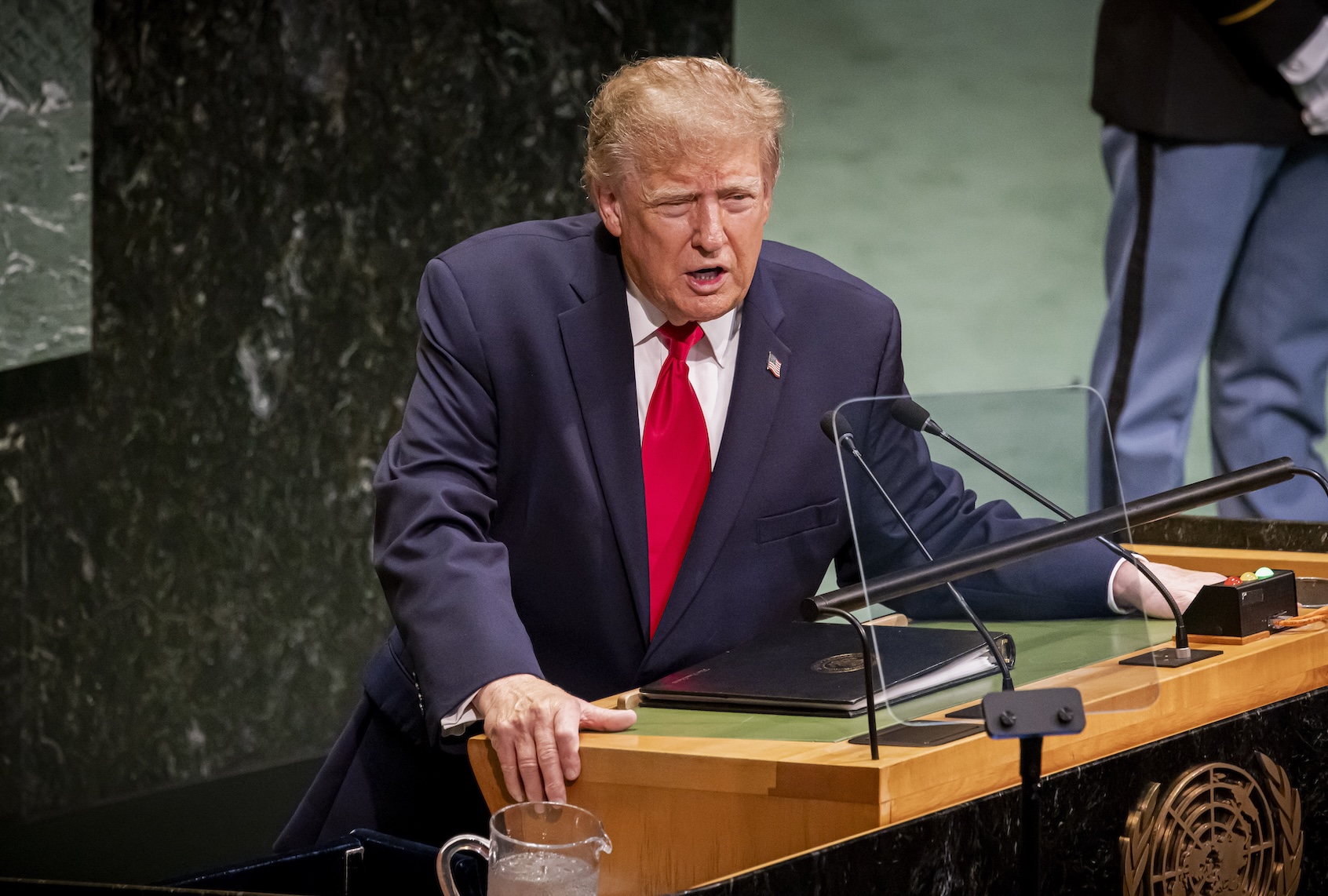

On Tuesday, Donald Trump stood before the United Nations General Assembly to give a speech in which he made it clear that the United States has now fully abandoned its last remaining fig leaf of decency and morality on the world stage, and has embarked on an imperialist model not seen since the 19th century. Since this was a Trump speech, filled with his usual bombast and braggadocio, it didn’t have quite the shock value it might have carried in the past. But there was a new atmosphere in the room. The world sees America as a threat now, and countries are making new arrangements.
The speech was the worst he’s given, and that’s saying something. Delivered with a bored, desultory tone, the obviously tired president spent 40 minutes rambling on and on with his usual litany of grievances and lies. He made it clear that he sees no limits on his power. Looking directly at the Iranian president, he mused aloud, “I have a big decision to make. Will a deal be made with Iran that lets them rebuild? Or do I annihilate the Islamic Republic? Do I drive them into hell with no chance of survival, and no hope of future greatness for generations?” It was outrageously provocative and insulting, and on Wednesday, Iranian President Masoud Pezeshkian responded in his own U.N. speech by describing the Islamic Republic as “victims of terrorism” at the hands of the U.S., while claiming “we are ready for dialogue and diplomacy and negotiations without accepting the language of force.”
In many ways, this was familiar ground for the president. But there was one portion of his speech that brought home just how far gone American foreign policy is today. Speaking of his policy of murder on the high seas in the Caribbean, Trump claimed that drug traffickers, whom he calls “terrorists,” must be “killed, exiled or detained as enemy combatants without the possibility of release, which is what we’re doing.” The Navy is routinely blowing up small boats and killing human beings based upon unproven claims that they are transporting drugs. No U.S. or international law sanctions such a thing. And according to a fact-check by the New York Times, Trump’s assertion that this operation has reduced the flow of drugs by 90% is a blatant lie. It has made no difference at all. The policy is an abomination, and it proves to the world that the United States has abandoned all fealty to the rule of law, not to mention common decency.
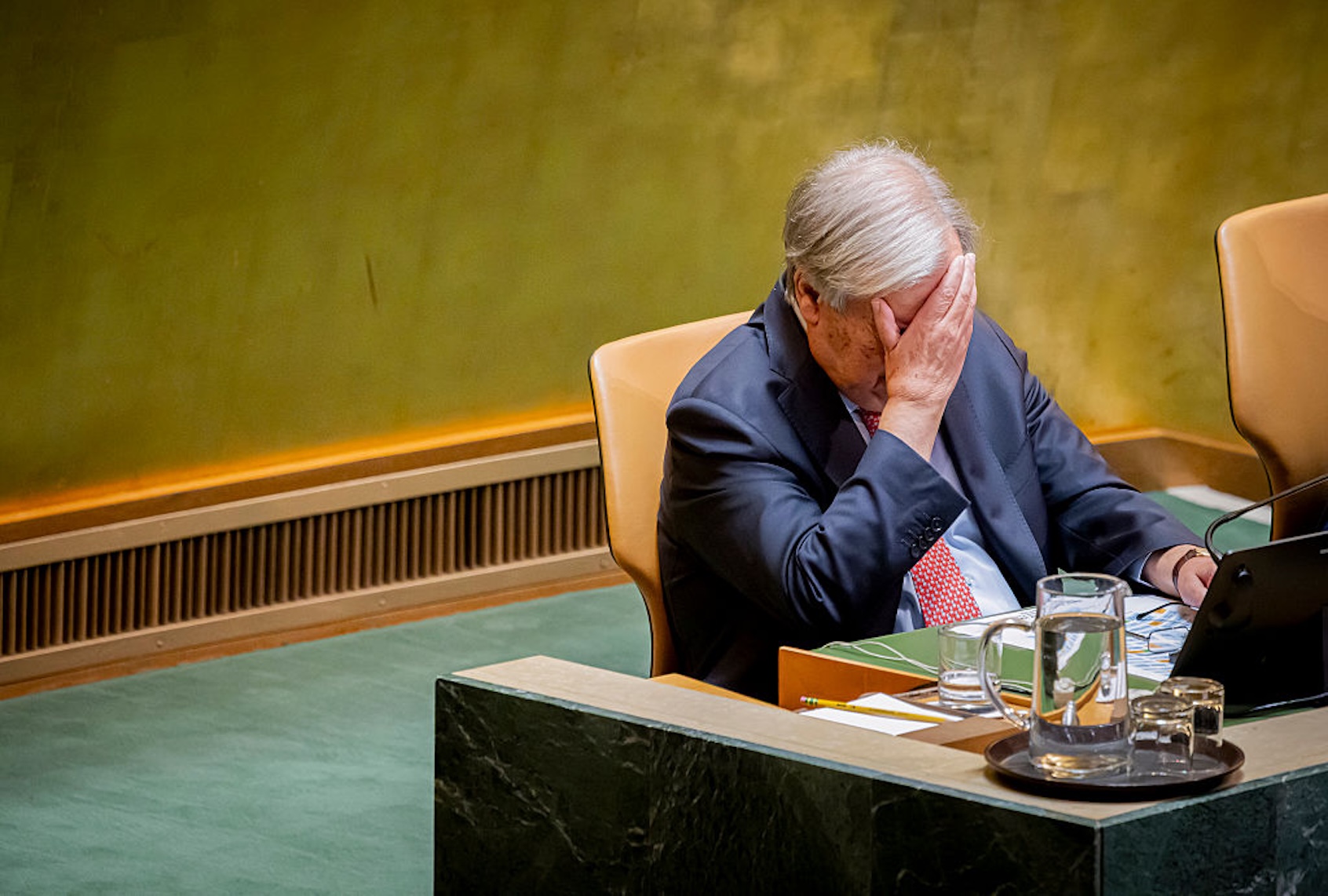
(Patrick van Katwijk/Getty Images) United Nations Secretary General Antonio Guterres during the speech of President Donald Trump during the 81st U.N. General Assembly on Sept. 22, 2026.
But that wasn’t all. The president bragged about his actions in Venezuela, declaring that since his incursion in January, which deposed President Nicolás Maduro, Trump has now acquired “more than 60% of the oil in the world . . . it was a war, but it’s perhaps the biggest deal ever made. To the victor belong the spoils. You’ve all heard that.” (The number is actually about 23%, according to the Times.) We have certainly heard that before — from him. The saying is one of his favorite maxims, but it hasn’t been uttered by any other world leader for centuries. He went on to proclaim, “Our actions in Venezuela are proof that the United States will no longer permit threats to America to gain a foothold anywhere in the Western Hemisphere. And if necessary, we will use our unmatched military might to secure the vital national interests of the United States.” What threat Venezuela posed to our “vital national interests” is unclear, unless it means simply having something we want to take.
To say this at the U.N., which was formed to prevent this very behavior, confirms every nation’s worst fears about what the United States has become under Trump. It is crude, antediluvian imperialism, and the assembled dignitaries did not applaud or even respond, although the Iranian and Cuban delegations did walk out when they were threatened.
The U.S is obviously now seen by many as a rogue state, disrespected and disdained by allies and adversaries alike. All you had to do was look at the faces of those in attendance to see it.
But many are realizing, even as Trump besmirched the U.S. and U.N. alike, there is a new “leader of the free world” on the scene.
Mark Carney did not speak at the General Assembly, but he did hold bilateral meetings and a press conference. In the process, the Canadian prime minister gave some measure of hope to those — including many Americans themselves — who see the U.S. as a threat to world peace and yearn for something better.
Mark Carney did not speak at the General Assembly, but he did hold bilateral meetings and a press conference. In the process, the Canadian prime minister gave some measure of hope to those — including many Americans themselves — who see the U.S. as a threat to world peace and yearn for something better. “This is, in many respects, a time that comes once or twice every century,” Carney told the media gathered in New York. “What comes ahead, it’s not wishful multilateralism, which defends only the status quo, nor a cold realpolitik that dismantles the status quo altogether. The alternative that Canada and many others are pursuing is values-based realism, an approach that’s both principled and pragmatic.”
The last few weeks have been productive for Carney, as he led a summit of big money investors and CEOs, partnering with former prime minister Steve Harper to make a bipartisan pitch for opportunities in manufacturing, natural gas, mining and ports on two oceans. Canada has a wealth of resources, including an educated workforce. You know, kind of like America — before it turned itself into a global pariah.
Carney followed his U.N. appearance with a triumphant trip to Europe, where he was greeted like a rock star, obviously appreciated for his bold break with the U.S. that began with a visionary speech in January at the World Economic Forum in Davos that called for a new world order. On Sept. 16, at the meeting of the European Commission, President Ursula von der Leyen called for Canada to become the European Union’s first “associate member.” In making the case, she said, “We must urgently reimagine our partnerships. And build global coalitions for our resilience and democracies.”
Want more sharp takes on politics? Sign up for our free newsletter, Standing Room Only, written by Amanda Marcotte, now also a weekly show on YouTube or wherever you get your podcasts.
In his speech, which was greeted ecstatically by E.U. members, Carney said “Put simply: we’re in a position where we need to pursue calibrated alliances, integrating deeply with those countries who share our values, remaining open-eyed with those who do not.”
That vision was put into action this week in New York, when Carney and leaders from the European Union and six other nations announced “Partners for Multilateralism,” which he described as “a new forum that looks at universal institutions, practical coalitions and capacities that exist outside of governments to build trust and bring people together.” The prime minister explained that they do not see this as an attempt to form consensus among nations, an impossible task, but to instead create a new paradigm for countries “formed around problems rather than geography or size, not as an alternative to multilateralism, but as an instrument of it.”
We need your help to stay independent.
Finally, someone is proposing something new to take its place. It’s still in the very nascent stages, and who knows where it will go? But it’s a serious proposal that seeks to find some stability and predictability in a modern, multi-polar world that requires both cooperation and flexibility.
We can thank Carney for taking the president’s threats to Canadian sovereignty seriously and starting this overdue conversation. He is the man to whom those who believe in freedom and democracy now look for leadership, and we should all be grateful that he has willingly taken on the role.
Read more
about Trump’s foreign policy
